
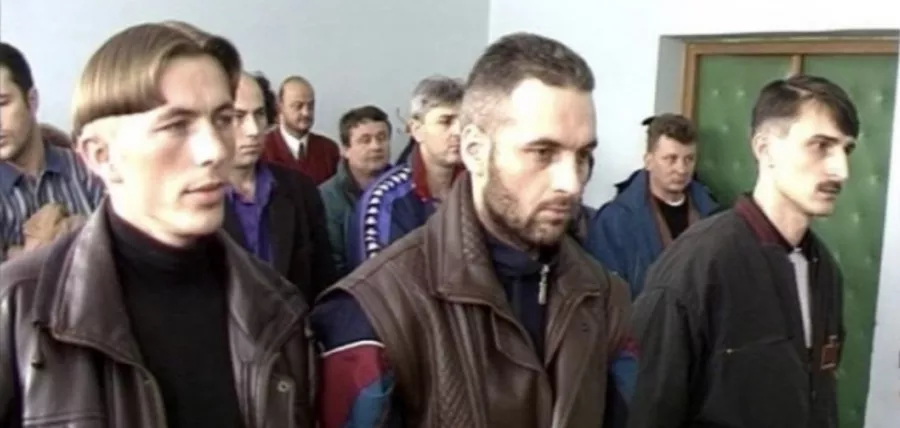
SARAJEVO, (Patria) - The human rights of Behudin Husić have been violated. This was established by the Constitutional Court of Bosnia and Herzegovina in mid-December while considering an appeal by one of the three Srebrenica men whom the judiciary of the Republika Srpska has been prosecuting since 1996, accusing him of killing Serbian civilians together with Ahmo Harbaš i Nedžad Hasić while, from July 1995, he tried for months to break through the forest to Tuzla, Istraga.ba reports.
“A violation of Article II/3.d) of the Constitution of Bosnia and Herzegovina and Article 5, paragraph 3 of the European Convention for the Protection of Human Rights and Fundamental Freedoms is established because the appellant Behudin Husić, after being deprived of his liberty on 14 September 2021 pursuant to the Decision of the District Court in Bijeljina number K-32/99 of 24 April 2001, was not brought before a court until the adoption of the Decision of the District Court in Bijeljina number 12 0 K 002550 11 K of 20 September 2021”, reads the Decision of the Constitutional Court of BiH adopted at its session on 16 December last year.
Behudin Husić from Srebrenica was held in custody for six days without being brought before a competent judge in Bijeljina. SIPA officers arrested him on 14 September 2021 based on a warrant from Bijeljina issued 20 years earlier. After that, Husić was taken to the Correctional Facility in Bijeljina where he was detained. He was held there for six days without being brought before the competent District Court in Bijeljina at all.
“The Constitutional Court notes that from the case file it appears that the appellant, because he was a fugitive at the time of the decision ordering his detention (24 April 2001), was not brought before a court ‘immediately’ and ‘promptly’, nor at the moment of his deprivation of liberty (14 September 2021 when he was deprived of liberty), but only on 20 September 2021, i.e., after six days from the day of deprivation of liberty”, it is stated in the reasoning of the Decision.
But what is perhaps even more important for this case is the question of the existence of reasonable suspicion, i.e., the main prerequisite for arrest, detention and the imposition of prohibitive measures.
“The Constitutional Court concludes that there has been a violation of the right under Article II/3.m) of the Constitution of Bosnia and Herzegovina and Article 2 of Protocol No. 4 to the European Convention when the regular court imposed prohibitive measures on the appellant even though from the contested decisions it appears that regarding the existence of reasonable suspicion, insufficient and relevant reasoning was given because in the reasoning of the contested decisions the court did not state that there exist ‘facts or information on the basis of which an objective observer would conclude that the person in question could have committed the criminal offence for which he is charged’, and from the submitted and known documentation it is not clear what the appellant is charged with in the indictment”, the Constitutional Court of BiH states in the appeal of Behudin Husić.
Therefore, there is no reasonable suspicion at all that Behudin Husić, Ahmo Harbaš and Nedžad Hasić committed the criminal offences for which the Bijeljina judiciary has been prosecuting them since 1996, when IFOR members handed them over to the Republika Srpska police. Below we will briefly recall the genesis of this case. After the fall of Srebrenica, seven Bosniaks from that town set out through the forest towards Tuzla. For months, fleeing the RS Army and the RS Ministry of Interior, they hid in the forests of Podrinje. Nedžad Hasić, Behudin Husić, Ahmo Harbaš, Vahdet Avdić, Samir Avdić, Enver Harbaš i Muharem Hasić decided on 11 May 1996 to surrender to IFOR members at Crni Vrh, on the Kalesija – Zvornik road, after 10 months they had survived in the devastated Podrinje region, where they hid after the Srebrenica genocide. Soldiers from the American contingent of IFOR promised to transfer them to Tuzla, lied, and handed them over to a police patrol of the CSB in Zvornik.
After that, criminal proceedings were initiated against them on charges of killing four ‘Serbian woodcutters’: Đorđe Petrović, Nikola Modraković, Momčilo Ristanović i Vlajko Zekić. The murders were allegedly committed on 2 May 1996 in the village of Krušev Do, 40 kilometres south of the centre of Srebrenica and about a hundred kilometres from the place where Husić, Harbaš and others surrendered to IFOR members. In early December 1998, a first-instance verdict was pronounced at the District Court in Bijeljina for the murder of four woodcutters. Ahmo Harbaš and Nedžad Hasić were sentenced to 20 years each, Behudin Husić to 11, Samir Avdić, on charges of murdering Munib Mustafić to 10 years in prison. Vahdet Avdić, Enver Harbaš and Muharem Hasić were acquitted and released.
Then followed arduous negotiations between entity political officials who found a compromise in exchanging the convicted Harbaš, Hasić and Husić for three convicted Serbian criminals from Zenica prison. The agreement was signed in 1999. The Bosniaks were transferred to allegedly serve their sentences in Tuzla prison, and the Serbs to Kula in East Sarajevo. Immediately after arriving in Kula, the three Serbian prisoners were released by pardon from the then RS President Nikola Poplašen, and shortly after, the three convicted surviving Bosniaks were also released.
The agreement between the RS and the Federation was signed in January 1999. But then the authorities of the Republika Srpska began a deception. Three months after the Agreement, the Supreme Court of the Republika Srpska, by its Judgment of 26 April 1999, annulled the judgment of the District Court in the part concerning Behudin Husić, Ahmo Harbaš and Nedžad Hasić, and returned the case for retrial. The reasoning of the judgment stated, among other things, that the first-instance judgment was contradictory, incomprehensible and other reasons, for which it was annulled. The District Court in Bijeljina was ordered to retry the case, and Husić, Hasić, and Harbaš were declared unavailable. In 2001, a red Interpol warrant was issued for them, and from that moment a ‘search’ for them has been ongoing. Hasić and Husić remained living in BiH, while Harbaš managed to move to Switzerland. The authorities there refused to extradite him to the judiciary in Bijeljina. In November 2020, Nedžad Hasić was arrested in Tinja near Srebrenik. The Bijeljina court ordered his detention.
After he was released, the Constitutional Court of BiH stated that he was unlawfully held for seven months. Despite the decision of the Constitutional Court, the District Court in Bijeljina continued the same practice. SIPA officers on 14 September 2021 arrested Behudin Husić and transferred him to the KPZ Bijeljina. There, as evident from the decision of the Constitutional Court of BiH, he was held for six days without any court decision. After that, he was released and prohibitive measures were imposed on him. The Constitutional Court of BiH on 16 December stated that he was unlawfully held in custody. And most importantly, it stated that there is no reasonable suspicion that the ‘Srebrenica trio’ who survived the genocide committed any criminal offence at all.
Komentari (0)
Prijavite se za komentiranje
PrijavaJos nema komentara. Budite prvi!
Minuta
Sve →Iz drugih kategorija

High Representative Not Elected: Germans, French and British Sabotaged Americans, New Attempt at End of June

ČOVIĆ WITHOUT MERCY: How Those Who Brought Ademović to Office Created a Political Hell for Him



Sunny Saturday, quite warm



Tragedy in Albanian resort: Two minors drown












