
Written by: Rasim Belko @rasimbelko
Bosnia and Herzegovina is on the verge of opening negotiations, at least according to announcements from the European Commission and domestic authorities. However, regardless of whether the negotiations start this year, next year, or some third year, there is a problem we must solve so that it does not become a burden that will hinder our country in those negotiations, just as it hindered it during the struggle for candidate status and negotiations.
Special and parallel relations, granted as compensation for ethno-territorial units, have long outgrown their basic form. The special relations of the RS with Serbia and the FBiH with Croatia are limited by the Constitution of Bosnia and Herzegovina, i.e., by the protection of the sovereignty and territorial integrity of BiH.
Nevertheless, soon after their establishment, they began to grow into the form we have today, which has largely breached the constitutional limit. These special relations are now used to transfer not only political but also economic, energy, and other parts of Bosnia and Herzegovina's sovereignty to neighboring countries.
Instead of serving to implement the Dayton Peace Agreement, special and parallel relations have turned into their own opposite. Through the manipulations of the SNSD in the RS, the coordination mechanism for special and parallel relations has been lost, and in that entity they are most pronounced across all segments of activity. Milorad Dodik realized that the House of Peoples, as a control mechanism, was an obstacle, so he subordinated it to his own policies.
Thus, special and parallel relations have become a gray area that encourages separation, thereby establishing a polycentric state based on the right to special and parallel relations, i.e., a de facto confederal state.
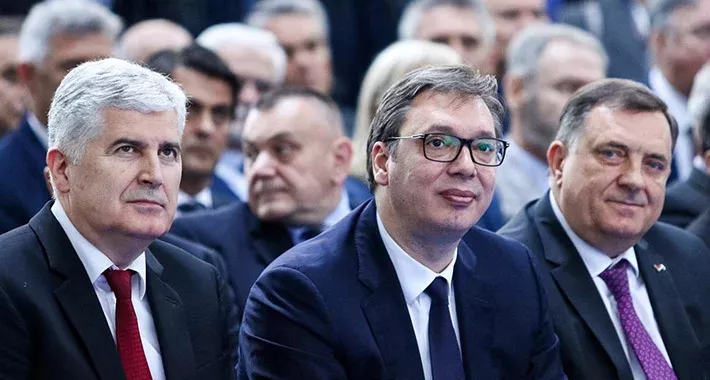
On the other hand, Dragan Čović and Andrej Plenković have channeled this right to special relations into several interest streams, such as the Election Law and the Southern Gas Interconnection, thereby undermining the sovereignty and territorial integrity of BiH.
However, the special and parallel relations of the RS and Serbia have begun to create a new reality by maximally encouraging separatism.
And this separatism and the violated sovereignty of Bosnia and Herzegovina through the abuse of rights granted by the Dayton Agreement will be a constraint from which Bosnia and Herzegovina will find it difficult to progress on the European path. Especially since, through the negotiating chapters, Bosnia and Herzegovina transfers part of its state sovereignty into European legislation. If the current situation were to remain even then, BiH's sovereignty would be divided between the EU, the state of BiH, and through special and parallel relations with Serbia and Croatia.
Given that special and parallel relations already complicate European integration, along with the coordination mechanism that has introduced all administrative units and state institutions vertically into decision-making on the European path, Bosnia and Herzegovina could become a record-holder in negotiations with the EU.
The responsibility to prevent this therefore lies with the international community, i.e., the Peace Implementation Council (PIC), which should consider this issue at its next session, especially if we obtain negotiations.
Of course, it would be pointless to demand the complete abolition of special and parallel relations, but their revision and further restriction are necessary. The Peace Implementation Council is obliged to do this, because Bosnia and Herzegovina cannot do so from its internal capacity.
Limiting special and parallel relations would imply the right to maintain ties concerning cultural cooperation, shared history, script, language, traditions… Because through these ties, Serbia and Croatia would not be able to slow down and obstruct Bosnia and Herzegovina's integration paths.
It is absolutely necessary to exhaustively limit these ties, especially by eliminating the possibility of cooperation in transferring BiH's energy sovereignty, as well as by curbing the political ties that Belgrade and Zagreb use to pursue their interests in Bosnia and Herzegovina.
It is therefore the obligation and burden of the PIC to limit these ties to a space without the side effects we have witnessed since the establishment of special and parallel relations. And especially taking into account the facts from the information of the US national security services that, parallel to the story about negotiations with the EU, a threat of real separatism and an even more real armed conflict looms over Bosnia and Herzegovina.
Komentari (0)
Prijavite se za komentiranje
PrijavaJos nema komentara. Budite prvi!
Minuta
Sve →Iz drugih kategorija

High Representative Not Elected: Germans, French and British Sabotaged Americans, New Attempt at End of June

ČOVIĆ WITHOUT MERCY: How Those Who Brought Ademović to Office Created a Political Hell for Him



Sunny Saturday, quite warm



Tragedy in Albanian resort: Two minors drown












