
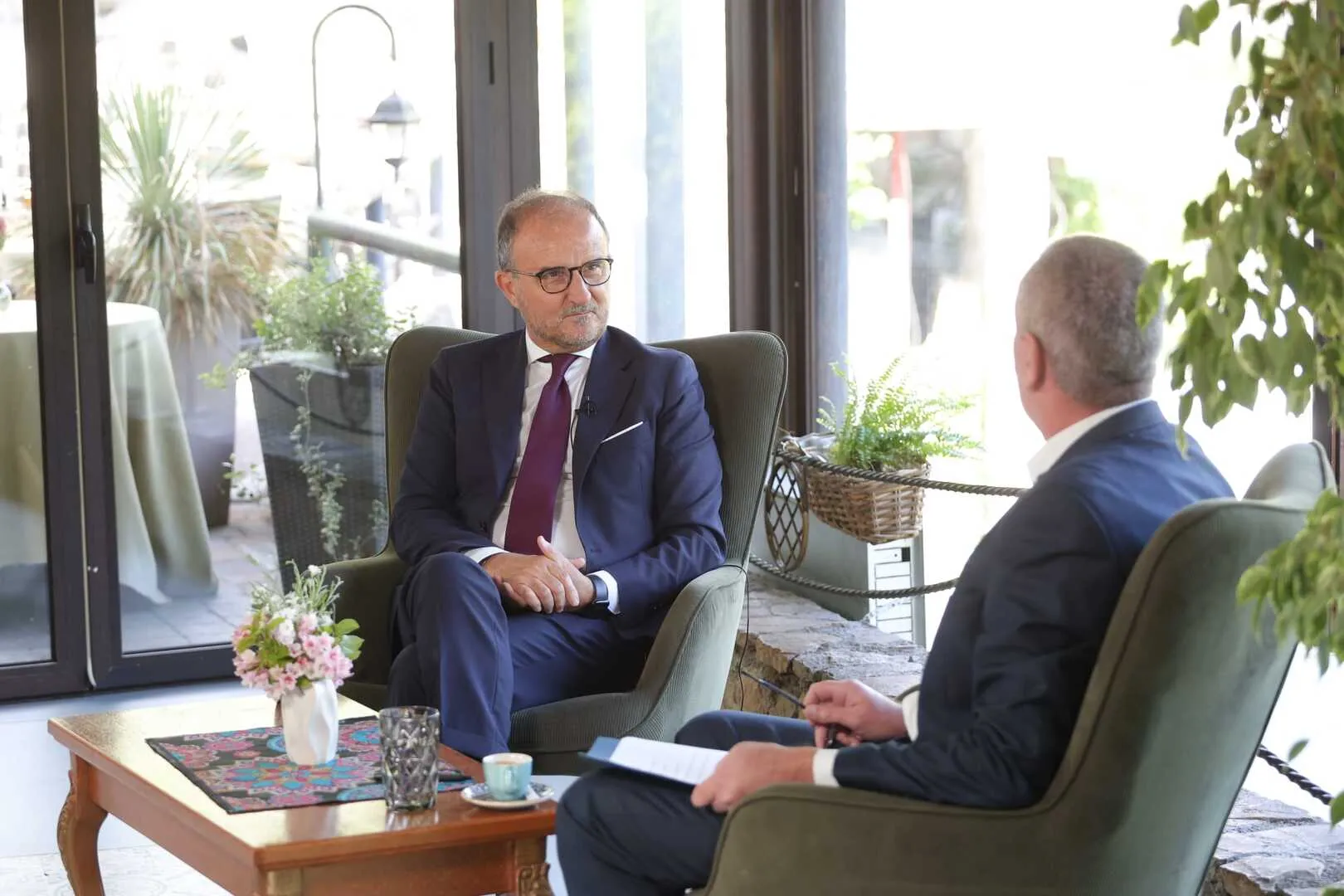
In a video interview for Politicki.ba broadcast on Hayat TV, the Special Representative and Head of the Delegation of the European Union to Bosnia and Herzegovina, Luigi Soreca, spoke about the sudden announced resignation of Christian Schmidt, energy efficiency problems, the non-construction of Corridor 5c, and the non-implementation of reforms.
He does not hide his disappointment with the actions of the authorities of Bosnia and Herzegovina.
At the same time, he announces European Union investments in Bosnia and Herzegovina, the launch of quality internet connections in 116 cities of Bosnia and Herzegovina, new investments in defense systems, and initiatives and activities for a better life for all citizens of this country.
Soreca also talks about the announced session of the Peace Implementation Council and the beginning of consultations for the election of a new High Representative, why it is important, and also discusses in more detail the resolution of the state property issue.
He specifically emphasizes that this issue must be resolved in the Parliament of Bosnia and Herzegovina in accordance with the decisions of the Constitutional Court of Bosnia and Herzegovina.
He announced a meeting of the PIC for June 3.
Soreca: It is very important for us that the PIC and any successor to Christian Schmidt be involved in European integration, so that they are part of the European Union's role in this country. Why? Because that is ultimately what the citizens of this country want. And we will continue to do so within the framework of the PIC and in the context of our overall activities. We know that this country needs our support for more efficient institutions, strengthening the rule of law, fighting corruption, and strengthening equality of citizens before the law. At the same time, allow me to take this opportunity to reiterate our strong commitment to the constitutional order, sovereignty, and stability of Bosnia and Herzegovina. Now, as at any other time, I say this because we strongly believe, because we are committed to it, because our daily work is precisely in that direction within the framework of our activities under the auspices of the PIC. It is undeniable that the role of EUFOR is very important for a stable and secure environment, and in the coming days, we will announce additional financial support for the defense sector in Bosnia and Herzegovina, so that the EU will continue to cooperate closely in the context of the PIC to ensure that Bosnia and Herzegovina progresses towards what we believe is its future, and that is in the European Union.
Who is the new High Representative? Will an Italian be the new High Representative?
Soreca: We will wait for the consultation process to begin, because it is truly impossible to speculate at this moment.
The integration process is increasingly problematic. It seems to me that this is a path to nowhere, that we have reached a standstill, the blockades are increasing. What is the way out? How to overcome this situation?
Soreca: As you know, I have been in the country for almost two years and I am well acquainted with the decision-making system, which is based on dialogue, trust, and consensus, but currently, we have none of these three elements. There is currently no coalition at the level of Bosnia and Herzegovina. For more than a year, this has inevitably affected the capacity of this complex decision-making mechanism.
But I must tell you, I am disappointed.
When I arrived in Bosnia and Herzegovina two years ago, I wished for a rapid pace of progress. We had some progress, from border security to the adoption of the reform agenda last year.
However, there was no political will. I think, also due to the mistrust between the entities within the coalition. I truly regret this, because the rest of the region is progressing rapidly.
You know that Montenegro is currently working on an Accession Treaty with the Union. I hope this will be an incentive for the domestic authorities to respond to the calls of the citizens. Ultimately, the election campaign is approaching, and I hope that citizens will insist on the accountability of their political representatives.
Yes, elections are approaching. Before that, we will likely face Bosnia and Herzegovina being placed on the grey list by Moneyval and FATF.
Soreca: You have probably heard me speak before about the price of inaction. Bosnia and Herzegovina was under observation by the Financial Action Task Force against the financing of terrorism. With a whole series of activities that needed to be undertaken.
These activities were not undertaken, and ultimately, the law was adopted in the Parliamentary Assembly at the last moment, perhaps a little too late, but it is there, along with a whole series of other steps. And now the decision of FATF, which is not an EU structure, but a global international structure, their decision is expected in mid-June, and it is very likely that it will happen. What does this specifically mean for the citizens of this country? First of all, financial transactions will be more expensive, slower, and more difficult for you. Investments from abroad will be further complicated, and unfortunately, it may take a year before Bosnia and Herzegovina is removed from the grey list. This is the price of inaction.
How much money are we talking about annually?
Soreca: We are talking about millions. It all depends on the circumstances, but this directly affects the lives of every citizen, every individual.
This is not something that concerns only the private sector, which is precisely why we insist on Bosnia and Herzegovina joining SEPA, the Single Euro Payments Area. That would be a big step forward for Bosnia and Herzegovina.
Why?
Soreca: Just take the example of the numerous diaspora.
So, transactions with European countries would be much more favorable, much cheaper, for example, if you send 1,000 euros, the bank fee is 50 euros. This would not be the case if the country were a SEPA member.
We are talking about saving hundreds of millions annually in the country. So you see the value. Other countries in the region, North Macedonia, Serbia, Albania, Montenegro, are already SEPA members, and we are working closely with the Governor of the Central Bank of Bosnia and Herzegovina on this.
In this regard, the entity legislative bodies have adopted the relevant legislation, of course, the Moneyval decision will affect all of this, but if you do not act, there are consequences.
We are already seeing the consequences on the Reform Agenda, we have lost more than a hundred million euros. And now we are facing the possibility of losing up to another 380 million euros. Where will it end? We are losing valuable funds.
Soreca: Believe me, I am one of those who are most disappointed. The Reform Agenda, the Growth Plan, are truly an incredible instrument available to Bosnia and Herzegovina and the rest of the region, and the goal is gradual integration of the country even before formal membership in the EU.
However, as you know, the Reform Agenda was adopted after significant pressure from the EU. Since November, we have literally seen no concrete action from the domestic authorities, as a result.
Commissioner Kos and I were forced to warn the domestic authorities that without concrete steps in the coming months, this grace period given to Bosnia and Herzegovina, I want to emphasize this very clearly, we have been very flexible on our part, we have given Bosnia and Herzegovina an additional year to start implementing reforms and based on that, withdraw available funds, but...
And again, inaction has consequences.
The result of this is that, unfortunately, an additional 373 million euros will be withdrawn from funds for Bosnia and Herzegovina and transferred to other countries in the region. This is certainly not our wish, but it is an obligation to our taxpayers to report what we do with the funds given to us to help Bosnia and Herzegovina on its European path.
I would like to emphasize the last and perhaps most important reason why a billion euros cannot be allocated, and that is the issue of state property. The issue of state property is a significant obstacle to the realization of the Corridor 5c project and other projects. If this issue is not resolved soon, given that we are approaching the end of our budget period by the end of 2027, everything will have to be redirected elsewhere.
Therefore, if this issue is not resolved, we will lose almost 2 billion euros in grants, credits, and loans.
On the topic of state property, according to some of my information, the Americans are working on a state property law that would allegedly be adopted before the elections and allow the construction of the Southern Interconnection.
Soreca: I think that is a question for someone else, not for me. What I can tell you is that we are committed to informing the domestic authorities about the risks associated with inaction.
If the issue of state property is not resolved, and we are ready to cooperate with the local authorities on this issue, I think it is very important that this issue comes from domestic actors. So, it is very clear that it must be a state law that reflects the decisions of the Constitutional Court of Bosnia and Herzegovina. Any other solution will not resolve the issue of state property.
So, we are not talking about an imposition by the High Representative, even though the Office of the High Representative is part of the Dayton Peace Agreement.
Soreca: We are talking about a solution in accordance with the decisions of the Constitutional Court, and that is a state law. Therefore, a decision by the Parliamentary Assembly of Bosnia and Herzegovina is needed.
Komentari (0)
Prijavite se za komentiranje
PrijavaJos nema komentara. Budite prvi!
Minuta
Sve →Iz drugih kategorija

High Representative Not Elected: Germans, French and British Sabotaged Americans, New Attempt at End of June

ČOVIĆ WITHOUT MERCY: How Those Who Brought Ademović to Office Created a Political Hell for Him



Sunny Saturday, quite warm



Tragedy in Albanian resort: Two minors drown












