
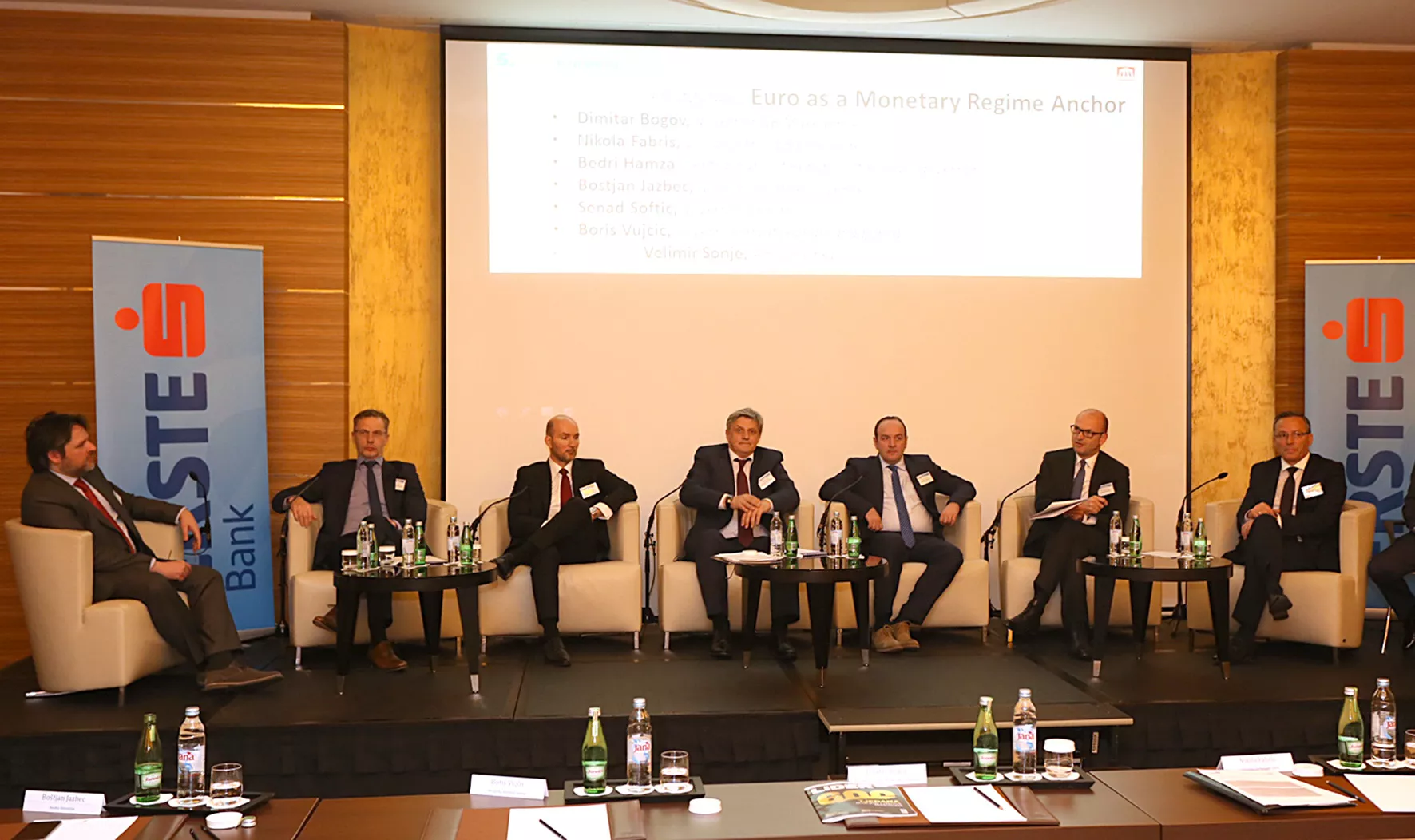
Governor of the Central Bank of Bosnia and Herzegovina (CBBiH), Dr. Senad Softić, participated in the 5th meeting of central bank governors of the region, held today, March 31, 2017, in Umag, Republic of Croatia, organized by the business magazine „Lider“.
This year's summit of governors, which in addition to the CBBiH governor brought together the central bank governors of Slovenia, Macedonia, Montenegro (vice-governor), Kosovo, and host Croatia, focused on the topic „The Euro as an Anchor of Monetary Regimes“. The aim of the discussion was to analyze the advantages and disadvantages of current monetary regimes from the perspective of each central bank individually, in order to stimulate debate on the pros and cons of introducing the euro.
Today's discussion was particularly challenging given that the panel included governors whose countries are in different statuses: eurozone members, those that have implemented unilateral/informal euroization, those entering the eurozone accession process, and countries running a fixed exchange rate regime or a currency board arrangement, which is the case of Bosnia and Herzegovina. It turned out that, despite different models, all countries in the region lean towards stability through pegging to the EUR as an anchor currency.
Speaking about Bosnia and Herzegovina's experience with the currency board, Governor Softić emphasized that this monetary regime, in place since the establishment of the CBBiH, has significantly contributed to establishing monetary and financial stability in Bosnia and Herzegovina.
- The exchange rate of the national currency has been strictly fixed to the euro for almost 20 years. In the European Union's economic program for BiH, the currency board has been assessed as an anchor of stability, monetary and thus financial, relied upon by international financial institutions and international sovereign credit rating agencies. I believe that, although the currency board is a conservative monetary policy, in the BiH context it does not limit economic growth, quite the contrary. The real effective exchange rate does not show significant deviations from the equilibrium position, implying that the relatively low economic growth and insufficiently fast export growth in BiH are not a consequence of price non-competitiveness, but, among other things, lower productivity compared to trading partners.
Finally, there are also aspirations for EU membership, whereby the phases of the country's economic and monetary integration into the EU should be taken into account - emphasized Governor Softić.
In addition to the governors' panel, this year's event also brought together commercial bankers who, during the discussion, touched upon financing economic growth. This year's keynote speaker was the regional resident representative of the International Monetary Fund (IMF) for Central and Eastern Europe, Bas B. Bakker, who provided an overview of changes in the monetary regimes of emerging European economies.
Komentari (0)
Prijavite se za komentiranje
PrijavaJos nema komentara. Budite prvi!
Minuta
Sve →Iz drugih kategorija

High Representative Not Elected: Germans, French and British Sabotaged Americans, New Attempt at End of June

ČOVIĆ WITHOUT MERCY: How Those Who Brought Ademović to Office Created a Political Hell for Him



Sunny Saturday, quite warm



Tragedy in Albanian resort: Two minors drown












