
For Istraga.ba writes: Almir Bečarević
Bosnia and Herzegovina will not have a state gas law. The issue of gas and electricity will be regulated by entity laws. This is the essence of the Reform Agenda adopted by the Council of Ministers of BiH, by the votes of ministers from the "Trojka" parties (Elmedin Konaković, Zukan Helez, and Edin Forto).
"Adopt and fully harmonize the legislation in the field of natural gas with the Third Energy Package, through two entity gas laws. Republika Srpska has a Gas Law ("Official Gazette of Republika Srpska", no. 22/18 and 15/21) which is harmonized with the Third Energy Package. The Federation of BiH has a Draft Law on Gas (February 2025.).
In this way, the transposition and implementation of the Third Energy Package (i.e., assigning regulatory powers to the competent authority, implementing obligations for the separation of the transmission system operator, adopting appropriate network tariffs, opening the market, etc.) will be achieved in the part of BiH (FBiH) where this has not been possible so far due to the use of gas legislation that is not harmonized with EU acquis communautaire.
Furthermore, the conditions for resolving capacity allocation, transport network development, balancing, gas market, establishment of network rules, certification and separation of the transport system operator, and other issues for the natural gas sector, including in the Federation of BiH, where this has not been possible so far due to the use of gas legislation that is not harmonized with EU acquis communautaire, will be defined", it is stated in Chapter 1.4.1.2.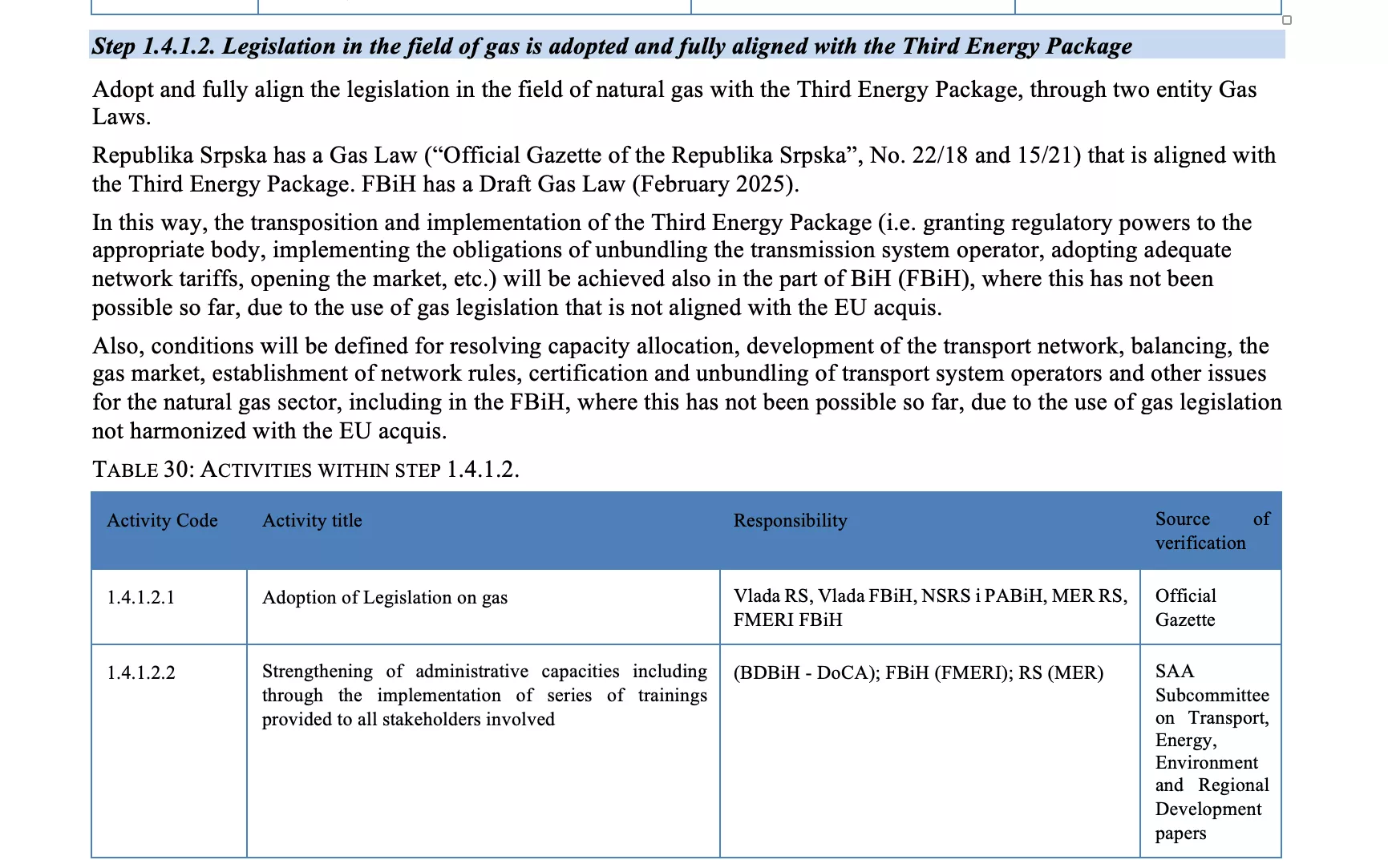
As can be seen, the state of BiH does not exist in the context of the gas law. In this way, the transposition and implementation of the Third Energy Package would be at the entity level, which would permanently eliminate the obligation to adopt a law at the state level. Network tariffs, market opening, company certification, capacity allocation, etc. would be regulated at the entity level, which no Western Balkan country has regulated in this way.
Specifying through the Reform Agenda that two entity laws are equal to a state law can only be done by someone who lacks basic knowledge in this area and by someone who does not consider integration to be the solution to all problems in areas that the state must prescribe. This practically means that in the area of gas, each entity will pursue a separate policy.
To hide what the Reform Agenda truly says, the ministers in the Council of Ministers have amended Table 1.4.1, which originally looked like this: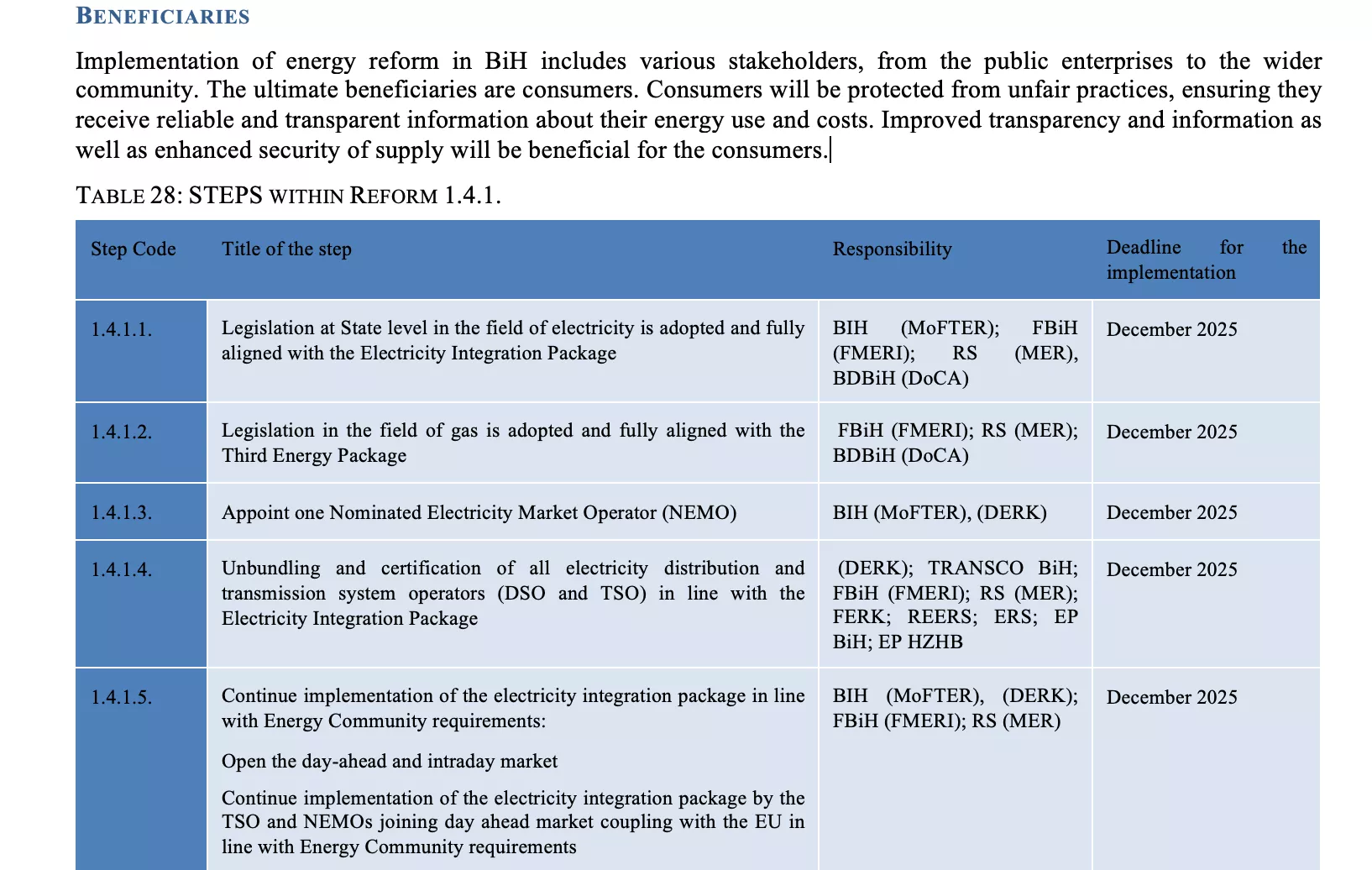
Point 1.4.1.2 mentions gas.
"Legislation in the field of gas has been adopted and fully harmonized with the Third Energy Package," it is stated in the table, which further stated that this was the task of the Federation, Republika Srpska, and Brčko District.
However, this part has been amended, so Table 1.4.1 now looks like this.
Point 1.4.1.2 has been merged with point 1.4.1. However, the sentence is the same.
"Legislation in the field of gas has been adopted and fully harmonized with the Third Energy Package," reads the new provision.
In this case, the part of the table mentioning entity ministries and Brčko District has been deleted.
However, Chapter 1.4.1.2 explains in detail what will be done in the energy sector, so within that table it is stated that the adoption of gas legislation is necessary. The table is located at the beginning of this text.
We remind you that the Reform Agenda was adopted on Tuesday, and ministers from the "Trojka" parties presented it as a great success. Otherwise, the Reform Agenda is a document that was a condition for accessing funds from the Growth Plan for the Western Balkans. That document contains a list of measures that Bosnia and Herzegovina will implement in the coming period.
The list of measures relates to reforms that BiH must implement and which mean approximation to EU acquis communautaire, and which would ultimately open access to money allocated for our country by the European Union.
In the field of energy at the state level, BiH Presidency member Denis Bećirović has submitted the Law on the Transport of Natural Gas, the Regulator and the Internal Market in Bosnia and Herzegovina for procedure. This law is fully harmonized with the Third Energy Package and would regulate the area of gas transport and state regulatory authority in the field of transport.
All other competencies would be at the entity level. It would be logical for this obligation to be included in the Reform Agenda, as all Western Balkan countries have a state-level Gas Law. Denis Bećirović's draft law reflected the constitutional competence that transport, any kind, should be regulated at the state level, especially because the gas pipeline passes through both entities.
What did we get in the Reform Agenda?
Instead of a state gas law, ministers from the parties that supported Denis Bećirović agreed to Republika Srpska's positions that gas issues should be at the entity level. This is also contrary to the positions of Western partners (primarily the USA), who insisted that the state, not the entities, should lead gas policy. This would reduce the influence of the Russian Federation on the issue of gas supply.
Komentari (0)
Prijavite se za komentiranje
PrijavaJos nema komentara. Budite prvi!
Minuta
Sve →Iz drugih kategorija

High Representative Not Elected: Germans, French and British Against Americans, New Attempt at End of June

ČOVIĆ WITHOUT MERCY: How Those Who Brought Ademović to Office Created a Political Hell for Him



Sunny Saturday, quite warm



Tragedy in Albanian resort: Two minors drown












