
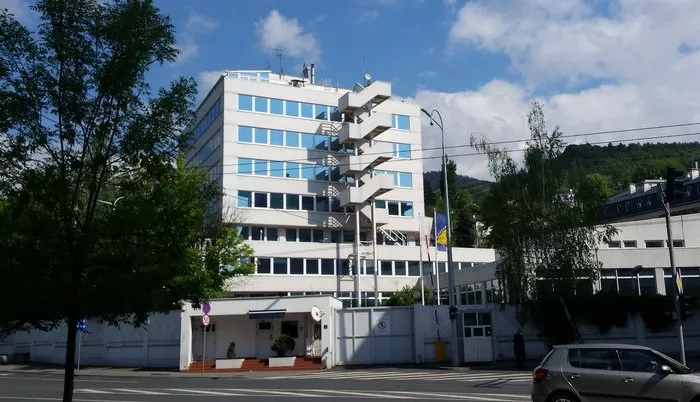
(Patria) - Over the next two days, a regular session of the Steering Board of the Peace Implementation Council (PIC) will be held in Sarajevo. The PIC meets twice a year, in June and December, except when it convenes for an emergency session.
This session is taking place while Bosnia and Herzegovina is experiencing one of its most severe political crises, triggered by moves of the authorities of the RS entity led by Milorad Dodik, after the Court of Bosnia and Herzegovina issued a first-instance guilty verdict against him on February 26 for disregarding the decisions of the High Representative in Bosnia and Herzegovina.
Since the end of February, state-level authorities have not been functioning, and the work of the House of Peoples of the Parliamentary Assembly of Bosnia and Herzegovina has stalled due to constant violations of the Rules of Procedure and avoidance of the removal of Nikola Špirić and two SNSD ministers from the Council of Ministers of Bosnia and Herzegovina.
While the House of Representatives of the Parliamentary Assembly of Bosnia and Herzegovina can function without SNSD, in the House of Peoples, the quorum of the Serb Club is held by three SNSD delegates, and they have used this mechanism multiple times by leaving sessions to avoid their removal.
Invited to the PIC session are leaders of the Troika parties from the Federation of Bosnia and Herzegovina, the president of HDZ Bosnia and Herzegovina Dragan Čović, who together with SNSD form the state government. Also invited are the presidents of three opposition parties (PDP, SDS, List for Justice and Order) that have representatives and delegates in the Parliamentary Assembly of Bosnia and Herzegovina. No invitation was extended to representatives of SNSD.
In addition to political leaders, the PIC will also discuss with representatives of the non-governmental sector and other stakeholders about the current political situation in Bosnia and Herzegovina.
The culprit for the political, constitutional, and even security crisis, given the ban on SIPA operations in the RS territory and the opposition and threat of force by members of the RS Ministry of Interior against SIPA investigators at the end of April when they attempted to serve an arrest warrant for Milorad Dodik, for whom an internal warrant was issued due to his failure to respond to the Prosecutor's Office of Bosnia and Herzegovina, which is conducting an investigation for an attack on the constitutional order against Dodik, Nenad Stevandić, and Radovan Višković.
In the past three months, Dodik has visited Russia, Israel, Serbia, Hungary, and Austria, while avoiding coming to the Federation of Bosnia and Herzegovina entity.
Although parties of the Troika (FBiH) claim they have nothing to discuss with Dodik, there is information, also published by the Istraga portal, that negotiations with Dodik are indeed taking place, involving at least one security and intelligence service.
In addition to sanctions from several European countries, first Austria and Germany, which banned Dodik from entering those states, after the then-minister Ana Lirman was expelled from Banja Luka on his orders, sanctions from Poland and Lithuania followed. However, it is increasingly heard that within the European Union there is indecision on how to proceed in the case of Milorad Dodik, so the mantra of a "domestic solution" and "internal agreement" is repeated.
After numerous meetings of members of the Presidency of Bosnia and Herzegovina with the US administration in Dayton in May, they received a clear signal to seek a domestic solution. US support for the territorial integrity and sovereignty of Bosnia and Herzegovina is not in question, but it is difficult to expect any solution to be imposed.
In this context, member of the Presidency of Bosnia and Herzegovina Željko Komšić summarized the meetings in America, emphasizing that this space can now be used by the EU and the United Kingdom.
In the last three months, the United Kingdom's Special Envoy for the Western Balkans, Karen Pierce, and Foreign Minister David Lammy have visited Bosnia and Herzegovina twice.
At the meeting Pierce held with the head of HDZ last week, as announced by the British Ambassador to Bosnia and Herzegovina Julian Reilly, the establishment of a new state coalition was discussed.
However, even if an agreement is reached, the blockade of the House of Peoples of the Parliamentary Assembly of Bosnia and Herzegovina could last until the next elections.
The High Representative in Bosnia and Herzegovina, Christian Schmidt, was also in Dayton and called on local leaders to find the key to success.
It is difficult to expect the PIC to impose any solution that could push Bosnia and Herzegovina into a deeper crisis, which has already begun to affect the economy of Bosnia and Herzegovina, especially the RS entity, as well as the emigration of the population from Bosnia and Herzegovina.
Komentari (0)
Prijavite se za komentiranje
PrijavaJos nema komentara. Budite prvi!
Minuta
Sve →Iz drugih kategorija

High Representative Not Elected: Germans, French and British Sabotaged Americans, New Attempt at End of June

ČOVIĆ WITHOUT MERCY: How Those Who Brought Ademović to Office Created a Political Hell for Him



Sunny Saturday, quite warm



Tragedy in Albanian resort: Two minors drown












