
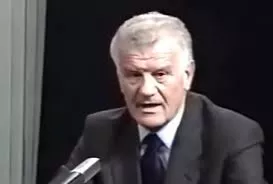
23 years ago, on September 24, 1987, the Eighth Session of the League of Communists of Serbia was held, where Slobodan Milošević began his path to wars and crimes, writes Patria News Agency.
At that time, Milošević clashed with the moderate faction of Ivan Stambolić and Dragiša Pavlović. Stambolić was a democratic alternative to Milošević, but after two months, Milošević removed him from politics.
After everything, he was brutally liquidated on August 25, 2000. Only three years after the murder, one of the killers confessed, and Stambolić's remains were found buried on Fruška Gora. It was said that he was severely wounded and buried alive while still wounded.
The people of Sarajevo remember his visit to the tormented and massacred city in April 1995.
Journalists from Radio Free Europe conducted a major interview with Stambolić. The most interesting parts are those that speak precisely about Stambolić's experiences in the besieged city.
RFE: You traveled to Sarajevo even during the war and during the siege of that city. It was the spring of 1995. You were there with the first organized group of people from Belgrade. It was a risky journey, not only because there was shooting there, but also because you had to return. Why did you decide to make that trip?
Stambolić: Because of the people in Sarajevo and solidarity with those people. But also because of those here, who were against killing, destruction, and the annihilation of a city and its people. And because of those who commanded and controlled it. As I said in Sarajevo at the time, by such an act, I wanted to show that patriotism, if it is not love for humanity, is false.
RFE: Did you say that to the people of Sarajevo then?
Stambolić: Yes, I said that then, and I remembered it now.
RFE: Which encounter was the most moving for you?
Stambolić: Every encounter in Sarajevo, during those few days, was moving. My throat was constantly tight, and I was almost on the verge of tears. I remember many. The conversations and the days I spent with Izet Sarajlić remain in my very deep and vivid memory. But, I would tell one story, since we are talking about encounters. I was walking through the park between the Government and the Presidency. A light rain was falling, and a decently dressed and groomed woman, middle-aged, with an umbrella in her hand, turned into the park where we both were, with no one else around, and walked straight towards me. It was a bit unusual. She approached, tried to say something, couldn't, hugged me, and started to cry. Then it lasted, it seemed long to me, but it was only a few moments. My throat tightened too. We were in that embrace, the woman separated, left, and didn't say a word. I went to the Presidency, and it took me a long time to calm down. That woman obviously recognized me; television showed us a lot those days. There were many such encounters there. With old friends and with new ones we made, who told us what they had experienced from the shelling. It was a journey that is not forgotten. And I would have been very sorry, I would have been much poorer, if I hadn't done it.
RFE: You arrived by plane. There was a ceasefire then, and no shots were fired for several days. However, precisely during the time the first group from Belgrade was in Sarajevo, things escalated, heavy shelling began again, and it was no longer possible to return, the airport was closed. How did you return, through the tunnel?
Stambolić: That is a journey, an odyssey, that deserves its own story. First, through that tunnel. They brought us to the tunnel around dusk, through protected streets. We entered it, water up to our knees. I was carrying a small suitcase. It's interesting that it's nine hundred and something meters long, and halfway through, we were all sweating. When we emerged, the army was waiting for us there.
They recognized us, they welcomed us warmly. We stayed there for a long time. We were sweaty, and it was very cold. We dried ourselves somehow in the cold, there was nowhere to go inside. I thought I would surely get pneumonia. I comforted myself that we would somehow reach Split, and surely there would be a hospital there. Those soldiers, every single one of them, asked us why we needed this, why this, why this, what we had done to ourselves. Those conversations with them were an experience, how they saw that war.
Komentari (0)
Prijavite se za komentiranje
PrijavaJos nema komentara. Budite prvi!
Minuta
Sve →Iz drugih kategorija

High Representative Not Elected: Germans, French and British Sabotaged Americans, New Attempt at End of June

ČOVIĆ WITHOUT MERCY: How Those Who Brought Ademović to Office Created a Political Hell for Him



Sunny Saturday, quite warm



Tragedy in Albanian resort: Two minors drown












