
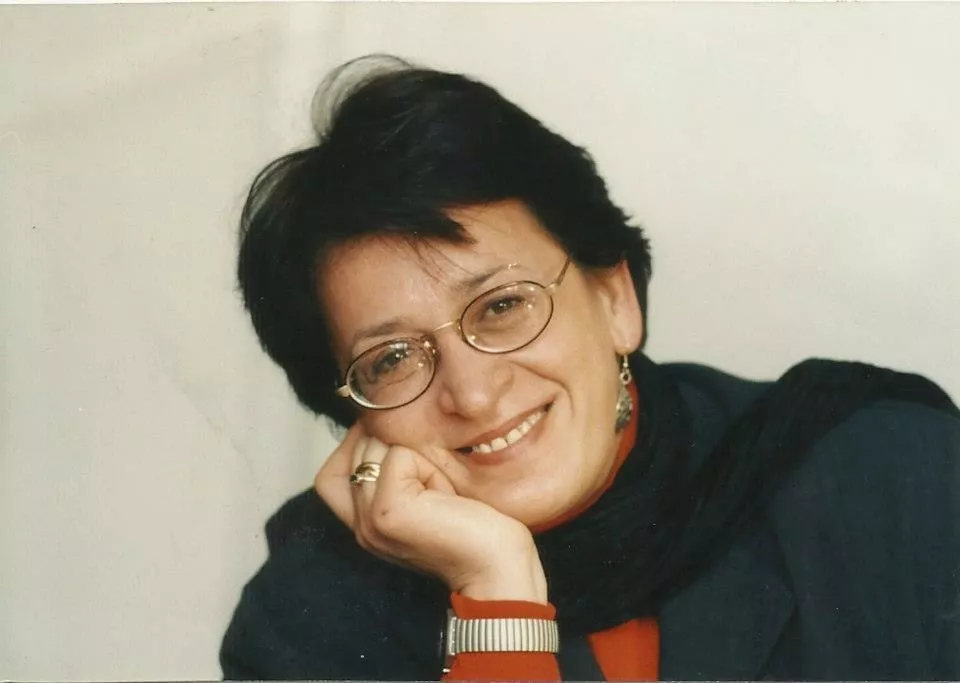
Interviewer: Sead Omeragić
She is accredited as an English translator for all European institutions, then for the UN, the Hague Tribunal, and the World Bank, and the State Department, with tens of thousands of hours of simultaneous and consecutive interpreting behind her around the world. Her main job was translating books that, for the most part, spoke about or in any way related to Bosnia and Herzegovina. She translated numerous essays, short stories, and poetry from and into English...
You have translated more than 40 works for readers in Bosnia and Herzegovina, and then about ten works by local authors into English. That is a huge undertaking and unimaginably important for a culture. I am intentionally starting the conversation by asking how aware people in BiH are of the significance of your monumental work in promoting BiH and its culture?
Kreso: I don't think about my work – let alone myself – in those terms or categories. I love my profession. I love the challenges it constantly presents me with, whether I'm engaged at a conference, in a translation booth, where every speaker – with their unique way of thinking, style of presentation, clarity and obscurity of thought, coherent or, as happens painfully often, incoherent sentence – throws me, as I like to say, into a kind of minefield.
Naturally, translating books is an even greater challenge because it involves an effort to transfer not only the text itself into another language, but also the entire corpus of the author's experience and knowledge, based on their education, the culture they come from, their worldview, their beliefs, to transfer a completely different universe into another language. My good fortune is that most of the authors whose works I have translated are alive, so I could consult them when the meaning of their phrase, sentence, or passage eluded me.
As for the reception of what I have done so far, the only thing that matters to me is that I have contributed to making some important books about Bosnia readable in the Bosnian language. And that they have readers.
Social recognition, praise, or awards – I assume that's what you're aiming at with your question – I perceive as a kind of social grimace, and I don't care about them. I have witnessed the commissioning of laudatory book reviews and the rigging of awards for translations, which sometimes required considerable effort from experts and proofreaders just to be published, for them to be important to me. Don't forget that we live in a time when all values are turned upside down, and when even diplomas are bought. I would worry about my work if someone decided to joke and give me some award.
When I was given the book "The Shadows of the Pomegranate Tree" by Tariq Ali as a gift back in 1998, I read it as if enchanted. There was a magic that kept me within that world for days, even after I closed it and went about my business. I confessed to the friend who gave me the book that images from that world of Al-Andalus still haunted me. His answer was: That's thanks to Senada Kreso's translation...
Kreso: The story of how the Bosnian translation of "The Shadows of the Pomegranate Tree" came about is unusual. I stumbled upon that book by chance on a shelf in a London apartment where I was staying in 1994 with the Sarajevo String Quartet. We went to England at that time for the Sarajevo String Quartet to hold a series of concerts. The then British ambassador asked me to accompany them to translate for them, to be of assistance, and to briefly introduce them to the audience before the concerts. I read "The Shadows" in one go, in a day and a night. Enchanted, just like you, because it was a story about Bosnia, about us, about my old mother, about my childhood home where I remember a pomegranate tree – about my Mostar, which was then doomed to disappear. Just as the world of Al-Andalus, Granada, and the Alhambra was doomed to disappear and did disappear.
I knew nothing about the author, Tariq Ali. Fortunately, I knew a journalist who knew him well and who arranged a meeting for me. I must have been very convincing in presenting Tariq with the reasons why the book had to be translated into Bosnian and why I specifically wanted to translate it, because his agent sent me a letter the next day granting me perpetual rights for the Bosnian edition. Every one of our readers apparently experiences that recognition, that identification with the characters of "The Shadows." There is no other explanation, as the book has been published by three publishers so far, and I have lost count of the reprints. Buybook, as the latest in the series, published "The Shadows" as part of Tariq's pentateuch, which tells stories about the relationship between Muslims and the world, or rather, the worlds that surround them. These are obsessive themes for Tariq, which are simultaneously so current that they crucially define the world we live in.
I think there is another explanation for this truly special reception of "The Shadows": in the process of working on the translation, I realized that the language of the translation had to be archaic Bosnian, because the similarity between the fate of Al-Andalus and Bosnia simply pulled in that direction. Many readers, known and unknown to me, told me how particularly touched they were by it – the language of their grandmothers and grandfathers. It was, I believe, a fortunate amalgam of the story and the translation language in which it was told.
I felt that same magic in your translation of the book "Love Thy Neighbor" by Peter Maas, a Pulitzer Prize winner. Then came one of the most interesting books in my last ten years of reading, "The Executioner's Trail" by Julian Borger, of course in your translation. Do the authors you translate realize how interesting and powerful you make their works? And how do they react to that fact?
Kreso: You have highlighted books about our recent past, which are also very important to me. I consider "Love Thy Neighbor" to be one of the best books about the recent war. Julian Borger's book reveals the behind-the-scenes dealings related to the work of the Hague Tribunal and the arrests of war criminals: these are incredible, sometimes almost fantastic stories about the hunt for these beasts of war, which, quite understandably, took place hidden from our eyes.
In response to your question, I will only say that all "my" authors have remained my friends, and I regularly keep in touch and see most of them. That is a kind of confirmation for me that I have not let them down.
In the past two years, you have translated Ed Vulliamy's "The War Is Dead, Long Live the War" and the book I am currently reading, "Violence as a Generative Force" by Max Bergholz, which has attracted attention in BiH and has also won some international awards in the meantime. Both books deal with history and ethnic crimes. You once said that translation is the most thorough possible reading and understanding of a work. If a work is moving for the reader, I wonder how it is for the translator, who must understand and experience it most deeply.
Kreso: I literally suffered through some of my translations, such as Lara Nettelfield and Sarah Wagner's book "Srebrenica After the Genocide," Gilles Peress and Eric Stover's "The Graves," or, for completely different reasons, Paul Auster's novel "The Invention of Solitude." Fortunately, there is a cure for this illness. And doctors. With the experience of that condition, which I call "post-partum depression," I managed to overcome it each time, no matter how difficult it was. And not only that, but I developed a theory that this state in my case is the result of a conscious decision by the brain and mind to retreat and withdraw in order to recover from trauma and renew for new tasks.
I have always admired translators, especially of poetry. The translation, or rather the poetic adaptations, of Ogden Nash by Dragoslav Andrić were like discovering a new world to me. Similarly, the poetic adaptations of German poets by Branimir Živojinović, especially the great Rilke. Translation here is almost like a new authorship. I recently interviewed a dear man, a great translator, Ivan Ivanji, who has since successfully entered literature with interesting works about Roman emperors. Do you also sometimes wish to write your own, original work?
Kreso: Never, not for a moment. When you learn to read books with pleasure – but also critically – when you know the difference between a good and a bad book, then you also know your own measure and limitations. Too much paper is already being used for bad books; thousands of titles that I call trash are produced worldwide every year, and I am convinced they would be better used as toilet paper, while forests are shrinking. I would not want to contribute to this destruction of the planet – both physical and spiritual.
Do you have any insight into how much people read in BiH in general, how it compares to other Balkan nations, and how it compares to Europe?
Kreso: It's difficult for me to make comparisons with countries in our region because I don't have insight into how much they read there. I do know, however, that more is published in Croatia and Serbia than here. Compared to the world, we read devastatingly little. Especially young people. They think it's not cool. It's the same with education. That's why we have illiterate, inarticulate journalists and lawyers, for whom language is a tool of their work. Believe me, I know what I'm talking about because when you receive a text that is untranslatable, it's clear that it's meaningless in itself. I constantly repeat that this is our deepest and most difficult problem. Because the importance of education, both for the individual and for society, can never be emphasized enough. Because the issue of education – and reading, or not reading books – has long-term consequences. And because, as the English writer Alexander Pope long ago said, "A little learning is a dangerous thing" or, as it is incorrectly quoted, "A little knowledge is a dangerous thing." A little learning/knowledge is a dangerous thing!
Komentari (0)
Prijavite se za komentiranje
PrijavaJos nema komentara. Budite prvi!
Minuta
Sve →Iz drugih kategorija

High Representative Not Elected: Germans, French and British Sabotaged Americans, New Attempt at End of June

ČOVIĆ WITHOUT MERCY: How Those Who Brought Ademović to Office Created a Political Hell for Him



Sunny Saturday, quite warm



Tragedy in Albanian resort: Two minors drown












