
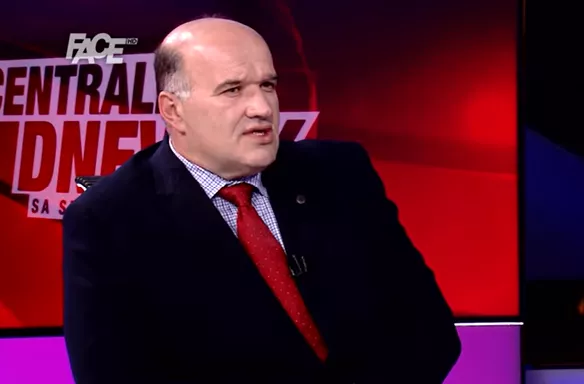
SARAJEVO, (Patria) - Sarajevo journalist Senad Pećanin said on Friday evening on FACE TV that the speech of Patriarch Irinej and Serbian President Aleksandar Vučić from Niš on March 24 this year, on the anniversary of the NATO bombing of Serbia, reminds him of a replay of Gazimestan from 1989, when Slobodan Milošević announced the bloody events in the former Yugoslavia that would soon follow.
"Instead of Milošević, today we have Vučić and Dodik," said Pećanin, adding that the price for such a repeated scenario would again be paid by Bosnia and Herzegovina and its citizens.
Asked what that scenario is, Pećanin said it is a new joint criminal enterprise, devised by Franjo Tuđman and Slobodan Milošević, but not realized in the last war against Bosnia and Herzegovina.
Pećanin seeks support for the possibility of a bloody scenario recurring in Bosnia and Herzegovina in international relations, relations in the region itself, primarily in the relations of Serbia and Croatia towards BiH, in relations within BiH itself, and, as he said, what did not exist in 1992 exists now, and that is Islamophobia "which Muslims Bosniaks carry on their shoulders."
"Relations between Serbia and Croatia are the worst in the last 40 years, but they are connected by common interests towards BiH. The result of that policy is also the excellent relations between Dodik and Čović that we are witnessing," said Pećanin, as reported by the Patria agency.
'RESERVE COMPOSITION OF THE RS MUP'
Speaking about the reserve composition of the Republika Srpska police, which will soon be formed, Pećanin said that this is just a continuation of Milorad Dodik's policy, noting that enormous amounts of weapons were previously procured in the RS. He recalled that a few weeks before the creation of legal conditions for the formation of the reserve composition in the RS, Milorad Dodik brought out police with long-barreled weapons to the inter-entity boundary line near Sarajevo, for which he later said could become a state border within 24 hours.
In BiH, Pećanin believes, the framework and assumption are being set that this demonstration exercise with the police does not remain only at the level of an exercise, but that a pretext is staged for those police officers to actually become border police officers.
"The migrant crisis in BiH could be used for that," warned Pećanin, who said that the problem of the migrant crisis in BiH is additionally and deliberately multiplied by Serbia and Croatia.
'CROATIA HARMS BiH'
Pećanin said that Bosnia and Herzegovina's problems are also caused by its western neighbors, recalling statements by Croatian President Kolinda Grabar-Kitarović who speaks of BiH as a nest of terrorists, while Croatian politics portrays Bosnian Muslims as a potential danger to Europe...
"All of this fits into the attempt to patch up Serbian-Croatian relations at the expense of Bosnia and Herzegovina, while the fate of Gaza and the West Bank is being prepared for Bosniaks," said Pećanin.
Meanwhile, Pećanin notes, Bosniak leaders, as he said, show a complete statesmanlike immaturity for such a situation.
"Bosniak leaders are limited to their four-year mandates," Pećanin believes.
He said it is incredible that in the situation when the involvement of the Croatian SOA in recruiting Salafis from BiH and attempting to plant weapons in their communities was revealed, Šefik Džaferović and Željko Komšić did not inform the UN Security Council, the European Commission, the European Parliament, NATO, the OSCE...
"The situation for BiH is worse than in April 1992, because international circumstances are not in our favor," said Pećanin, noting that Russia's influence is greater than before, the EU is preoccupied with Brexit, while the rise of xenophobia and fascism is noticeable in almost all EU countries.
Pećanin assesses that great responsibility for the poor state in BiH also lies with the parties of the civic bloc, because they rejected the chance to be part of the government in BiH and thus try to change processes in the country.
Komentari (0)
Prijavite se za komentiranje
PrijavaJos nema komentara. Budite prvi!
Minuta
Sve →Iz drugih kategorija

High Representative Not Elected: Germans, French and British Sabotaged Americans, New Attempt at End of June

ČOVIĆ WITHOUT MERCY: How Those Who Brought Ademović to Office Created a Political Hell for Him



Sunny Saturday, quite warm



Tragedy in Albanian resort: Two minors drown












