
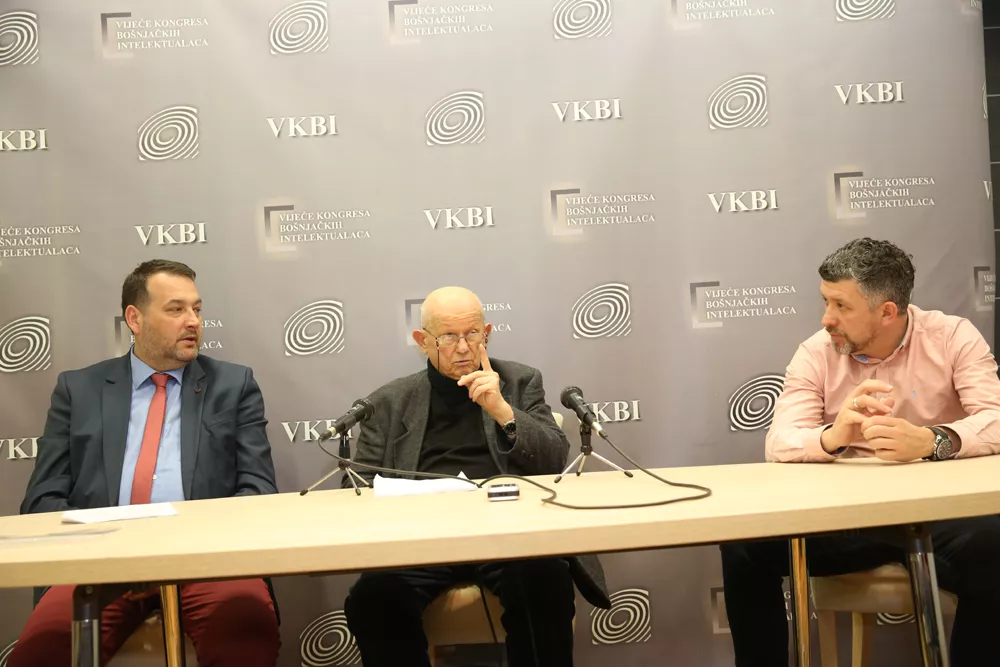
SARAJEVO, (Patria) - A public forum "On the Language of Sephardic Jews" was held at the premises of the Congress of Bosniak Intellectuals, with Prof. David Kamhi, a retired professor of the University of Sarajevo, as the introductory speaker.
Emir Zlatar, Secretary General of the Congress, in his capacity as an introductory speaker at the forum, emphasized that the language of Sephardic Jews is a unique centuries-old cultural heritage of Bosnia and Herzegovina, which we want to save from oblivion.
The language of our Bosnian Sephardic Jews is one of the hallmarks of the multicultural history of Bosnia, which is unfortunately on the verge of disappearing. Bosniaks have a historical obligation to promote this heritage, especially in today's global geo-strategic political relations, which are dominated by negative stereotypes of Islamophobia and anti-Semitism.
Prof. Dr. Alen Kalajdžija, Director of the Institute for Language of the University of Sarajevo, pointed out that this language is a rarity on a global scale, and offered the Institute's resources in the context of creating video recordings with Prof. Kamhi, with the aim of preserving facts and records about the language of Sephardic Jews in Bosnia.
In his presentation, Professor David Kamhi stated that it is an undeniable fact, both linguistically and socially, that the Jews did not immediately adopt the Spanish language upon their arrival in the Iberian Peninsula with the Arabs in the 7th and 8th centuries. Semites – Jews and Arabs – retained their languages (Hebrew and Arabic) for a long time. The real process of assimilation with the Spanish language began in the 11th and 12th centuries, reaching its peak in the 13th, 14th, and early 15th centuries. By then, the formation of the Spanish language was slowly concluding, but some linguistic changes continued. As is known, after their expulsion, Sephardic Jews, regardless of dialectal differences, preserved the pre-classical spoken Spanish of that time.
Sephardic Jews came to Sarajevo from Spain relatively quickly after their expulsion, but not directly, unlike those who arrived in the ports of the Ottoman Empire (Constantinople and Thessaloniki). There is data suggesting their presence in Sarajevo as early as before 1520, while some sources place it later, which is not fundamentally important. Much more important is that they brought with them, along with their language, a vast cultural heritage that had been formed over centuries. This culture, in addition to its Jewish dimension, was part of a tri-culture (Jewish-Arab-Christian) from the 13th to the 16th century (El siglo del oro) – the "Golden Age". The language belonging to that culture was enriched by Sephardic Jews with words from the peoples of other cultures in the countries they settled in. Among philologists who study Spanish and languages that have roots in it, both in the region and worldwide, there is considerable confusion regarding the name of the Sephardic Jews' language. We know that in this regard, there are several names or variants of the same; djidjo, džudijo, žudijo, džudezmo, español, španjol, judeo-espanol, džudeo-espanjol, and ladino, as well as haketia (hakitiya). Španjol, žudijo, džudijo, or djidjo (đigio) are names used by Bosnian Sephardic Jews. In Bosnia, these terms were equated with the adjective "Jewish".
Today, after almost 500 years of Sephardic presence in Bosnia, the Sephardic language is spoken in only two families in Sarajevo. In any case, every Spanish language department in the region, and especially in Sarajevo, should study the language of Sephardic Jews, as the culture of Bosnian Sephardic Jews is an integral part of the culture and heritage, not only of the people of Bosnia and Herzegovina but also of a much wider area.
Komentari (0)
Prijavite se za komentiranje
PrijavaJos nema komentara. Budite prvi!
Minuta
Sve →Iz drugih kategorija

High Representative Not Elected: Germans, French and British Sabotaged Americans, New Attempt at End of June

ČOVIĆ WITHOUT MERCY: How Those Who Brought Ademović to Office Created a Political Hell for Him



Sunny Saturday, quite warm



Tragedy in Albanian resort: Two minors drown












