
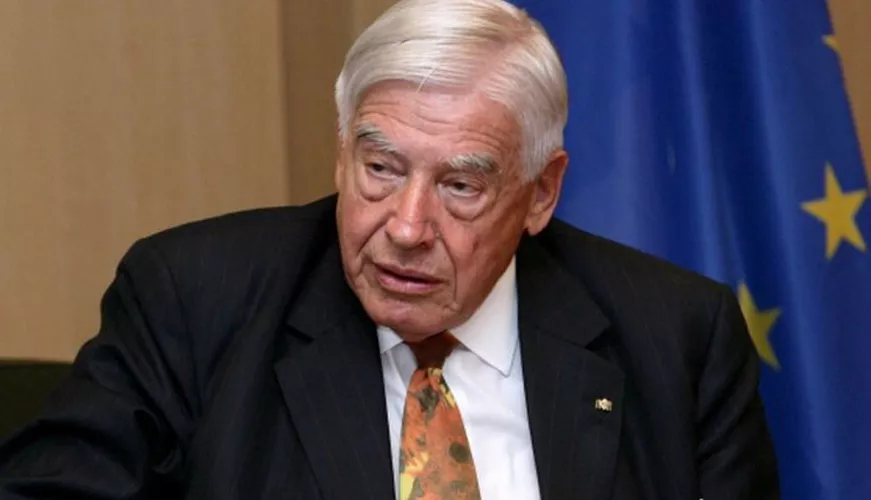
The Bled Strategic Forum conference in Slovenia discussed, among other things, issues of integrating Western Balkan countries into the EU. The gathering brought together foreign ministers of those countries. However, there were noticeably few foreign ministers from EU member states, writes Christian Schwarz-Schilling in a new commentary for Deutsche Welle.
The guest who certainly attracted the most attention was American Matthew Palmer, the newly appointed special envoy for the Western Balkans.
The US has now taken the initiative and made the first step to shake up the EU - busy with its own problems - to bring the Western Balkan countries back to the negotiating table and encourage them to find a genuine solution to the disagreements that have existed for almost 20 years.
The US does not want to leave the region to Russian influence
It was actually the EU's task to work energetically on the region's problems and the European integration of these countries. During the 1990s, when Bosnia and Herzegovina and later Kosovo were involved in horrific wars, it was the US initiative that set things in the Balkans on the right track.
Experience has shown us that only those solutions that were agreed between America and Europe were successful and lasting. All previous actions by Brussels were too watered down and did not really lead to the goal. Therefore, we should be grateful to the United States for this initiative, even though some Europeans certainly do not like it.
A good connoisseur of the region, Professor Daniel Serwer, said that President Trump, ahead of next year's presidential election, wants to chalk up another success - regarding the stalemate in resolving the issue between Serbia and Kosovo. It is also believed that the US cannot simply leave the region to Russian influence, which has become very strong.
Everyone agrees that Matthew Palmer's focus is on Kosovo. The discussion about the dangerous "exchange of territories" between Kosovo and Serbia, with catastrophic consequences for Bosnia and Herzegovina and other countries in the region, was removed from the agenda after the Berlin conference on the Western Balkans at the end of April.
I have long vigorously warned about the danger of new border drawing along ethnic lines. I hope it is now clear that this firm position of the international community coincides with the peace agreements. Palmer has not yet decisively declared himself on this. However, despite that, he carries the message that the US does not want mono-ethnic states in the Balkans, but rather "civic" states. This aligns with the European line and Germany's stance.
Europe cannot be clear on the issue of BiH
Shouldn't the European Union now take the initiative and appoint a special envoy precisely for the talks between Pristina and Belgrade, an envoy who would also be responsible for the Western Balkan region? That would be consistent. Isn't it time to give the Serbian minority living in Kosovo its own voice, rather than just waiting for Belgrade to be the only one speaking on behalf of those Serbs?
Serbian President Aleksandar Vučić has just met with US Senators Ron Johnson and Chris Murphy. Republican Johnson is an expert on security issues at home and abroad - and that is a good signal. The EU should start cooperating with the US as soon as possible to bring its European perspective into all of this.
The question must also be asked whether Bosnia and Herzegovina, which experienced the most horrific ethnic war, has not been a hostage to Balkan disagreements for years. It should have been made clear long ago that Milorad Dodik's ambition to secede the Republika Srpska from Bosnia and Herzegovina leads to the destruction of the state of Bosnia and Herzegovina. Since Europe is apparently unable to say this clearly and loudly, the US must now do so.
Previously warring states Serbia and BiH cannot simply be left to negotiate on their own due to historical processes. The policy of the Republika Srpska undermines the unity of Bosnia and Herzegovina. This must be clearly stopped - especially because it directly contradicts the Dayton Agreement, which America negotiated with the warring parties. The hope remains that the US and Europe have gathered enough historical experience and will, with Mr. Palmer's new initiative and with new people in the European Commission, recognize the importance of joint action and meeting each other halfway.
Prof. Dr. Christian Schwarz-Schilling was Minister of Post and Telecommunications in Chancellor Helmut Kohl's government from 1982 to '92. He resigned in protest against the restraint of the German government during the war in BiH. For ten years he was an international mediator for BiH, and in the period 2006-2007 he served as the High Representative in BiH. He occasionally writes columns for DW.
Komentari (0)
Prijavite se za komentiranje
PrijavaJos nema komentara. Budite prvi!
Minuta
Sve →Iz drugih kategorija

High Representative Not Elected: Germans, French and British Sabotaged Americans, New Attempt at End of June

ČOVIĆ WITHOUT MERCY: How Those Who Brought Ademović to Office Created a Political Hell for Him



Sunny Saturday, quite warm



Tragedy in Albanian resort: Two minors drown












