By: Rasim Belko @rasimbelko
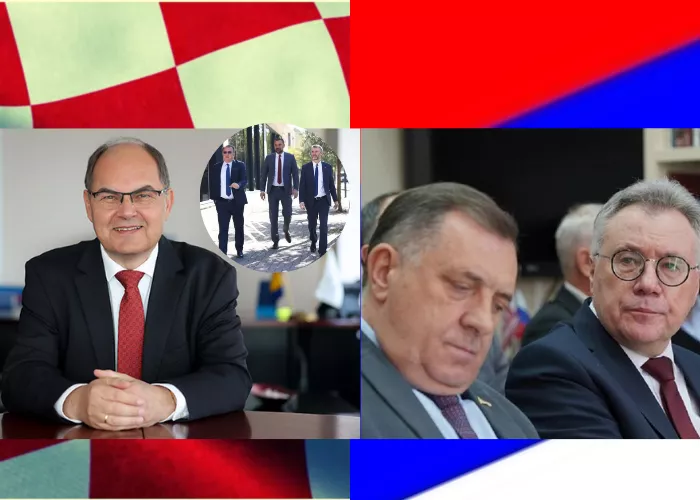
The new report by High Representative Christian Schmidt to the UN Security Council shows the continuity of anti-Bosniak, anti-Bosnian, and anti-Islamic actions of the Bavarian at the head of the OHR, colored by Nazi ideology.
In the report, Schmidt speaks about the judgments of the European Court of Human Rights and says: „Among other things, the High Representative is responsible for the sustainable development of democracy in Bosnia and Herzegovina. In this regard, I will invite all relevant parties in the coming period to launch an initiative for the implementation of the judgments of the European Court of Human Rights.” However, the High Representative approaches this issue selectively. While formally advocating the thesis of implementing the Sejdić-Finci and other judgments, Schmidt, in coalition with Croatia, is trying to overturn the Kovačević judgment, which, if confirmed, could have far-reaching implications for the Constitution and the rule of law in BiH.
„As High Representative, I continue to call on all relevant parties to show greater tolerance and increase their engagement in inter-ethnic dialogue towards reconciliation,” says Schmidt, and then in the same report states: „The controversy surrounding the construction of the Mevlana Intercultural Center at a disputed location in Mostar continues. The Mevlana Intercultural Center in Mostar is perceived by the Croatian political group, including HDZ BiH, as a strategic move to affirm the Bosniak presence in the predominantly Croatian western part of the city.“
Therefore, while claiming to work on inter-ethnic dialogue, Schmidt will emphasize to the Security Council that Bosniaks are “attacking” the western part of Mostar, the capital city of Croats, through the Intercultural Center.
„My decision of April 27, 2023, unblocked the appointment of the Government of the Federation of Bosnia and Herzegovina and helped overcome the political deadlock in the entity,” Schmidt boasted, perhaps in a desire for the Security Council to once again understand that he is a dictator who undermines elections and political action and that, with a few sentences, he can choose the government.
Conclusion: In the report, Schmidt, with a masked tone, once again confirmed his anti-Bosniak, anti-Bosnian, and dictatorial policy. Because why else would Schmidt care about the unease of the UZP policy due to the intercultural center of Muslims? Why would he repeat the story about the suspension of the Constitution rather than tell the Bosniaks that he will intervene if they do not elect those who suit him? Schmidt also attacked the Constitutional Court due to the decision in the Vareš case, fearing that the occupation-aggression investments in BiH, in which he himself participated, would be called into question due to the court's decisions.
The day after Schmidt, we could read the column by the Russian ambassador Kalabuhov, which is a kind of report for the domestic public from the BRICS Summit. In that report, Dodik is the key figure, and his meetings with Putin are praised. Descriptively comparing two major world blocs, Kalabuhov clearly agitates, stating that the bloc he advocates does not impose, does not threaten sovereignty, nor does it subjugate states.
However, the head of BiH diplomacy, Elmedin Konaković, says: “One must not go to BRICS.” He didn't say from whom one must not, but it's not hard to guess.
The question arises: is it a mistake to let Dodik go alone to a Summit that carries the weight of half the world's population, including major Eastern powers, but also Turkey as a NATO member seeking access to BRICS, or Brazil as one of the founders of BRICS, and at the same time a NATO partner?
Is it then possible that Turkish President Recep Tayyip Erdogan is so much less capable than BiH's political “academics” that he sees the potential of BRICS, while being under the umbrella of the Western military alliance?
No, that's not the issue. And it's not a question of whether the EU and NATO are the primary goals of Bosnia and Herzegovina – they are, without a doubt – but only blind passengers in politics, imposed to rule by “joystick,” can turn their heads away from a bloc that has the potential for serious military-political and economic rise, with the creation of a separate currency system.
A policy that has no alternative to primary interests is doomed to blindly follow one path. That path can be prosperity, but it is burdened and slow, thus dangerous, much more destructive than attempting cooperation with the West and the East.
So dangerous that the division of Bosnia and Herzegovina along the line of the Neretva River is not a negligible option. And as we watch Schmidt and the politicians he appointed care more about Croatian interests than state interests, anything is possible. The chances increase as Kalabuhov, Dodik, and Putin strengthen their partnership.
In the development of the situation between Schmidt and his politicians on one side, and Dodik and Kalabuhov on the other, Bosniaks, as proponents of a unified BiH, will be left with the Neretva River as their last refuge.
Komentari (0)
Prijavite se za komentiranje
PrijavaJos nema komentara. Budite prvi!
Minuta
Sve →Iz drugih kategorija

High Representative Not Elected: Germans, French and British Sabotaged Americans, New Attempt at End of June

ČOVIĆ WITHOUT MERCY: How Those Who Brought Ademović to Office Created a Political Hell for Him



Sunny Saturday, quite warm



Tragedy in Albanian resort: Two minors drown












