
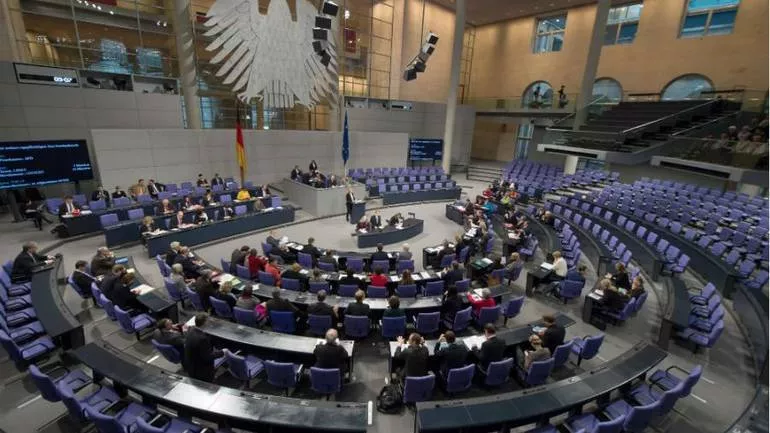
Across Germany, polling stations opened this morning where 61.5 million voters are electing the 19th Bundestag.
Al Jazeera writes that Germany has one of the most complex voting systems for electing a parliament (the lower house) in Europe, with a term lasting four years.
In this year's federal elections, 61.5 million people have the right to vote, of which 31.7 million are women and 29.8 million are men. Almost three million people will be able to exercise their right to vote for the first time.
More than a third of voters in Germany, almost 22 million, are people over 60 years old. Many analysts believe that the older generation will have a significant impact on the outcome of the elections.
The largest number of people with the right to vote live in the states of North Rhine-Westphalia (13.2 million), Bavaria (9.5 million), and Baden-Württemberg (7.8 million).
First and Second Vote
Germans will be able to cast their vote in the elections for a district representative (political representative) and for one of the parties. With the first vote (Erststimme), Germans give their support to a candidate who will represent their district in parliament. Every candidate who wins one of the 299 electoral districts is guaranteed a seat in parliament. With the second vote (Zweitstimme), Germans give their support to one of the parties, in order to fill the other half of the 598 seats in the Bundestag. This vote determines the percentage representation of each party in the Bundestag.
There are also so-called "overhang seats" (Überhangmandate), and according to many experts, this is precisely what makes the German electoral system special. Germany is divided into 299 electoral districts and as many direct mandates in parliament.
If a party wins more direct mandates than the number it is entitled to based on its proportional success achieved with the second vote, then this difference is counted as "overhang seats." Other parties then also receive more seats in parliament, which ultimately makes the Bundestag larger than it is. Due to this rule, there are currently 631 parliamentarians in the Bundestag.
Federal states with larger populations are numerically more represented in the Bundestag than others. In order for a party to enter the Bundestag, it must win at least five percent of the second votes (electoral threshold). This year, according to current statistics, the FDP and the far-right party Alternative for Germany (AfD) will be fighting to cross this threshold.
Secret Ballot
Currently, five parties are represented in the Bundestag: the Christian Democratic Union (CDU), the Christian Social Union (CSU), the Social Democratic Party of Germany (SPD), The Left, and the Greens.
Unlike, for example, the United States, voters in Germany do not directly elect the Chancellor (head of government). The new parliament must convene no later than one month after the elections, and the main candidate of the party that wins the most votes usually forms a coalition. The President of the country then presents that person as a candidate for Chancellor. After that, in a secret ballot, the parliamentarians approve (or reject) the candidate for Chancellor.
In Germany, the Chancellor does not have a term limit, but no head of government since Helmut Kohl in the cabinet has served more than a total of 16 years. He served for a full 16 years.
The German parliament has the task of passing laws, electing the Chancellor, and controlling the work of the government. It also adopts the state budget every year.
As the parliament works in committees, the strength of a party in parliament determines how many of its deputies will be in those committees. Some committees are permanent, and some are temporary.
The President of the Parliament, currently CDU politician Norbert Lammert, is formally the third-highest-ranking person in the country, after the President of Germany and the President of the Federal Council. The President of the Bundestag must be a member of the strongest parliamentary group. He represents the parliament, presides over sessions, and ensures the rights of the people's representatives are respected.
At least six parties will be represented in the new Bundestag, which has not happened since 1990.
Komentari (0)
Prijavite se za komentiranje
PrijavaJos nema komentara. Budite prvi!
Minuta
Sve →Iz drugih kategorija

High Representative Not Elected: Germans, French and British Sabotaged Americans, New Attempt at End of June

ČOVIĆ WITHOUT MERCY: How Those Who Brought Ademović to Office Created a Political Hell for Him



Sunny Saturday, quite warm



Tragedy in Albanian resort: Two minors drown












