
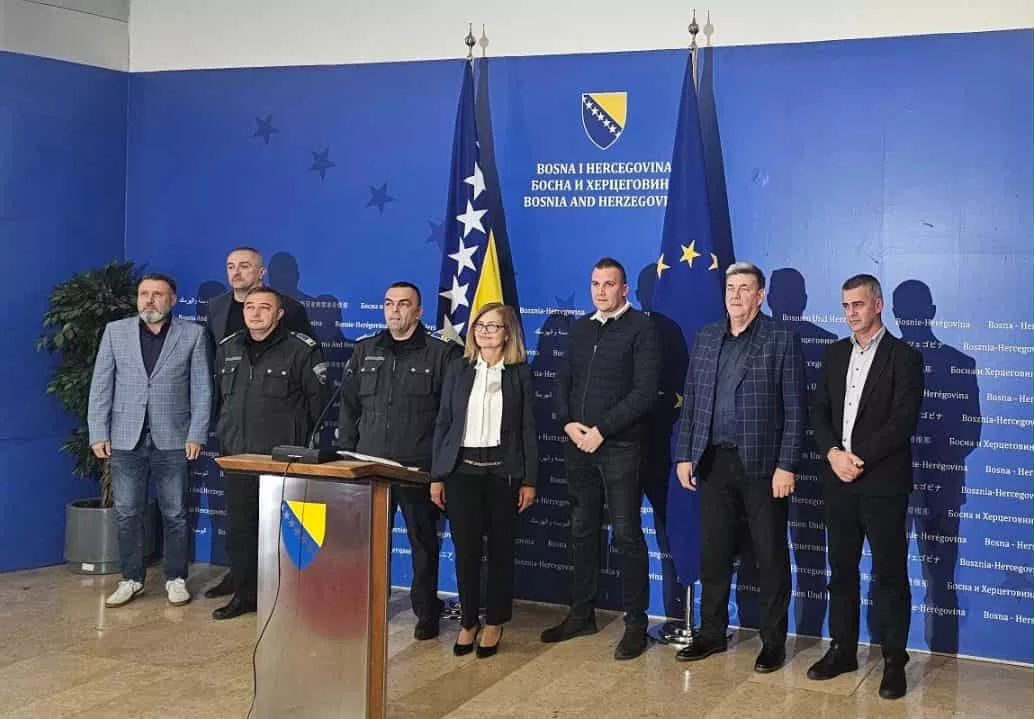
(Patria) - The Union of Police Bodies in BiH, comprising the Border Police Union, SIPA Union, and DKPT Union, sent a letter to all representative clubs in the House of Representatives of the Parliamentary Assembly of BiH, regarding the Bill on Amendments and Additions to the Law on Police Officers of Bosnia and Herzegovina, proposed by representatives Nihad Omerović, Jasmin Imamović, and Predrag Kojović, which is scheduled for consideration at the session on January 22.
The Union reminds of previously stated positions and notes that such a law carries numerous risks for the police system of this country.
Namely, it provides for the possibility of extending the working life of police officers employed in the police bodies of Bosnia and Herzegovina up to the age of 60, even though they have acquired 40 years of insurance service.
"The extension would be granted at the request of the police officer, decided by the head of the police body, or as stated, 'if it is in the interest of the police body'. The unions still believe that such a bill, neither formally nor substantively, is satisfactory and hides numerous dangers that the general public is not even aware of. The unions remind that the Law on Police Officers of Bosnia and Herzegovina is a systemic regulation, and any potential amendments and additions must be the result of systemic solutions. Such a bill gives too much discretion in deciding who among the employees can extend their employment within the police body and leaves room for unequal treatment of police officers and favoritism of individuals, which is in no way in line with the principles of legality, accountability, fairness, legal certainty, and institutional sustainability, which the proposer invokes in their proposal. The risk of politicization of parts of the police system, therefore, becomes much greater. In addition, this proposal is justified by the proposers, from the beginning, by personnel deficit and the principle of operational efficiency. Personnel deficit is a reality and a problem that unions have been pointing out for years, but this will not solve it. Unions have a justified assumption that the possibilities and benefits of this proposal will only be used by managers and high-ranking police officers, while on the other hand, lower-ranking police officers, who are the bearers of operational activities in the field, will not have room for advancement. This will lead to an additional gap and divisions within the system, as well as demotivation of young and promising police officers. Likewise, how much operational efficiency, which the proposer calls a principle, can be expected from a police officer who is 65 or 60 years old," the Union asks.
The proposal also envisages that the amended provisions will apply, in terms of personnel structure, to a maximum of 80% for police officers from the rank of police officer to senior inspector, and up to 20% for categories of police officers with the ranks of independent and chief inspector.
"It is unclear how and based on what indicators such a provision can be applied without circumventing discrimination against certain police officers."
The membership of the Union of the State Investigation and Protection Agency has also taken a stance against the aforementioned solution.
The Agency itself issued a statement, stating that any amendment to any law that directly relates to the Agency, without consulting the Agency, is not good, as it is mostly based on inaccurate data and proposes legal solutions that will negatively affect the functioning of the Agency. The Agency stated that adopting legal solutions that would allow employees to remain employed for years after acquiring the conditions for retirement and that such a stay depends solely on the employee's will would create legal uncertainty, unequal and unfair treatment, prevent career advancement, and have a number of other negative consequences. The Agency's position is that this would also prevent the recruitment of new police officers, as job vacancies in the initial ranks would not be available.
The amendments proposed by the representatives of the Troika have not been agreed upon with any Union operating within the Union of Police Bodies in BiH as the sole representative union for negotiations of this kind.
"The positions stated at two meetings we had with the proposers are not aligned with the positions of the unions, and therefore, such a proposal is unacceptable to us. What is devastating is that the representative Union-SSPO in BiH was not informed about the content and text of the Law at the very beginning, which violates the provisions of Article 94, Paragraph 1 of the Law on Labor in BiH Institutions, as well as Articles 6 and 7 of the signed collective agreement, which stipulate the obligation of the Union's participation in the adoption of general legal and sub-legal acts and consultations with the representative Union, which was not done in this case. Only after media pressure were we invited for talks and negotiations related to the aforementioned issue.
Furthermore, the proposal for amendments and additions to the Law on Police Officers itself, in Article 2, point 14, which relates to the extension of the mandate of appointed police officers until December 31, 2028, at the latest, contradicts
the provisions of Article 14 of the Law on the Border Police of BiH, which provides for the appointment and dismissal of the director and deputy director of the BiH Border Police."
Similar or identical provisions apply to the Law on SIPA and the Law on DKPT.
The proposed Law is also in contradiction with the Law on Independent and Oversight Bodies of Police Structures of BiH, where Article 3 of the aforementioned Law relates to the competencies of the Independent Oversight Body of the Parliamentary Assembly of BiH.
The proposed amendments and additions to the Law on Police Officers of BiH do not have a positive opinion from the Directorate for European Integration of BiH, as it did not wish to comment on its alignment with the EU acquis, which was confirmed by its act, which is a working document and available on the website of the House of Representatives of the PA BiH as part of the agenda of the session and this item on the agenda.
The Union of Police Bodies in BiH is of the opinion that a new Law on Police Officers, as a systemic solution, needs to be adopted as soon as possible.
"Considering our proposal, we are of the opinion that the House of Representatives of the Parliamentary Assembly of Bosnia and Herzegovina should completely reject the proposed amendments and additions to the laws and, as soon as possible, in accordance with its competencies, initiate the process of adopting a new Law, which would resolve all important issues in a systemic and legal manner," the Union states.
Komentari (0)
Prijavite se za komentiranje
PrijavaJos nema komentara. Budite prvi!
Minuta
Sve →Iz drugih kategorija

High Representative Not Elected: Germans, French and British Sabotaged Americans, New Attempt at End of June

ČOVIĆ WITHOUT MERCY: How Those Who Brought Ademović to Office Created a Political Hell for Him



Sunny Saturday, quite warm



Tragedy in Albanian resort: Two minors drown












