
By: Rasim Belko
Political PTSD has affected certain Bosniak structures, making the substitution of theses not only a habit but also a working methodology. Thus, from the SDP, as well as from some other circles, the message that the election of Željko Komšić to the Presidency of BiH was the cause of severe Bosnian-Herzegovinian crises is increasingly heard, because, of course, nothing explains complex political blockades better than a convenient scapegoat. This is a dangerous premise that has been promoted in recent days, among others, by SDP cadre Dženan Skelić and journalist from Herzegovina Nermin Bise.
Why is this substitution of theses dangerous? Firstly, because it practically tells every Croat in Bosnia and Herzegovina that they have the right to political self-determination, provided they are already predetermined as they should be, i.e., under the banner of HDZ BiH. This is a perception that Dragan Čović has quite successfully served to a part of the Bosniak public. And here we come to the second, perhaps more serious danger, the misdirection of blame. Because, for all the blockades orchestrated by Čović and HDZ, sometimes alone, sometimes in tandem with Milorad Dodik, and indeed sometimes with the Trojka project, it now turns out that Komšić is to blame, or in perspective Slaven Kovačević. Elegantly idiotic, if nothing else.
These self-taught Bosniak politicians and analysts clearly do not understand that all post-war crises, political or institutional, have been driven by the agendas of Zagreb or Belgrade. In this context, Komšić appears as a Bosnian-Herzegovinian Croat patriot who was the last line of defense against anti-state policies taking control of the state vertically, because, let's face it, they had already largely done so horizontally.
Self-taught analysts from the Bosniak ethnic corpus clearly do not understand that the war aims of Republika Srpska and Herceg-Bosna did not disappear with the Dayton Agreement, but were simply repackaged in political attire, which, admittedly, often looks bad, but is persistently worn.
What SDP Bosniaks like Skelić, and I would say many prominent figures in that party, do not understand is the problem that lies in the fact that where HDZ's "legitimacy" reigns, governance towards others functions through institutionalized discrimination, while where that does not pass, they resort to somewhat cruder methods. Therefore, it seems somewhat unusual that Bise sides with quasi-analyst Skelić in the narrative that strengthening HDZ brings de-blockade and resolution of crises, or that removing Komšić is the key element of that process. The logic is, at the very least, creative, and appears lost.
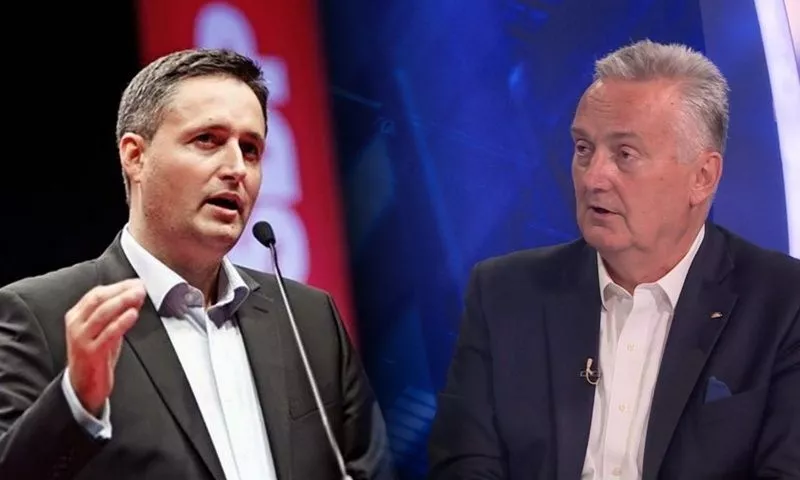
This is a complete schizophrenia of political narrative, but it remains unclear how the imitator of politicians, not to say political puppet from the SDP, Denis Bećirović, views it, whom the SDP has again pushed into the race for the Presidency, while a part of the membership publicly declares support for Dragan Čović's runner-up.
The question is whether Bećirović is actually calling for a scenario where, if he wins, he would share the Presidency with a political follower of UZP instead of Slaven Kovačević.
It is not impossible that such an outcome suits him, because those SDP members who do not rush to the cameras and social media prefer the election of Kovačević, a true advocate of a civic state, over Bećirović, who offers, as is usually the case, convenient guarantees and historical lectures for the international audience, with a rather flexible attitude towards selectively chosen "friends of BiH".
Due to this difference in political substance, it is not far-fetched to conclude that Bećirović would actually prefer that SDP Bosniaks, for whom he is, to put it mildly, unconvincing, vote for Čović's runner-up Darijana Filipović instead of Kovačević.
After all, Bećirović has long shown that he is quite quick on the trigger when it comes to supporting solutions tailored to HDZ. For those who have forgotten, it is enough to recall how he supported Borjana Krišto as the head of the Council of Ministers without much hesitation. In the case of Filipović's election, he would at least have a convenient excuse that there is "no choice" but to decide in accordance with HDZ's interests.
What remains an open question in this whole story is the position of the formal leader of SDP BiH, Nermin Nikšić, and the informal one, who is increasingly trying to return to the game, Zlatko Lagumdžija.
The games within the SDP have clearly begun, which is why Bećirović's election has been called into question. The fact that Lagumdžija is trying to take over the party from the shadows with some obedient caricature at the helm hardly bodes well for Bećirović's campaign. This is due to both the saturation with Lagumdžija in the SDP and the divisions that will inevitably follow.
Here, besides the aforementioned PTSD, one should also look for the reasons why there is a persistent attempt to create a myth that SDP Bosniaks will vote for Čović's candidate, even though it is an open secret that a significant portion of these voters will support Kovačević.
And precisely this possibility, it seems, disturbs Lagumdžija and Bećirović the most on one side, and emboldens those around Nikšić on the other. Because nothing destabilizes political calculations like voters who decide to think for themselves.
Especially when those voters are party members, and the polls go against the party's interests!
Komentari (0)
Prijavite se za komentiranje
PrijavaJos nema komentara. Budite prvi!
Minuta
Sve →Iz drugih kategorija

High Representative Not Elected: Germans, French and British Sabotaged Americans, New Attempt at End of June

ČOVIĆ WITHOUT MERCY: How Those Who Brought Ademović to Office Created a Political Hell for Him



Sunny Saturday, quite warm



Tragedy in Albanian resort: Two minors drown












