
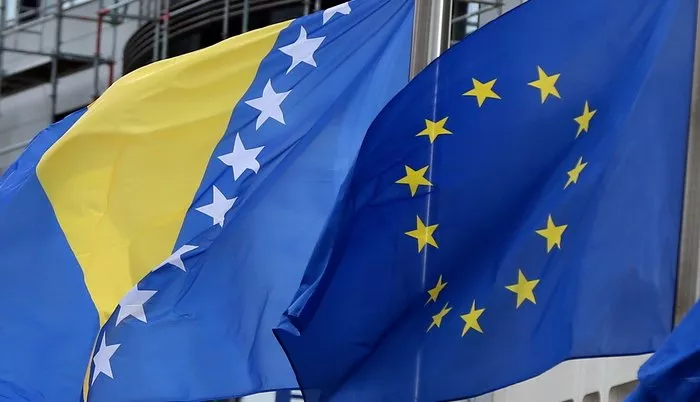
(Patria) - A group of Bosnians and Herzegovinians and Americans of BiH origin united in the "Working Group for Bosnia and Herzegovina" sent a letter to the High Representative of the European Union for Foreign Affairs and Security Policy Josep Borrell, calling on him and other EU officials, including European Commission President Ursula von der Leyen, to engage more decisively in response to the current crisis in Bosnia and Herzegovina.
As they stated in the letter, the European Union should focus its activities on imposing sanctions against those who pose a threat to peace, ensuring the reinforcement of the EUFOR mission in BiH, and providing strong public support for the authority and decisions of the Office of the High Representative in BiH.
The recent visit of European Commissioner for Enlargement Olivér Várhelyi to Bosnia and Herzegovina in November has raised serious concerns regarding the EU's commitment to supporting the rule of law, democratic values, and human rights in BiH, as well as its EU membership, according to this group.
"It appears that the discussions held during Commissioner Várhelyi's meeting in November supported the interests of Serb and Croat nationalists, who, with the support of the Russian Federation, seek to undermine the sovereignty and territorial integrity of BiH," they believe.
Based on the report of the November meeting compiled by the Head of the EU Delegation to BiH and EU Special Representative Johann Sattler, it was clear that Commissioner Várhelyi blames former High Representative Valentin Inzko for the current crisis in BiH because he imposed amendments to the Criminal Law banning the denial of genocide and glorification of convicted war criminals.
"Commissioner Várhelyi stated that a discussion should be held at the local level to reach a consensus and give domestic political representatives the opportunity to pass that law. This represents an unjustified and extremely inaccurate criticism directed against Inzko," the letter said.
They recall that Inzko consistently and energetically appealed to domestic politicians to pass that law, and the adoption of such a law had been proposed twice in previous years by delegates in the House of Peoples, Zlatko Miletić and Denis Bećirović, but its adoption was prevented by votes from delegates of the Croat Club and the Serb Club.
They consider it unexpected that a European commissioner would blame the High Representative for passing a law banning the denial of genocide and glorification of war criminals, given that it is fully in line with the legal principles and practices of the European Union.
Laws banning the denial of genocide in the EU recognize that denial constitutes hate speech that denies or diminishes the crime committed against a targeted group and makes that group vulnerable to the recurrence of such atrocities.
"By passing that law, Inzko, in addition to achieving a historic and timely affirmation of the rule of law, sought to protect those who survived the genocide, including the Mothers of Srebrenica, from the implicit threat and re-traumatization resulting from such hate speech," they emphasized in the letter.
They stress that Commissioner Várhelyi's focus on the new law represents a regrettable distraction, as it is clear that the current crisis should be blamed precisely on BiH Presidency member Milorad Dodik.
In the report that High Representative Christian Schmidt presented to the United Nations Security Council, it was warned that due to escalating threats to peace by Dodik, BiH is facing the greatest existential threat in the post-war period, and the denial of genocide and glorification of convicted war criminals is one of the main sources of destabilization, the Working Group for BiH letter warned.
Since Várhelyi was aware of discussions about preparations for secession, and the National Assembly of Republika Srpska subsequently voted on a decision to establish its own army and judiciary, friends of BiH believe he should have energetically opposed such plans, given that any moves towards secession would represent nothing less than the realization of the genocidal goal of Republika Srpska to establish an ethnically homogeneous territory.
"Dodik's threats and his plan to form an entity army, the same army that committed atrocities against civilians in the period from 1992 to 1995, represent a cruel re-traumatization of survivors of the siege of Sarajevo, concentration camps, the Srebrenica genocide, and other atrocities," they said.
Due to all the above, members of the Working Group for BiH appealed to those responsible in the European Union to form an operational alliance between the United States of America, the United Kingdom, and the European Union with the aim of defending the sovereignty and territorial integrity of Bosnia and Herzegovina.
Specifically, they called on them to join the US in imposing targeted sanctions against Milorad Dodik and others who pose a threat to peace, and that after resolving the current crisis, accelerating Bosnia and Herzegovina's EU accession should be imperative as a matter of restorative justice.
The letter was signed by Professor of Philosophy and Holocaust and Genocide Studies at Southern Connecticut University David Pettigrew on behalf of the "Working Group for BiH."
Komentari (0)
Prijavite se za komentiranje
PrijavaJos nema komentara. Budite prvi!
Minuta
Sve →Iz drugih kategorija

High Representative Not Elected: Germans, French and British Sabotaged Americans, New Attempt at End of June

ČOVIĆ WITHOUT MERCY: How Those Who Brought Ademović to Office Created a Political Hell for Him



Sunny Saturday, quite warm



Tragedy in Albanian resort: Two minors drown












