
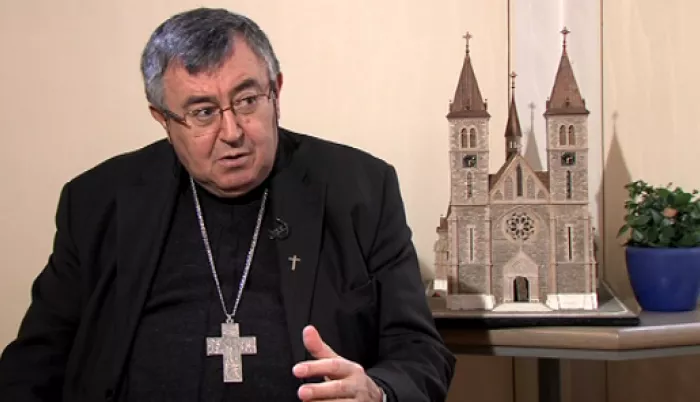
I think that theory existed even during the war, when they said we were no longer there, and I used to say: Do not bury us alive, we exist. Certainly, organization was one way of defense, but it is not true that where "Herceg-Bosna" did not cover, there are no Croats. That is not correct. Defense was organized, and thank God it was, but we cannot bury alive those who live outside that area, said Cardinal Vinko Puljić in an interview for TV1.
TV1: When the Dayton Agreement was supposed to be signed in 1995, Krešimir Zubak called you to say he would not put his signature on it. He believed that most of Bosanska Posavina should belong to the RS. He asked for your advice. Can you tell us what you told him then?
PULJIĆ: I did not tell him what he should do. I do not want to tell any politician that. I can only state my position. At that moment, I said I could not sign it. I still say that to all the politicians who signed it. They are responsible for why the situation does not change. At that time, it was only necessary to sign to stop the war. They did not implement Dayton, and what was implemented was implemented negatively and to the detriment of the weaker. Therefore, I believe that both the domestic signatories and especially the international mediators are responsible. I would not want to call the late Holbrooke from the other world, may God have mercy on him in the next world, but all the structures that signed it are responsible. I cannot say that local politicians can solve it. They are responsible for establishing equality in this country, which is a guarantee of stable peace. Without that, there is no stable peace.
TV1: Do you believe that establishing a "third entity" in the Federation of BiH without touching the RS would further legalize ethnic cleansing?
PULJIĆ: I cannot give such advice. What we bishops thought we should say, we said, and we were ignored on those positions. Therefore, I have no need to say it. If it is only resolved in one part and not touched in the other, ethnic cleansing is already legalized, let alone if it were legalized once more. However, we must approach solving this seriously. How to do it, let the lawyers figure that out. We asked our legal experts and, as bishops, submitted a proposal, and we were simply ignored. I no longer wish to give such a proposal. Let those who give proposals be responsible for what they give.
TV1: When discussing the reorganization of Bosnia and Herzegovina, why does official Croatian politics not mention or talk about the RS at all?
PULJIĆ: You have to ask politicians that, and I do not know why. Another serious issue here is that such an approach to dividing BiH is, in a way, legalizing injustice. Those who did it must approach correcting it. How they will do it, I do not know. Call the state whatever you want, the only question is what rights someone has in it. That is essential. If I do not have equal rights in that state, then that state is unjust. If I do not have equal rights in the Republika Srpska; property is returned to the Orthodox Church but not to the Catholic Church. Believers cannot return, and when they do, they are not protected. How can I then say it is a just state? It is an unjust state.
TV1: The opinion of the member of the Presidency from the Croatian people, Dragan Čović, is specific. He says that where the HVO was not organized, there are no Croats. He believes that 85 percent of BiH is predominantly ethnically clean. Does this actually send a message that Catholic Croats who remain in territories that are not ethnically clean do not exist for the politics that represents them?
PULJIĆ: I think that theory existed even during the war, when they said we were no longer there, and I used to say: Do not bury us alive, we exist. Certainly, organization was one way of defense, but it is not true that where "Herceg-Bosna" did not cover, there are no Croats. That is not correct. Defense was organized, and thank God it was, but we cannot bury alive those who live outside that area.
TV1: Are there serious disagreements between the efforts of the Church in BiH and Croatian politics?
PULJIĆ: My activity is to represent human rights, our survival. Clearly, I will tell them to their faces what is true.
TV1: The President of Croatia says that Islam in BiH is radicalizing. How do you view that?
PULJIĆ: That is not just her statement. It is also a statement of European leaders. There is extremism here, but that does not mean all Muslims are extremists.
TV1: How do you view the images coming from Syria?
PULJIĆ: That is a painful point. A small nation suffers when great powers clash. We simply need to protect the little man and not look at whose interests will prevail there. That nation is a victim of great powers, just as we were here.
Komentari (0)
Prijavite se za komentiranje
PrijavaJos nema komentara. Budite prvi!
Minuta
Sve →Iz drugih kategorija

High Representative Not Elected: Germans, French and British Sabotaged Americans, New Attempt at End of June

ČOVIĆ WITHOUT MERCY: How Those Who Brought Ademović to Office Created a Political Hell for Him



Sunny Saturday, quite warm



Tragedy in Albanian resort: Two minors drown












