
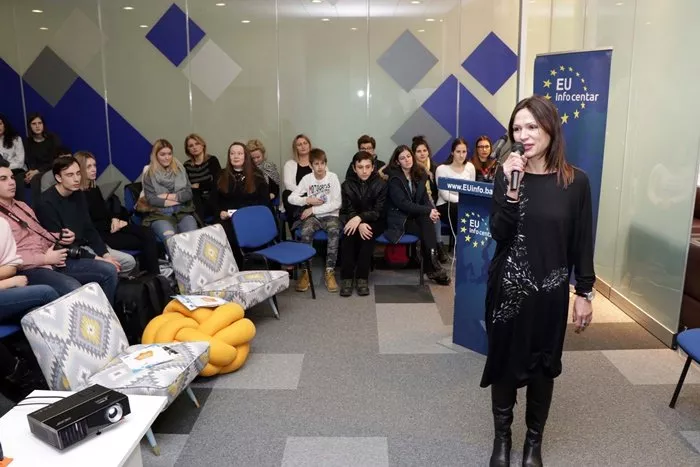
(Patria) - So far, Biljana Begović has conducted professional orientation tests for over 500 primary and secondary school students in BiH. Before BiH, she worked with children in Belgrade, where she tested over 1,500 students. Currently, she conducts testing privately, but believes it should be a widespread practice accessible to as many children as possible.
Thanks to the EU Delegation in BiH, over 200 students received free testing. With the support of World Vision, we tested over 100 students. That is very little; professional orientation should be part of formal education and supported by the state. Otherwise, apart from projects supported by representatives of the international community, mostly those who have money have the opportunity to be tested, says Begović.
In her work, she says she uses a battery of tests for general and specific abilities, personality tests, learning styles, etc. There is also a structured semi-standardized questionnaire, and an interview with students and parents. Through the interpretation of the tests, she determines the general and specific abilities and preferences of students for choosing future professions or continuing their education. Students receive a list of 10-15 professions that match their abilities, with the top 5 on the list being recommended as choices for future education.
- These are tests that show the level of intelligence and abilities of each individual. The obtained results show which professions a child has the most affinity for when choosing their education. Of course, this does not mean that you can finish school without studying, but it is certain that if children and parents listen to the advice, children will go through school with much more satisfaction and success. Parents will have less burden. The problem with the entire Balkans is that sometimes parents have their own wishes and expectations that they want to fulfill through their children, directing them towards their own wishes for further education. For this reason, this test is important because it will show them where they should not direct their child, as it is very important in their future life and work that children do what they love. It is important that they are satisfied and happy through their work and life, said psychologist Begović.
What and where after primary and secondary school? This is a decision that burdens a large number of young people, and especially their parents. Choosing the right profession in a society like Bosnia and Herzegovina is very difficult. Students and parents are torn between the needs of the labor market, their own desires, possibilities and abilities, and the limited offerings, especially in secondary schools. Unfortunately, the final decision is least related to the child's actual psycho-physical abilities, which are decisive for the success of what we do and what we learn.
On the other hand, the problem lies in the educational system, which lacks an adequate system for professional guidance and counseling. Instead, students are presented with the needs of the labor market, the offerings of secondary schools and faculties, and tests are conducted that indicate students' personal inclinations. This is, as Begović says, certainly useful, but by no means sufficient for making a quality decision about choosing a future profession.
- The decision about choosing a profession is certainly up to the students, young people, and parents. The freedom to choose a profession and a job, after all, is one of the basic rights of every human being. What I do is a process by which individuals are directed towards areas of work that best suit their psychophysical abilities, personality traits, and professional interests. This can certainly benefit society as a whole. Professional orientation is of great importance in forming an appropriate attitude towards work, creating a professional spirit and satisfaction in future work, emphasizes Begović.
Previous research has shown that in the Western Balkan countries, 75% of a generation qualifies for enrollment in higher education institutions. Almost all young people who qualify for enrollment in higher education institutions enroll in studies. However, only 20% of those who enroll in higher education institutions find employment in their field. This means that 55% of a generation is educated for the wrong professions. This is a frighteningly large number. The situation in the Western Balkans does not differ from that in Western European countries. Wrong directions are expensive, paid for by: parents who finance studies, the state which finances the education of a large portion of students and maintains enormous educational capacities in higher education institutions, and the economy which must further train academically educated citizens so they can work in companies. Precisely because of this, in some developed countries, professional orientation is an integral part of primary education, which allows for continuous monitoring of the development and abilities of each student. Given the situation in BiH, it is difficult to expect that something like this could be implemented soon in our educational process.
Precisely because of this, psychologist Begović has a great desire to establish a Center for Professional Orientation and Family Support in Bosnia and Herzegovina as an adequate alternative solution in this area, which is certainly not new in the world.
- Such a Center would have multiple benefits. In addition to testing students, instructive classes would be organized to strengthen young people's capacities necessary for understanding and researching the labor market, as well as developing skills necessary for presenting their abilities as effectively as possible. In addition, the Center would have a counseling role through family support in solving various problems, primarily socialization and motivation in young people, as well as improving learning and work results, to professional support in resolving crisis situations, says Begović.
According to Biljana Begović, such a Center could provide services on a commercial basis, but it would be much better to develop a model in partnership with state institutions whereby such services would be available free of charge, at least to socially vulnerable families.
Komentari (0)
Prijavite se za komentiranje
PrijavaJos nema komentara. Budite prvi!
Minuta
Sve →Iz drugih kategorija

High Representative Not Elected: Germans, French and British Sabotaged Americans, New Attempt at End of June

ČOVIĆ WITHOUT MERCY: How Those Who Brought Ademović to Office Created a Political Hell for Him



Sunny Saturday, quite warm



Tragedy in Albanian resort: Two minors drown












