
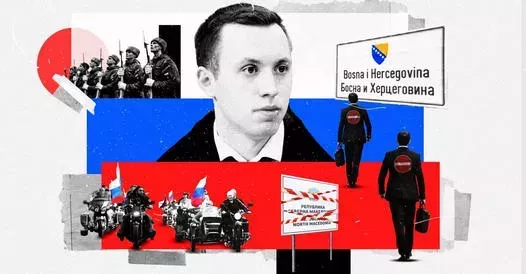
By: Detektor/Nino Bilajac, Nermina Kuloglija-Zolj
April 2022, and Russian Ambassador Sergey Bazdnikin was summoned to the premises of the Ministry of Foreign Affairs of North Macedonia. He was handed a diplomatic note stating that six diplomats were persona non grata in that country and would have to leave its territory within the next five days.
Among them was the name of Ilija Serov, press attaché of the Russian Embassy in North Macedonia.
As early as April 8, Serov told a local media outlet that the expulsion of five Russian diplomats from North Macedonia would not go unanswered, and seven days later, Serov himself was among the group of six new Russian diplomats expelled by the authorities in Skopje after the invasion of Ukraine began.
A statement from the Ministry of Foreign Affairs of North Macedonia dated April 15 specified that the Russian diplomats were expelled based on information indicating they were carrying out activities contrary to the Vienna Convention on Diplomatic Relations. The statement did not name the diplomats, but publications by a Russian biker group revealed the identities of at least one of them.
The Russian diplomats were given five days to leave North Macedonia.
A year after being expelled from Skopje, in May 2023, the twenty-five-year-old Serov appeared at a celebratory concert of the Sarajevo Philharmonic Orchestra in Vijećnica on Victory Day over Fascism, attended by representatives of the international community and domestic authorities. He was already on the official diplomatic list in BiH at that time.
The concert was organized by the City of Sarajevo and Mayor Benjamina Karić. The City Administration did not respond to Detektor's request for comment.
However, Serov is not the only Russian diplomat expelled by European countries after the invasion of Ukraine who is accredited to the Russian mission in Bosnia and Herzegovina.
Detektor journalists have identified at least one other Russian diplomat in BiH who was expelled from their previous mission in the European Union. He recently met with the director of the Service for Foreigners' Affairs to exchange information about their work.
Earlier, Radio Free Europe revealed a similar practice of expelled Russian diplomats arriving in Serbia, where they reported on the connections of two of them to Russian intelligence services.
Now, according to Detektor's investigation based on official and unofficial diplomatic sources, social media posts, and sources from security agencies, BiH is becoming a safe haven for diplomats who are unwelcome in other countries where Russian influence is less.
For Sead Turčalo, dean of the Faculty of Political Sciences in Sarajevo, this example demonstrates an internal weakness in the security system, as information about expelled diplomats can be found in open sources. The Border Police should have received intelligence data assessing these individuals as a threat to national security, Turčalo believes.
“The fact that such individuals cross the BiH border, reside in BiH, speaks to the lack of this system, meaning the possibility that some key structures have been penetrated by pro-Russian, so-called agents, or pro-Russian actors,” he says.
“This is a task that falls under what we call ‘hybrid warfare’ and represents a serious security challenge for BiH, which BiH is actually more or less unaware of,” Turčalo adds.
From Expulsion to Reception in Sarajevo
Detektor tracked Serov's journey from North Macedonia with the help of posts from the Macedonian leader of the “Night Wolves” – a pro-Putin motorcycle club under Western sanctions.
This biker club decided to organize a send-off for the expelled Russian diplomats, and its members accompanied them all the way through North Macedonia.
“These Russian diplomats and their families are persona non grata for the Macedonian authorities, and for us, they will always be good people and our friends regardless of the circumstances. We brought them safely to the Macedonian-Serbian border, wished them a safe journey, health, success, happiness, and hope to see them again in better times,” reads a post by the leader of the Russian biker club.
Earlier, Detektor uncovered close political ties between members of this club's branch in Bosnia and Herzegovina and the authorities in Republika Srpska, and the club played a significant role in the annexation of Ukraine's Crimea region and the secession of certain Ukrainian regions back in 2014.
Detektor determined that Ilija Serov is in photographs that were published at the time on the Facebook profile of Lenin Jovanovski, the leader of the “Night Wolves” in North Macedonia. Jovanovski declares himself a Macedonian nationalist and a great admirer of Russia and Vladimir Putin.
His social media posts show him attending biker gatherings that glorify Russia, moto parades in Crimea and Serbia, and at one of the gatherings in Crimea, he rode shoulder-to-shoulder with Putin.
Neither the Ministry of Foreign Affairs of North Macedonia nor the country's embassy in Sarajevo responded to Detektor's inquiry to confirm Serov's expulsion and request for comment.
For Vladislav Davidzon, an expert on post-Soviet history and a fellow at the Atlantic Council, Russian intelligence and security services remain deeply involved in operations in the Balkans and continue to explore weaknesses across the region.
“As the European Union has exerted pressure within EU member states, sending many of them home to Russia, and making it harder for Russian spies to operate using diplomatic cover – the Russians have shifted resources to countries on the periphery of the EU, where they can continue to operate more or less freely,” Davidzon explains.
“The BiH case is particularly sad for many of us who care about Ukraine and Western cohesion,” he adds.
Serov is currently an attaché at the Russian embassy in BiH, according to information from the official BiH diplomatic list.
Elmedin Konaković, the Minister of Foreign Affairs of BiH, who compiles diplomatic lists, has not responded to multiple inquiries from Detektor, sent over several months, regarding the data of Russian diplomats. Therefore, it was not possible to officially confirm the identities of the two Russian diplomats.
Detektor, with the help of an unofficial source in North Macedonia familiar with the details, confirmed Serov's biographical data, which matches the data from two independent sources in BiH.
“People working in the intelligence services of the Russian Federation are part of the diplomatic corps,” says Turčalo, adding that BiH's foreign policy should be reshaped through such a message.
“They prevent BiH from pursuing an independent foreign policy, influencing electoral policy in a certain segment, or focusing on the political opposition, which is generally something that members of Russian intelligence services, who are there in the capacity of diplomats, do in various countries,” Turčalo believes.
Haven for Diplomats Unwelcome in the EU
One of the diplomats now in BiH, Anton Sokolov, was expelled by Croatia. As confirmed to Detektor by a European diplomatic source and a security source in BiH, Sokolov was among the 18 diplomats expelled by Croatia on April 11, 2022.
His name is among the Russian officials on Croatia's diplomatic list from April 2022. At that time, he held the position of second secretary. However, his name is not on the list published a year later.
The name Anton Sokolov, as seen in publicly available data, is listed on the diplomatic list of the Ministry of Foreign Affairs of Bosnia and Herzegovina from May 2023, where it states that he has been appointed to the position of first secretary of the Embassy of the Russian Federation. This is his second term in BiH.
According to the annual report of the Croatian intelligence service, one of the reasons for expelling Russian diplomats was covert and illegal intelligence work in Croatia.
This document did not publish the names of the expelled diplomats, and the Croatian Embassy in BiH and the intelligence agency did not respond to requests to confirm Sokolov's identity, while the Ministry of Foreign Affairs of that country stated in its response that information could be requested from the Russian Embassy in Croatia.
Detektor also tracked Sokolov's movements through social media posts by his wife, Ana Sokolova. Her name was listed with Anton Sokolov's in 2019 on the BiH diplomatic list, as Sokolov was then second secretary of the Russian mission in Sarajevo. After that, her name was not listed in subsequent years.
During his first term, he attended screenings of films with Russian war themes, anniversary commemorations, and gatherings of the “Immortal Regiment” in memory of the Red Army.
Publicly available data, confirmed by Detektor from two independent sources in BiH, shows that Sokolov went from BiH to Croatia, from where he was expelled after the start of the Russian invasion of Ukraine.
According to publicly published photographs and tracking Sokolova's profile, it is possible to determine these movements. In Petrovo in 2017, they both attended the opening of the Russian Film Festival. During that period, Sokolova posted photos from numerous cities and mountains in BiH.
Ana Sokolova, as seen on Instagram, posted a photo from Varaždin, Croatia, on April 17, 2022.
Nine days later, or 15 days after Croatia decided to expel Russian diplomats, Sokolova announced on the same platform to her followers about her third move in a year.
As she stated, 1.5 tons of personal belongings were packed, followed by 24 hours in the car.
In one of the responses to comments on that post, Sokolova also revealed that the family had undergone checks at the border with Poland, and in the next, she specified that the family had returned to Moscow.
Further posts by Sokolova suggest that the family spent a period in Russia. This continued until January 21, 2023, when Sokolova posted a new photo from Bosnia and Herzegovina.
Ana Sokolova did not respond to a request for an interview sent to her Instagram profile.
Numerous European Union countries expelled dozens of unwelcome Russian diplomats after the start of Russia's invasion of Ukraine in February 2022. Russian embassies had to reduce their missions or replace expelled diplomats with new ones.
In Bosnia and Herzegovina, the Russian mission is growing. The opening of a consulate in Banja Luka is expected soon, and one diplomat on the list of Russian diplomats in BiH is already registered as an employee of the consulate, which has not yet officially opened. It has not yet been announced where the consulate will be located. At the same time, a Russian church, one of the largest in the Balkans, is being built in Banja Luka.
Davidzon believes that Russia's ultimate goal, in the long term, is to keep parts of the post-Yugoslav space not integrated into the EU and NATO – BiH, Serbia, Kosovo, and others – from moving in a Euro-Atlantic direction in the future.
“BiH remains very important as a place from which they can spy on Croats, Serbs, and Kosovars,” says Davidzon.
Earlier research by Radio Free Europe revealed that the Russian mission has also increased in Serbia, where at least three diplomats have found refuge after hundreds were expelled from EU member states or placed on a “blacklist,” with several countries citing suspicions of espionage as the reason. RSE reported that there are now 62 diplomats on the list in Serbia, compared to 54 in March 2022.
After being expelled from Croatia, Sokolov was received by the director of the Service for Foreigners' Affairs in July this year. According to a news item on the Service's website, Director Žarko Laketa informed Sokolov and another Embassy employee about the challenges of working with migrants, as well as the Service's organization, projects, and results. The report states that Sokolov thanked Laketa for the exchange of information he received from him and emphasized the importance of “further maintaining the established professional ties and relations between the Service and the Embassy.”
The Service for Foreigners' Affairs did not respond to the part of the inquiry requesting comment on the meeting with Sokolov, and in a written response, they explained that they are not competent to act towards diplomats and that the Ministry of Foreign Affairs handles that.
“In this case, when you have a person whom another country considers an active intelligence officer, whom the intelligence service of his country protects in various ways, and you do not have adequate counter-intelligence work in the country, then it is possible for him to meet and attend various events, talk with anyone, and thus gather appropriate information without the interlocutor perceiving him in any way other than as an ordinary diplomat,” says Turčalo.
The Ministry of Foreign Affairs of BiH has not responded to Detektor's inquiry as to whether BiH has expelled Russian diplomats. Official statements from the Ministry do not indicate that this has happened since the beginning of the Russian invasion of Ukraine, while the authorities of Republika Srpska, led by Milorad Dodik, continue to maintain close relations with the Russian authorities.
The Intelligence Agency also did not respond to whether they conducted any checks on the two diplomats who arrived in BiH.
Turčalo says that the Ministry of Foreign Affairs, precisely considering that these individuals were expelled – one from an EU member state and the other from North Macedonia – should have prevented them from being part of the diplomatic corps.
“They should have – precisely through their channels and the fact that they give approval – prevented such a person from being part of the diplomatic corps,” Turčalo believes.
The Embassy of the Russian Federation in BiH did not respond to the inquiry for comment or the request for an interview with Serov and Sokolov.
Komentari (0)
Prijavite se za komentiranje
PrijavaJos nema komentara. Budite prvi!
Minuta
Sve →Iz drugih kategorija

High Representative Not Elected: Germans, French and British Sabotaged Americans, New Attempt at End of June

ČOVIĆ WITHOUT MERCY: How Those Who Brought Ademović to Office Created a Political Hell for Him



Sunny Saturday, quite warm



Tragedy in Albanian resort: Two minors drown












