
By: A. Čorbo-Zećo
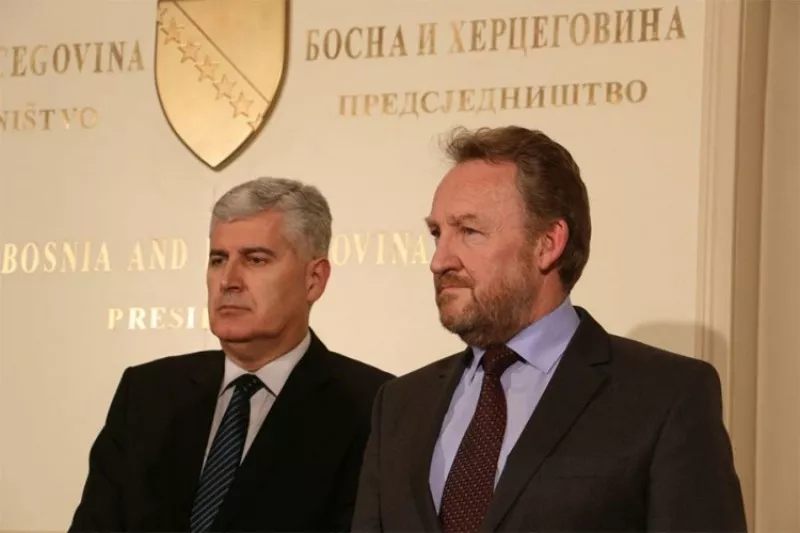
President of HDZ BiH Dragan Čović stated that he exchanged proposals for the formation of state government with the presidents of SDA and SNSD, and that in the next few days, the three parties will appoint one representative each who will harmonize the joint content of that statement.
Bakir Izetbegović, president of SDA, said yesterday that they had an agreement that SDA would offer a proposal for a statement, and that the statement was given and he received answers from HDZ and SNSD.
He added that they are "very close" to an agreement and expressed hope that the agreement will happen as early as the beginning of next week, which would be a prerequisite for the formation of the Council of Ministers.
However, there are still many uncertainties on paper, according to Patria's interlocutors. A major problem in the formation of the Council of Ministers and the distribution of portfolios will be the Ministry of Finance. Čović openly demands to remain the sovereign ruler of finances in BiH, while SDA, as things stand now, is not agreeing to such a distribution. Čović stated at the last press conference that HNS parties will "insist on the Ministries of Finance and Foreign Affairs in negotiations at the state level, and the Ministry of Justice could also fall to them."
"We are flexible there, and these first two ministries mentioned are something else," Čović said.
SDA is no longer willing to cede the Ministry of Finance to HDZ, "and they are no longer flexible there."
If the principle of rotation based on ethnic affiliation is applied, as in the case of the Chairman of the Council of Ministers, the distribution of ministries should be different compared to the previous term.
In that case, Bosniaks should get the Ministry of Finance and Treasury, the Ministry of Foreign Trade and Economic Relations, and the Ministry of Justice. Croats should get the Ministry of Foreign Affairs, the Ministry of Security, and the Ministry of Civil Affairs. Along with the head of the Council of Ministers, according to this principle, ministers from the Serb people should head the Ministry of Defense, the Ministry of Communications and Transport, and the Ministry of Human Rights and Refugees.
In some of the most important ministries, Bosniaks have not had ministers for more than a decade, such as the Ministry of Finance. This was the distribution of ministerial positions in the Council of Ministers in the last three terms:
The Ministry of Finance in the 2006-2010 term was led by Dragan Vrankić from HDZ, and in the 2010-2014 term, he was succeeded by Nikola Špirić from SNSD. Vjekoslav Bevanda headed this ministry in the period 2014-2018.
The Ministry of Defense from 2006 to 2010 was led by ministers from SDA, Selmo Cikotić and Muhamed Ibrahimović. In the 2010-2014 term, Zekerijah Osmić from SDP headed this ministry. In the current 2014-2018 term, Marina Pendеш from HDZ BiH heads the Ministry of Defense.
The Ministry of Foreign Affairs was led by Sven Alkalaj from the Party for BiH from 2006 to 2010, and he was succeeded by Zlatko Lagumdžija from SDP (2010-2014). In the 2014-2018 term, the head of BiH diplomacy is Igor Crnadak from PDP.
Since December 23, 2002, when the term of Azra Hadžiahmetović ended, no Bosniak has headed the Ministry of Foreign Trade and Economic Relations. In the last three terms, this ministry has been led by ministers from the Serb people, and from 2002 to 2006, this ministry was managed by cadres from HDZ BiH. In the 2006-2010 term, Slobodan Puhalac and Mladen Zirojević from SNSD shared the leadership of the MVTEO. Zirojević headed this ministry in the first half of the 2010-2014 term. Due to political turbulence, Mirko Šarović from SDS led it for eight months, and from October 2013 until the end of that term, Boris Tučić, also from SNSD, was in charge again. In the 2014-2018 term, the Minister of Foreign Trade and Economic Relations is Mirko Šarović from SDS.
In the last three terms, the Ministry of Security has been led by ministers from the Bosniak and Serb peoples. For most of the 2006-2010 term, Tarik Sadović from SDA headed this ministry, but he was dismissed in July 2009. He was succeeded by his party colleague Sadik Ahmetović, who also headed the Ministry of Security for the first two years of the 2010-2014 term. Fahrudin Radončić from SBB was then appointed to this position. The Ministry of Security in the 2014-2018 term was headed by Dragan Mektić from SDS.
For most of the 2006-2010 term, Božo Ljubić from HDZ 1990 headed the Ministry of Transport and Communications, and was succeeded by Rudo Vidović towards the end of the term. Vidović remained at the head of the Ministry until 2012, even though the elections were in 2010. He benefited from the fact that the formation of the Council of Ministers took 16 months at that time. Vidović was succeeded by Damir Hadžić from SDP, who headed the Ministry until the end of the term. In the period 2014-2018, the Ministry was first led by Slavko Matanović from DF for one year, and from 2016 until the end of the term, by Ismir Jusko from SBB.
Since its formation in 2003, the Ministry of Civil Affairs has seen Bosniaks and Serbs alternate at its head. In the first term, this ministry was led by Safet Halilović from the Party for BiH. In the 2006-2010 and 2010-2014 terms, Sredoje Nović from SNSD headed the Ministry. In the last term, 2014-2018, Adil Osmanović from SDA led this ministry.
The Ministry of Human Rights and Refugees in the 2006-2010 term was led by Safet Halilović from the Party for BiH. Damir Ljubić from HDZ 1990 led the ministry in the 2010-2014 period. The current minister (2014-2018 term) is Semiha Borovac from SDA.
For more than a decade and a half, no minister from the Bosniak people has headed the Ministry of Justice. In the period 2002-2006, Slobodan Kovač from SDS headed the Ministry. From 2006 to the present day, this ministry has been run by cadres from HDZ BiH. Bariša Čolak spent the 2006-2010 and 2010-2014 terms at the head of the Ministry of Justice. Josip Grubeša from HDZ is currently heading this ministry.
It remains to be seen how much the parties negotiating the formation of the Council of Ministers will adhere to the principle of constitutive rotation.
Komentari (0)
Prijavite se za komentiranje
PrijavaJos nema komentara. Budite prvi!
Minuta
Sve →Iz drugih kategorija

High Representative Not Elected: Germans, French and British Sabotaged Americans, New Attempt at End of June

ČOVIĆ WITHOUT MERCY: How Those Who Brought Ademović to Office Created a Political Hell for Him



Sunny Saturday, quite warm



Tragedy in Albanian resort: Two minors drown












