
Written by Sead Omeragić
At the beginning of the war in 1992, Bosnia and Herzegovina began to be systematically looted. Entire factories were dismantled and transported across the Drina, and some factories from eastern Bosnia were moved to Montenegro. A thorough inventory and analysis of this looting has never been made.
The attitude towards the property of the citizens of this country, who in the former system were the owners of those factories, was like that towards Alajbeg's straw. Both nations and individuals were at a loss.
What is happening two and a half decades later? The wealth of this country is still being seized by neighbouring states, on the principle: If they across the border are the owners of our values, then the state will also be common. In peacetime, military conquest policy has been replaced by miserable and losing great-state economic strategies. These great-national strategies took whatever they could get their hands on.
At the same time, entity rulers were dividing this country, threatening it with partition, halting the arrival of necessary foreign investments, and openly, without criteria and at a pittance, offering their values to brethren from across the border. Nothing unusual for a narrow circle of power holders, as most of them have huge properties in neighbouring Serbia and Croatia.
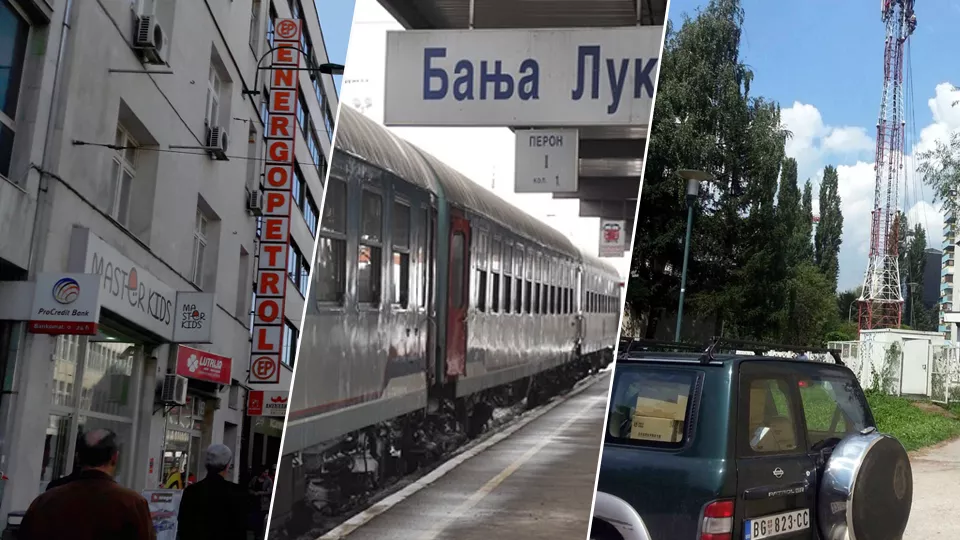
When one's own needs are satisfied and aligned with great goals, that should be a successful strategy. That is how the entity telecom operator was bought. Telekom Srbije, with the help of the Government of Serbia and then-Prime Minister Boris Tadić, took out an expensive commercial loan to buy Telekom Srpske. The money from that sale was soon squandered, numerous workers were laid off as surplus, and today there is nothing left of that value for the local people. In Serbia, it is said that for the loan of about 540 million euros to buy Telekom Srpske, more than 800 million euros have been repaid through constant rescheduling. It is cynically claimed that the money paid into the accounts of the RS Government was spent before they managed to repay the expensive loan in Serbia with which they bought the great Serbian telecommunications.
The same is true with telecommunications, which the Republic of Croatia wanted to dominate in BiH.
Let's say it is a matter of ordinary market conquest for profit. In Sarajevo, a series of privatisations and buyouts have been made by state-owned companies from the Republic of Croatia. These privatisations are affectionately called recapitalisations, because there is no law allowing state-owned companies from neighbouring countries to buy companies owned by another state.
Thus, for small money, mostly in an obvious fraud, the Mol-Ina consortium bought Energopetrol, the only BiH state-owned oil distributor. Of course, like all purchases of companies in Sarajevo and BiH, it could not happen without domestic power holders and sold souls, in whom huge sums of money were later discovered. Energopetrol is just an example. Dozens of state-owned companies in the capital were bought for a mark, and doors were opened wide for miserable private commissions.
Just as companies were sold, so were natural resources. In the Republika Srpska, everything is given to Serbia. Like Telekom once, the Railways of Srpska are intended to be sold for the so-called Greater Serbia. If anything is paid to save the entity from bankruptcy, it will certainly be for some new loan from the state of Serbia. Of course, such transactions would have to be overturned at the Constitutional Court of BiH. As in the case of the money from the entity telecom, this money will leak out even faster.
Buško Lake has been giving water for free to the HE Orlovac in Croatia for almost three decades.
Both Serbia and Croatia have long been in a financial bubble. Economists say that both will have to repay installments of over 6 billion euros just this year. That is three times the total external debt of Bosnia and Herzegovina, which is otherwise at the bottom of Europe.
We are in a situation where we are neighbours with two Greek syndromes, who are pouring out their economic strategy here for a general and complete collapse.
When, in a few years, the pockets of Greater Serbia and Greater Croatia are finally emptied economically here, not a stone will be left unturned. Seeking entities and "marking" one's territory is one thing. It is quite another to squander the values that mean the possibility of a decent and normal life for one's citizens. What will the dividers of this country do with territory without resources, factories, and their own valuable national companies?
The question is appropriate, but those asked, it seems, do not ask themselves anything.
Komentari (0)
Prijavite se za komentiranje
PrijavaJos nema komentara. Budite prvi!
Minuta
Sve →Iz drugih kategorija

High Representative Not Elected: Germans, French and British Sabotaged Americans, New Attempt at End of June

ČOVIĆ WITHOUT MERCY: How Those Who Brought Ademović to Office Created a Political Hell for Him



Sunny Saturday, quite warm



Tragedy in Albanian resort: Two minors drown












