
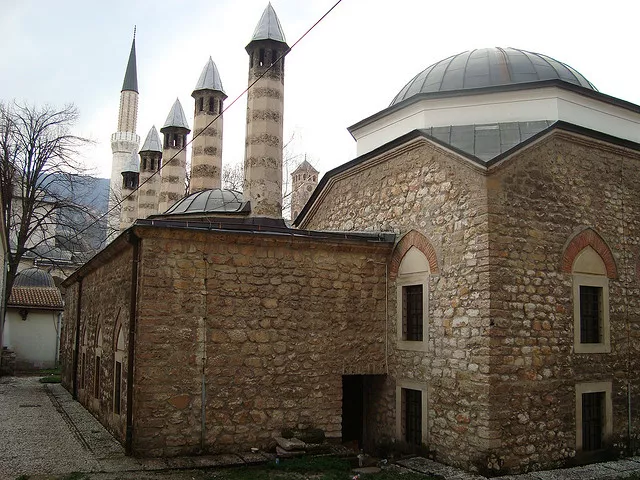
Gazi Husrev-beg Madrasa was founded on January 8, 1537, by the wise and far-sighted Gazi Husrev-beg, son of Bosnian nobleman Ferhat-beg. The mother of Gazi Husrev-beg, Seldžuka, was the daughter of Sultan Bayezid II. The madrasa was initially named "Seldžukijja", and later became known to the people as "Kuršumlija" (due to its roof covered with a lead casing). Naturally gifted, as children of this land often are, Gazi Husrev-beg was educated in elite schools and associated with princes. The knowledge he acquired, his proven courage, and noble heart enabled him to pursue a successful career as a bey, achieve great fame as a ghazi, and leave an indelible mark on history as a waqif: as a sanjak-bey he ruled Albania, Serbia, and Bosnia; as a hero he distinguished himself in Montenegro, Hungary, and Croatia; as a waqif he built mosques and tekkes, imarets and musafirhanas, bridges and inns, hammams, fountains, and shadrvans, schools and libraries, and he left all his properties in Bosnia, Slavonia, Dalmatia, and Greece for the benefit of the people. Thus, Gazi Husrev-beg gave a strong impetus to the development of the religious, economic, and cultural life of this city, this country, and this people, reports the Bosnian news agency Patria.
The building of Gazi Husrev-beg Madrasa was conceived as a multifunctional and representative structure, with the central space dedicated to teaching (dershana), while the rows of wing rooms were given a residential character. By the decision of the founder himself, the madrasa was placed in the very heart of the Sarajevo bazaar, and its design was entrusted to the then leading architect of the Ottoman Empire, the Persian Adžem Esir Ali.
According to his plans, the madrasa was built by Dubrovnik masters and local builders from Bosnian stone and lead. The compact, harmonious, and monumental building, completed in 1537, became and remains one of the symbols of Sarajevo. All subsequent additions and repairs to this day have adhered to the same concept. With the madrasa building, Gazi Husrev-beg rounded off the complex of endowments that would become the future religious, educational, and cultural center of Bosnia.
Based on its character (subjects studied, the reputation of the founder, the duties its graduates could perform, the salary of the muderris and other employees, etc.), it can be concluded that this Madrasa was a higher educational institution during the Ottoman Empire. The professors of Gazi Husrev-beg Madrasa were selected according to strict criteria prescribed personally by Gazi Husrev-beg in the founding document (waqfiyya), which included expertise, pedagogical experience, and human qualities. Many competed for the very demanding, prestigious, and, due to the high salary, attractive professorial position. The best were chosen. Among them were Arabs, Turks, Albanians, and Bosniaks, with Bosniaks naturally being the most numerous.
The students of Gazi Husrev-beg Madrasa, by the founder's decision, had modern instruction, distinguished professors, comfortable accommodation, and healthy meals. Enjoying high standards and studying diligently, they attained prestigious titles and high positions. They became: qadis, qadiaskers, sheikh ul-Islams; imams, muftis, reis-ul-ulemas; professors, scientists, academics; mayors, diplomats, ministers, and statesmen.
Gazi Husrev-beg Madrasa consists of two buildings, a male and a female madrasa, with the necessary classrooms and cabinets, as well as accommodation for male and female students. The male madrasa building is located in Baščaršija, near the Bey's Mosque, and the female one in Drvenija, on Hamdije Kreševljakovića Street, a 15-minute walk from the male madrasa.
Komentari (0)
Prijavite se za komentiranje
PrijavaJos nema komentara. Budite prvi!
Minuta
Sve →Iz drugih kategorija

High Representative Not Elected: Germans, French and British Against Americans, New Attempt at End of June

ČOVIĆ WITHOUT MERCY: How Those Who Brought Ademović to Office Created a Political Hell for Him



Sunny Saturday, quite warm



Tragedy in Albanian resort: Two minors drown












