
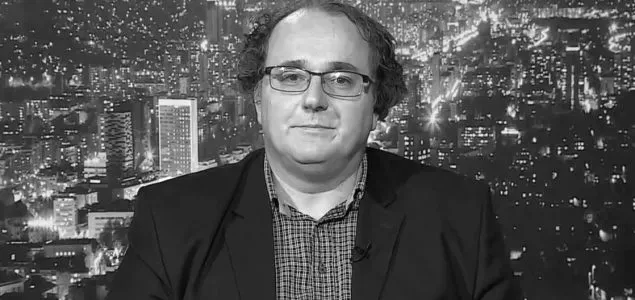
By Vahidin Preljević/Tacno.net
In the political and social dynamics of a community, one of the decisive factors is the dominant imagination, the inner image or idea of what the reality we want to live in should be like. Cornelius Castoriadis, a great and insufficiently recognized Greek-French thinker, called this subconscious fund the archetypal image, essentially the utopian core from which hope for a better and more just life, dreams of a bright future and a golden age, myths and legends, spring, which are in their basic structure inscribed in the collective consciousness and determine how we answer those fundamental questions: where do we come from and where are we going?
This "archetypal image" and structure of collective imagination is largely conditioned by shared historical experience, very often precisely by the mental energy that accumulates due to suffered injustice, and it differs from community to community in the character of its frameworks and values. It moves along convoluted paths of collective consciousness, manifesting itself in various practices and spheres of communication, from everyday speech to political rhetoric.
We are defined by what we dream of, and we dream predominantly of what we lack. Namely, when politicians or other bearers of public discourse talk about wanting a normal or just state, European standards, prosperity, etc., they, most often manipulatively, sometimes sincerely, appeal to the awareness of this lack: the political and social order of Bosnia and Herzegovina, which is based on corrupt ethnocracy (where it should be emphasized that the ethnocratic system is a prerequisite for corruption and is intrinsically linked to it), segregation, and apartheid, is in radical disharmony with what the majority of the population considers normal, just, and good.
This gap between ideals and reality naturally occurs more or less in all cultures, but it is rarely as deep as it is here, and in that sense, it probably fundamentally determines our political mentality.
The idea of "civic democracy" is an attempt at political articulation of that age-old dream of a just state of equal and free people.
Proponents of this idea act on the stage of political life sometimes convincingly, sometimes unconvincingly, and sometimes as populist demagogues. However, even those who criticize it, and are not, like Dodik and HNS, openly proponents of segregation and ethnic enclaves, most often say that they have nothing against the idea, but that it is unrealistic, that it is a vain utopia or a dream that will never come true, and that on the ground, one must, somehow or other, make arrangements.
These days, that "dream" has gained additional momentum and confirmation of its validity in the latest ruling of the European Court of Human Rights, following the lawsuit filed by Slaven Kovačević, the details of which we will only know in a few days. However, based on what has already surfaced in the public, it is clear that this ruling represents the most radical legal intervention in the existing system of discrimination (an intervention in the sense that the decisions of the ECtHR, under whose jurisdiction Bosnia and Herzegovina also falls, are binding for this country to an equal or even greater extent than the decisions of the Constitutional Court).
The "Kovačević ruling" accumulates insights from all previous rulings before this court: it unequivocally confirms that the political order in BiH is fundamentally unjust and anti-civilizational and that it must be changed from the root: ethnocentric (or legitimate) representation in the electoral system, as well as the concept of ethnically exclusive spaces (see Republika Srpska), Houses of Peoples, and the election of the Presidency member are anomalies in what we like to call the civilized world.
In the process of "European integration," which is the proclaimed common goal of all political elites in the country, all ECtHR rulings must be implemented. If party leaders and "pragmatic" international mediators could evade and make Solomon-like deals in Neum and elsewhere regarding the implementation of the Sejdić-Finci and other rulings, their room for maneuver in manipulation is now significantly narrowed.
Thus, dreams of a civic state cease to be "just dreams," they are no longer just a regulative principle for a few enthusiasts, but become the official destination towards which Bosnia and Herzegovina strives in its historical journey. How long this movement will last is certainly uncertain, but the goal cannot be changed.
Dreams are never just dreams, Arthur Schnitzler will write at the end of his Dream Story.
Finally: The fight for the interpretation of the ruling is yet to come, although its semantic framework, based on what we know now, is quite clear. As are its political implications. What must not be allowed is the devaluation of this historic ruling in public discourse and political action. Attempts at relativization are already underway, and the most regrettable thing is that they partially come from political Sarajevo and from the commentator milieu close to the ruling parties.
They and all other relevant political actors must be aware that the path to "normality" is inevitable, that the European future, which they otherwise like to talk about, is inextricably linked to the "Kovačević ruling," and that, incidentally, it is certainly better for them to show more respect for the "dreams" that the majority of citizens of this country have, if they do not want to wake up in a nightmare.
Komentari (0)
Prijavite se za komentiranje
PrijavaJos nema komentara. Budite prvi!
Minuta
Sve →Iz drugih kategorija

High Representative Not Elected: Germans, French and British Sabotaged Americans, New Attempt at End of June

ČOVIĆ WITHOUT MERCY: How Those Who Brought Ademović to Office Created a Political Hell for Him



Sunny Saturday, quite warm



Tragedy in Albanian resort: Two minors drown












