
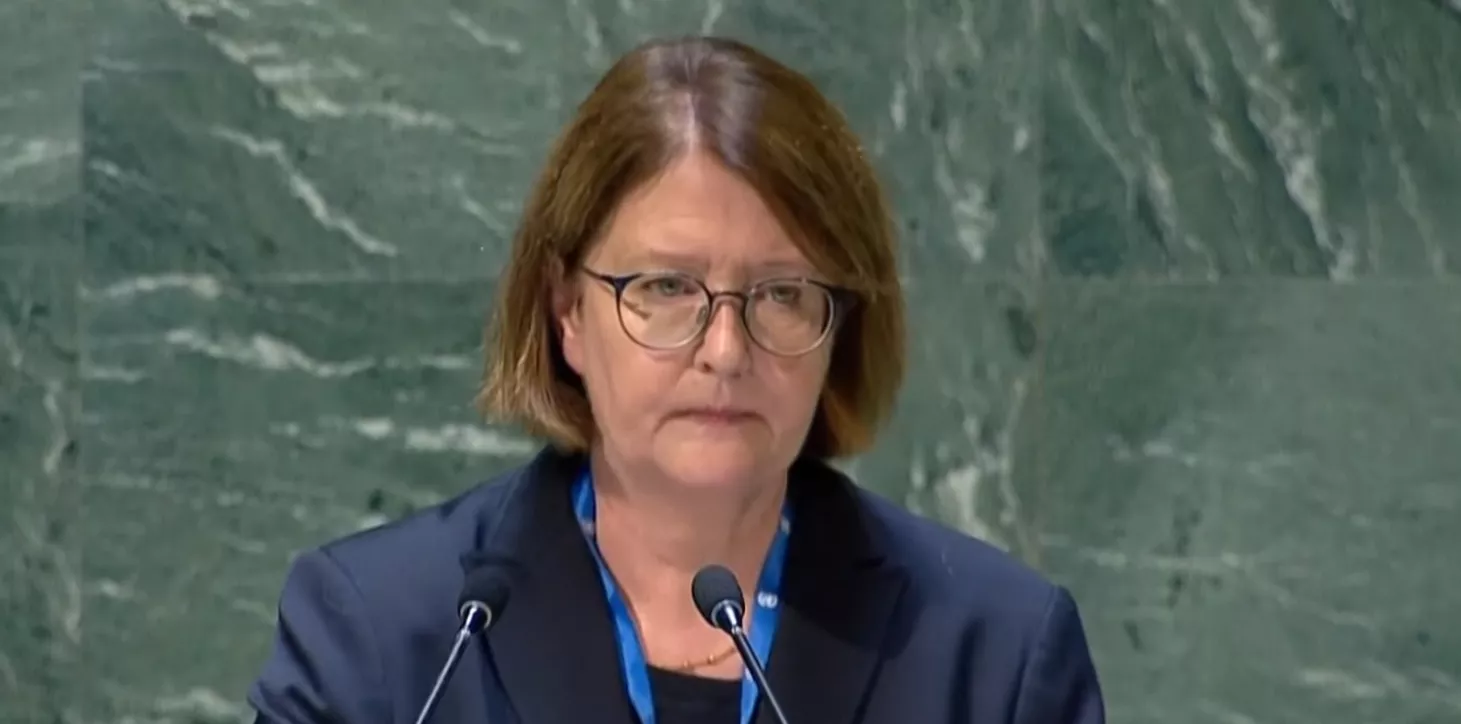
(Patria) - The UN General Assembly is currently meeting in New York, with its member states considering the Draft Resolution on the Srebrenica genocide.
The draft document was prepared by Germany and Rwanda, and Germany's representative Antje Leendertse explained the reasons for submitting the initiative for the adoption of the Resolution at the very beginning. You can read her address below.
"The United Nations was founded on the ashes of World War II – a war initiated by Nazi Germany, in which more than 60 million people died.
One of our common goals in this organization is to build a multilateral system that prevents such crimes from happening again.
We gather in this hall on numerous occasions to commemorate events that have left a deep mark on our collective consciousness. These failures must never be repeated.
Or as the Spanish-American philosopher George Santayana said: 'Those who cannot remember the past are condemned to repeat it.'
It is my privilege to present the Draft Resolution 'International Day of Reflection and Commemoration of the Srebrenica Genocide of 1995', on behalf of the co-facilitators, Germany and Rwanda, as well as an interregional key group of 17 Member States.
Almost thirty years ago, at least 8,372 Bosniak Muslims were systematically executed in the town of Srebrenica. The executions began on July 11, 1995, and lasted for several days.
The prior designation of Srebrenica as a 'Safe Zone' in Security Council Resolution 819 (1993) could not prevent this crime from happening.
Carried out in the midst of the Bosnian War, this act of genocide led to the tragic deaths of the victims and the unimaginable suffering of the survivors and their families.
Our initiative is about honoring the memory of the victims and supporting the survivors who continue to live with the scars of that fateful time.
In addition to the genocide against the Tutsi in Rwanda in 1994, the Srebrenica genocide has been recognized as such by international courts.
The genocide against the Tutsi in 1994 is commemorated every year, following a General Assembly resolution.
By designating July 11 as the International Day of Reflection and Commemoration of the Srebrenica Genocide, we are committed to closing this gap in the institutionalized remembrance of this organization.
The resolution is modeled after the General Assembly resolution on the International Day of Reflection on the 1994 Genocide against the Tutsi.
It creates a program for dissemination to enable annual commemoration within the United Nations. And it calls on everyone to join in this remembrance and reflection.
The draft resolution also emphasizes the role of international courts in combating impunity and ensuring accountability for genocide.
And it contains language against the denial of genocide and the glorification of perpetrators – calling on Member States to preserve established facts, including through education.
To be honest – false accusations about this resolution are being spread, so I want to provide some clarification.
This resolution is not directed against anyone – not against Serbia, a respected member of this organization. It is directed against the perpetrators of genocide.
Therefore, I call on everyone to assess the text on its merits and to support our call for commemoration and reflection on what happened in Srebrenica almost 30 years ago.
The resolution enjoys strong support from a diverse group of Member States, including states from the Western Balkan region, and co-sponsors from all parts of the world.
Recognizing the importance of regional ownership and participation, the core group decided to include proposed amendments in the text, even after the draft resolution had already been submitted.
Montenegro's proposal clarifies that criminal responsibility under international law for the crime of genocide is individualized and cannot be attributed to any ethnic, religious, or other group or community as a whole.
We are convinced that this helps prevent misinterpretation and we appreciate Montenegro's constructive engagement.
This resolution seeks to foster reconciliation, in the present and in the future. We welcome the strong regional support – including from youth organizations in Serbia – for this resolution.
All ethnic groups that participated in the wars in the former Yugoslavia suffered terrible losses. We mourn all victims equally. Having said all that, I include every ethnic group that has suffered tragic losses.
That perpetrators of crimes like genocide can be held accountable is a great achievement of the international community in recent decades.
We hope that this organization will unite in recognizing the genocide that its own judicial institutions have recognized.
As Emir Suljagić, a survivor of the Srebrenica genocide and director of the Srebrenica Memorial Center, said: 'To remember is to affirm our humanity and affirm our freedom.'
What message would we send to future generations if we – the General Assembly – decided not to commemorate the victims?
If we did not reflect on the historical context and judicial processing of the crimes that occurred in Srebrenica?
I call on all Member States to give their valued support to this resolution and vote in favor – if the resolution is put to a vote."
Komentari (0)
Prijavite se za komentiranje
PrijavaJos nema komentara. Budite prvi!
Minuta
Sve →Iz drugih kategorija

High Representative Not Elected: Germans, French and British Sabotaged Americans, New Attempt at End of June

ČOVIĆ WITHOUT MERCY: How Those Who Brought Ademović to Office Created a Political Hell for Him



Sunny Saturday, quite warm



Tragedy in Albanian resort: Two minors drown












