
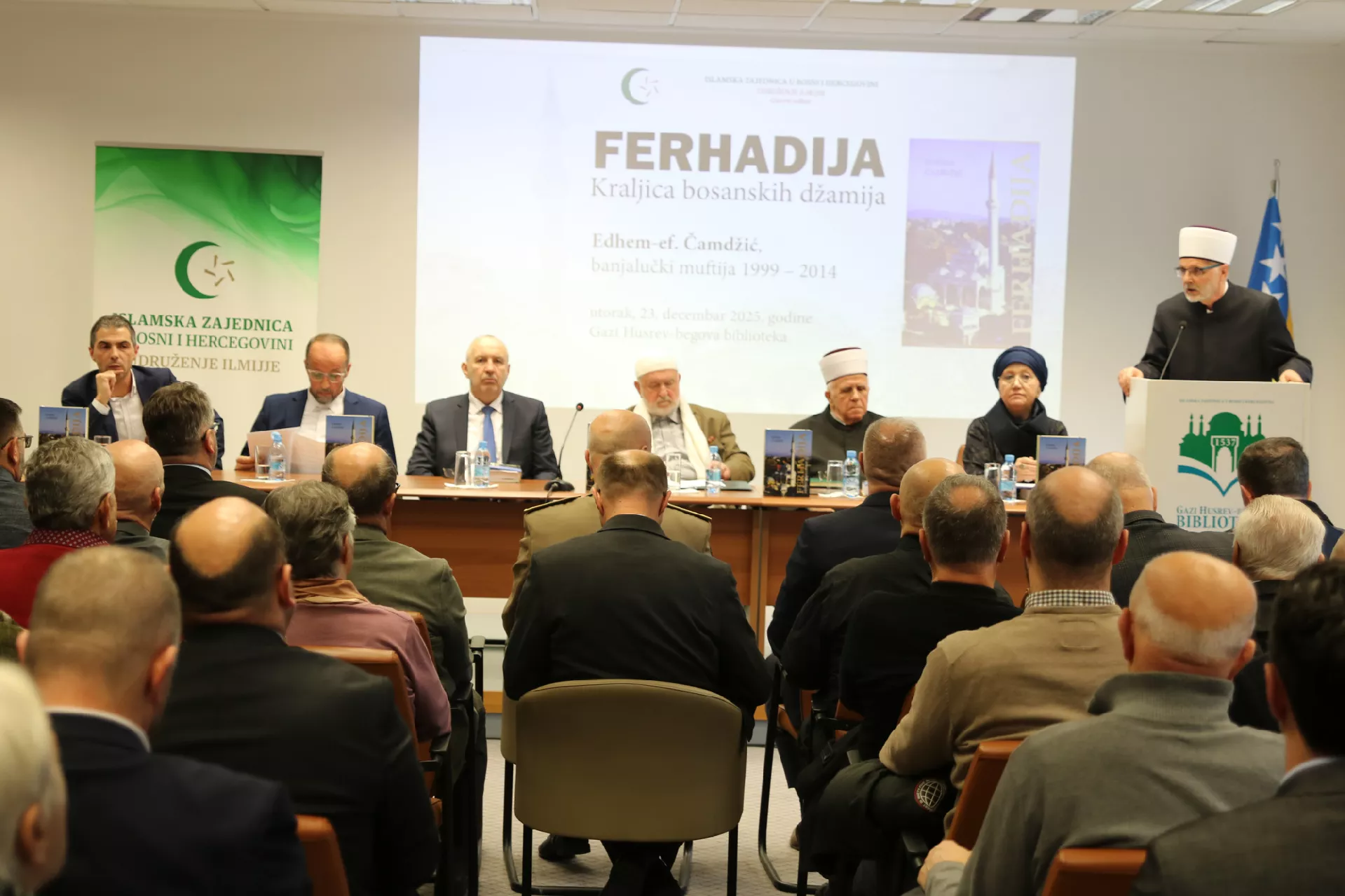
(Patria) - The book by Banja Luka mufti from the period 1999-2014, Edhem-ef. Čamdžić, titled "Ferhadija - Queen of Bosnian Mosques" was presented today at the Gazi Husrev-beg Library in Sarajevo.
The promotion was organized by the Association of Ilmijja of the Islamic Community in Bosnia and Herzegovina, and it was attended by numerous visitors, as well as representatives of religious and social life.
The book, among other things, thematizes Ferhadija as a symbol of resilience, renewal and identity of Muslims in Banja Luka and beyond.
It contains everything that Mufti Čamdžić recorded over 15 years.
- It is not something observed from a distance, not retold in someone else's words, but I, as the author, am simultaneously a witness and participant in all of it - said author Čamdžić.
The focus of the book is the Muftiship and everything that happened in this area, and it also contains a wealth of historical and geographical data.
- This book contains messages for the restorers, the destroyers, but also for the silent observers. May each of them find a message for themselves in this book - said on this occasion the Deputy Reis-ul-ulema of the Islamic Community in BiH, Enes-ef. Ljevaković.
Reis-ul-ulema from 1993 to 2012, Mustafa-ef. Cerić, pointed out that Mufti Čamdžić belongs to the group of people who remember and write, so that facts are not forgotten.
He particularly emphasized that he does not do this out of a need to be remembered, but out of a sense of emanet (trust) and awareness that what is not written down will be forgotten.
- His chronicle of Ferhadija is not a mere book, nor is it just the result of research curiosity. It is an act of testimony and a response of conscience to the violence of oblivion. It is a quiet but persistent rebellion against the erasure of the traces of a people from the face of history - assessed Cerić.
As pointed out by the Sarajevo mufti Nedžad Grabus, Čamdžić's authorial work is defined by groundedness, immediacy, principledness and orientation.
- The book is based on media and reports from governments and international organizations, on historical books and testimonies of individuals. Its groundedness is reflected in this, as well as in the fact that it is not a collection of his reflections. It is a grounded historical reader - said Grabus.
Nedim Hrbat, Executive Director of the Media Center Program of the Islamic Community, also spoke about the book. During the reconstruction of Ferhadija, as a journalist, he came to Banja Luka, participated in filming, documenting and visiting locations.
- Reporting on the reconstruction in the entity of RS, following Mufti Čamdžić and the Islamic Community in those years, the imams with whom the mufti collaborated, and numerous other people who were exposed to open hatred, physical attacks, stonings, curses, provocations, systemic obstruction, contestation, and denial, was not an ordinary job.
It was witnessing a miracle. On one hand, you had a system and atmosphere that wanted you gone, and on the other hand, people with unwavering faith and dignity. But there is that strange Bosnian gravity: the more they push you away from home, the more home pulls you back. That gravity was stronger than the logic of force - said Hrbat.
The book, Hrbat emphasized, collects texts, documents, reports and photographs. But its exceptional value lies in what "all these documents unify: it is the transition of a community from a state of 'predicted disappearance' to a state of active presence".
- It is a transition from the passive status of an 'object of oppression' to the status of a subject of history. In that sense, it is a permanent testimony that the Bosniak people possess the ability to overcome the greatest tragedies.
That people did not survive by some cosmic game of chance, but because at critical moments they had ontological defiance, pride, leaders, and institutions that refused to submit to a projected disappearance - emphasized Hrbat.
The chief imam of the Majlis of the Islamic Community of Ključ, Ermin-ef. Vučkić, spoke about the book from the perspective of a former associate of Mufti Čamdžić. In addition to presenting the content of the book, Vučkić also spoke about what preceded its creation.
- The central point of all events in this book is Banja Luka, and the central point of Banja Luka is precisely Ferhadija. This book describes in detail everything related to this city and this mosque - explained Vučkić.
Mufti Čamdžić recorded all his activities in 33 planners, and information from these manuscripts was used during the preparation of this book.
The book today stands as a testament to dedication to the homeland and the struggle for it.
Komentari (0)
Prijavite se za komentiranje
PrijavaJos nema komentara. Budite prvi!
Minuta
Sve →Iz drugih kategorija

High Representative Not Elected: Germans, French and British Sabotaged Americans, New Attempt at End of June

ČOVIĆ WITHOUT MERCY: How Those Who Brought Ademović to Office Created a Political Hell for Him



Sunny Saturday, quite warm



Tragedy in Albanian resort: Two minors drown












