
By Haris Ljevo
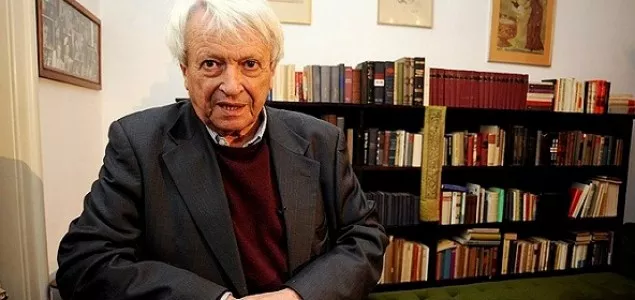
A year has passed since the death of one of the greatest intellectuals in these regions in the last hundred years, Predrag Matvejević.
Matvejević died on February 2, 2017, in Zagreb after a long and serious illness.
He spent his entire life and career fighting for human rights. He was, according to many, one of the greatest humanists, civic activists, and cosmopolitans in the former Yugoslavia, as well as in Europe. As long as his health allowed, he attended all protests for the rights of the poor and disenfranchised.
As a native of Mostar, he could not accept the fact that there were barbarians who, on the eve of the twenty-first century, destroyed the Old Bridge, the symbol of the city.
.jpg)
After members of the HVO (Croatian Defence Force) managed to destroy the symbol of Mostar on November 9, 1993, after prolonged shelling, Matvejević wrote an article in the Split magazine Feral Tribune in which he did not hide his sadness for the Old Bridge.
THE BRIDGE
- I didn't believe anyone would dare to destroy the Old Bridge in my hometown. I traveled to foreign cities in recent months and spoke about it: 6 bridges were destroyed in and around Mostar, but not this old one. It seemed that, despite the barbarism, it would remain as a value and as history. I believed that, precisely on the basis of value and history, a solution would be found and what could still be saved in Bosnia and Herzegovina would be saved. Once again, I was naive.
It would be inappropriate at this moment to discuss the beauty of the Mostar Bridge, its harmony with the surroundings, the boldness of its construction, and the whiteness of the stone from which it was carved. Memories of my childhood and youth are tied to it. We simply called it "the old one," as one calls a father or a friend: we would meet "at the old one," swim "under the old one," the bravest of us would jump into the Neretva "from the old one." Below it are rocks that Mostar residents call caves: "Zelenika," over which figs and pomegranates grew, "Šuplja" under which was a dangerous whirlpool ("kapak"), small and large "Soko," "Glavar" resembling a pier in a small harbor, the large "Duradžik" on which boys prepared for "the jump from the bridge." Seagulls from the sea would land in all these places. This is the Mediterranean…
Here we lived in harmony for a long time, despite differences. My friends had Catholic, Orthodox, and Muslim names: we recognized each other more by our qualities than by our names. We didn't like those who came from the east or west when their differences were more important than harmony. We called them in anger "grmalji" and "škutori." As if we sensed what they would do to our coexistence. During the previous war, World War II, a battalion of wounded and exhausted partisans sneaked into Mostar at night, a city through which foreign and domestic armies passed and ravaged – Germans, Ustaše, Italians, Chetniks – we were solidary despite our differences. We were proud of that: history has confirmed such values.
In the history of barbarism, the worst place is reserved for the destroyers of cities. "Serbs" began to destroy Mostar, "Croats" continued – I put them in quotes to distinguish them from those Croats and Serbs who are not guilty, who are ashamed along with us. Regardless of who "started it," who destroyed or killed more or less, one guilt cannot be justified by another. Everyone will answer for themselves, the destroyers of Mostar as well as Vukovar, the torturers of Sarajevo.
The Old Bridge was finally destroyed, there is no doubt about it, by the fighters of the so-called Herceg-Bosna. They caused immense damage to Croatia itself at a time when the world was beginning to understand it better, to accept it as a wounded nation. Reliable foreign witnesses, the same ones we cited when they testified about Serbian atrocities in camps like Omarska, Manjača, Odžak, or Trnopolje, recently warned the world about the existence of similar camps in Dretelj, Gabela, Ljubuški, at the terrible "heliodrom" near Mostar itself. The honesty of a nation is manifested, among other things, in its willingness to admit the atrocities committed in its name. This is perhaps the highest degree of national feeling, at once the noblest and the riskiest.
Along with the war crimes committed by Karadžić and Mladić's hordes, murders in Mostar and Herzegovina, as well as revenge for them in central Bosnia, have been mentioned for months. Mate Boban will not be able to convince anyone that the destruction of the bridge is an unimportant, accidental incident. He recently wrote letters to the President of Croatia, full of ignorant and tasteless flattery, stating that they were realizing his "vision." I have not heard the president's disavowal of such words, of the destroyer of a work that is included in the heritage of human values and history.
I join the Croatian intellectuals who have asked President Tuđman to consider his resignation.
Paris, November 9, 1993, the day the Old Bridge in Mostar was destroyed
.jpg)
Great Italian writers Umberto Eco and Claudio Magris, along with a group of Italian writers and professors, nominated Matvejević for the Nobel Prize in Literature in early 2016. Matvejević later said he was pleased that such an idea came from Italian intellectuals, but he regretted that such an idea did not come from home.
- I was not happy with that idea, I asked him to withdraw, I felt I did not deserve such recognition. I was sure I wouldn't get it, so I thought there was no point in being nominated. I honestly thought so, however, now that the emotions have subsided, I feel very honored, it is pleasant to hear that so many people think I deserve this recognition. It shows that what I did was not in vain, that people noticed it, that they appreciate my effort. It is evident that my 14 years teaching at the University of Rome La Sapienza left a mark, that people remember my lectures, articles in magazines, and speeches at forums I held all over Italy. On the one hand, I am, of course, glad that Italian intellectuals initiated this, but at the same time, I regret that I did not receive such recognition at home - Matvejević said in an interview for the Zagreb magazine Telegram in one of his last interviews before his death.
In 1998, before the visit of Pope John Paul II to Split, Matvejević sent an open letter to the Pope in which he warned him that a mass for the Ustaše criminal Ante Pavelić was being held in Zagreb.
- I received a reply from the Pope's office very quickly, thanking me for the letter and stating that the Pope was informed of the content of my request. I was very good friends with the Slovenian writer Edvard Kocbek, who studied theology, who was the leader of the Catholic cultural left in Slovenia, a representative of the Christian socialists among the partisans. I enjoyed discussions with them, even though they had different beliefs regarding the Church and religion. I regret that the role and significance of Monsignor Svetozar Rittig, a Catholic priest who participated in the National Liberation War, is completely marginalized in our country. I am not against the Church and faith, but I am against religious extremism, exclusivity, and intolerance towards other religions - Matvejević said.

For his work in Italy, Matvejević received great honor in 2016. Students in Italy were given topics from classical books for their final exams, but that tradition was abandoned, so one of the topics for the final exam became Predrag's book Mediterranean Breviary.
In the justification for the Nobel Prize nomination, it is stated that Predrag Matvejević is a "synthesis of Europe and Eastern Europe, recognized by the Mediterranean and its history: his life, his family, his literary and literary-political opus, in times of the Iron Curtain, where members of all ethnic groups, religions, nationalities, and cultures meet, and which today, as yesterday, some wish to turn into a region of conflict.".
Besides the open letter to the Pope, one of the most famous, if not the most famous, details of Matvejević's rich intellectual career was the open letter sent in 1974 to the President of Yugoslavia, Josip Broz Tito, in which he asked him to step down as president and hand over the position to someone younger.
- It was a very polite letter in which I suggested Tito step down from all his positions and leave the governance of the country to young people. As I wrote a lot for French newspapers and magazines at the time, especially for the prestigious Le Monde, no one bothered me because of that letter - Predrag said.
Matvejević's wife, Mirjana, recalled in the aforementioned interview for Telegram that she did not know her husband had written a letter to Tito, and she found out about it at work when her friends asked her how Predrag was. They told her they had heard he had ended up in the hospital, actually in a mental institution.
Witnesses claim that after the letter, Tito gathered his closest circle of associates and friends and told them he was considering stepping down, but that another great Yugoslav writer, Miroslav Krleža, convinced him to abandon the idea, believing that there was no one of sufficient quality to replace him.
Before the wars and the breakup of Yugoslavia began, Matvejević wrote a letter to Slobodan Milošević asking him to commit suicide, as that was the only way he could save his honor.
His wife Mirjana best described what kind of man Predrag was.
- Predrag is, above all, a modest man, full of mercy and compassion for others, he never strived for material wealth. Although we earned well, we never managed to save anything. Predrag constantly gave away money, he helped everyone and anyone, all the beggars in Zagreb know him. They still stop me on the street and ask how Predrag is. For five full years, we didn't go on vacation, which Predrag loved so much, because he had given away all the money he had earned.
In November 2001, he published an article in the Zagreb daily Jutarnji list titled "Our Taliban," in which he demanded that writers Dobrica Ćosić, Matija Bećković, Momo Kapor, Ivan Aralica, Rajko Petrov Nogo, Milo Pešorda, and Anđelko Vuletić be tried as "collaborationist writers" for their war-mongering texts about the war in Bosnia and Herzegovina. The Municipal Court in Zagreb convicted him of defamation for that article, sentencing him to five months in prison, suspended, which was confirmed by the Supreme Court.

Predrag Matvejević was born in 1932 in Mostar. His father, Vsevolod Matvejevič, was a Russian from Odesa, Ukraine, and his mother, Angelina Pavić, was a Croat. His father never renounced his Bolshevik beliefs, even though his father and brother died of starvation in the gulag. He completed his studies in French language and literature in Zagreb. In 1967, he received his doctorate from the Sorbonne University in Paris. Until 1991, he taught French literature at the Faculty of Philosophy of the University of Zagreb, after which he left Croatia.
From 1991 to 1994, he taught Slavic literatures at the Third Paris University (Nouvelle Sorbonne), and from 1994 to 2007, he taught Serbian and Croatian languages and Serbian and Croatian literature at the University of Rome La Sapienza. He is the author of numerous essays and books, including "Open Letters – Moral Exercises," which is significant for civic courage, and some of his best-known and most translated works are "Mediterranean Breviary," "Second Venice," and "Yugoslavism Today."
He held numerous positions of international significance and is the recipient of many prestigious titles. He is an honorary lifetime vice-president of the International PEN Club in London. He is the recipient of decorations awarded to him by the presidents of the Republics of France (Legion of Honor), Croatia (Order of Danica Hrvatska), Slovenia, and Italy. In 2013, he was awarded the Duško Kondor Award for Civic Courage in Sarajevo.
He was a member of the Academy of Sciences and Arts of Bosnia and Herzegovina. Matvejević received honorary doctorates in France, Bosnia and Herzegovina, and Italy.
Komentari (0)
Prijavite se za komentiranje
PrijavaJos nema komentara. Budite prvi!
Minuta
Sve →Iz drugih kategorija

High Representative Not Elected: Germans, French and British Sabotaged Americans, New Attempt at End of June

ČOVIĆ WITHOUT MERCY: How Those Who Brought Ademović to Office Created a Political Hell for Him



Sunny Saturday, quite warm



Tragedy in Albanian resort: Two minors drown












