
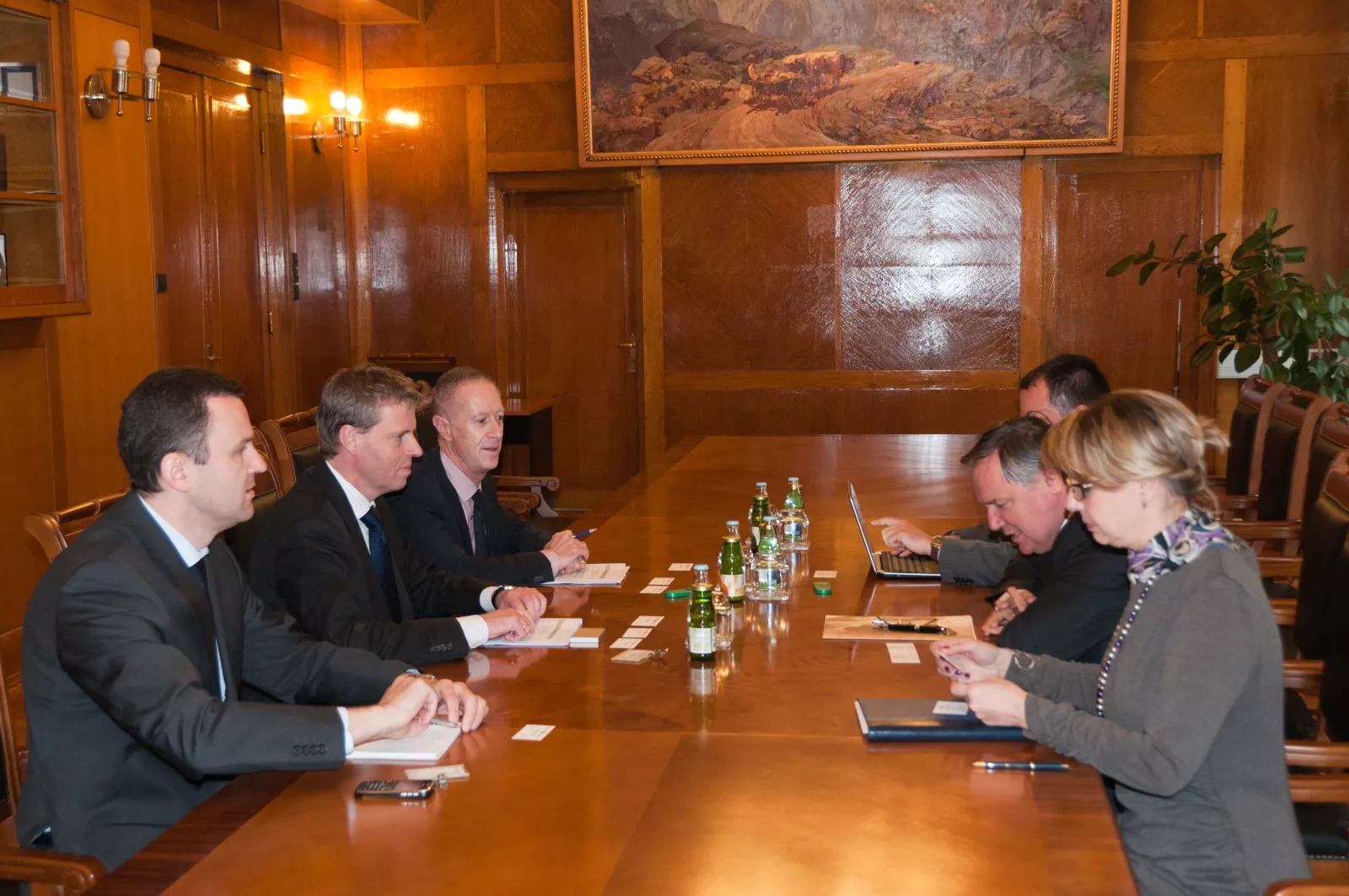
Director of the Western Balkans Office at the European Bank for Reconstruction and Development (EBRD) Holger Muent and the newly appointed Director of the EBRD Office in Bosnia and Herzegovina Ian Brown visited the Central Bank of Bosnia and Herzegovina (CBBiH) where they held a meeting with Governor Dr. Kemal Kozarić and his associates, reports the BiH news agency Patria.
The purpose of the visit by the EBRD representatives was for the newly appointed representatives of the institution for the region and Bosnia and Herzegovina to become acquainted with all key elements of the relationship with the country, and to determine modalities for future cooperation. A special focus of the EBRD delegation's talks with the CBBiH management was the banking sector, in whose reform the EBRD representatives have actively participated over the years.
During the talks, Holger Muent emphasized that Bosnia and Herzegovina remains one of the EBRD's most important partner countries, and that the CBBiH is the EBRD's key partner institution in this country. In the discussion about the banking sector, it was highlighted that the banking sector, despite all challenges, has remained stable, well-capitalized, and liquid, but that there is a problem of growing non-performing loans, which now amount to 15.5%.
In line with this, the EBRD representatives positively assessed the information that Bosnia and Herzegovina, i.e., the banking agencies of both entities, are rapidly working on creating a legal framework that will enable the resolution of the issue of non-performing loans, which are now the biggest challenge for the BiH banking sector.
Governor Kozarić thanked them for their engagement in Bosnia and Herzegovina so far, and pointed out that the EBRD, with its 116 projects since 1996, totaling 1.68 billion euros, is one of the most important institutional investors in Bosnia and Herzegovina.
- It is particularly worth noting that the EBRD maintained maximum engagement even during the crisis, thereby significantly helping to preserve the level of economic activity in Bosnia and Herzegovina, and in addition to direct engagement, the EBRD was able to attract many other investors and interest them in starting their investments in BiH - Kozarić emphasized.
It is worth mentioning that the largest percentage of the EBRD's investments to date has gone into infrastructure projects – 46%, 29% of all investments have gone into financial institutions, 11% into energy production-related projects, and 14% into industry, trade, and agribusiness.
In its strategy for the period from 2014 to 2017, the EBRD will focus on restructuring and expanding the local and private sector, creating stronger links with wider regional markets, and promoting more efficient and sustainable use of resources.
Komentari (0)
Prijavite se za komentiranje
PrijavaJos nema komentara. Budite prvi!
Minuta
Sve →Iz drugih kategorija

High Representative Not Elected: Germans, French and British Sabotaged Americans, New Attempt at End of June

ČOVIĆ WITHOUT MERCY: How Those Who Brought Ademović to Office Created a Political Hell for Him



Sunny Saturday, quite warm



Tragedy in Albanian resort: Two minors drown












