
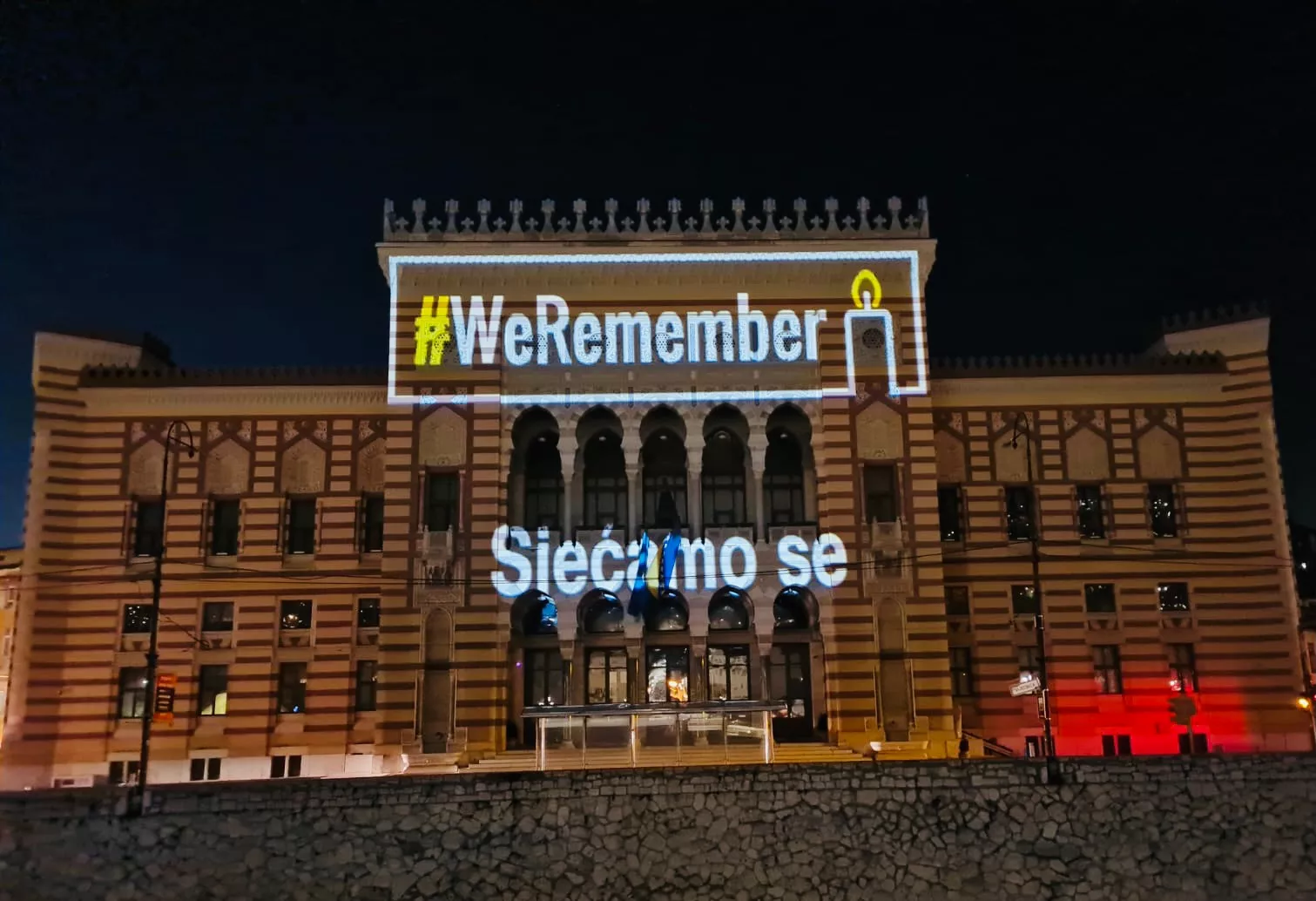
SARAJEVO, (Patria) - On the occasion of the International Day of Remembrance for the Victims of the Holocaust, the message "We remember - Sjećamo se" with a candle symbol was projected on the Sarajevo City Hall.
The UN General Assembly, at its session on November 1, 2005, adopted a resolution on marking the International Day of Remembrance for the Victims of the Holocaust.
January 27 was chosen as the date for commemoration, i.e., remembrance of the millions of victims who perished in the Holocaust during World War II, the day when units of the Soviet Army liberated the largest Nazi concentration camp - Auschwitz in 1945. On that occasion, 7,500 prisoners left behind by the Nazis were freed.
The International Holocaust Remembrance Day is especially observed in European countries where 53 million people lost their lives during World War II, among them nearly 31 million civilians.
According to data from various sources, the total number of Jews, victims of Nazi persecution, ranges from at least 4,194,000 to 5,820,960, while including all other peoples, it is estimated that between nine and eleven million people perished in the Holocaust.
The Holocaust was an unprecedented genocide; it was a comprehensive and systematic act carried out by Nazi Germany together with its collaborators, with the aim of destroying the entire Jewish people and erasing their culture and tradition from the face of the Earth. The primary motive for the Holocaust was the antisemitic racist ideology of the Nazis. Jews were not the only victims of Nazi Germany, but they were the only people or group they sought to completely exterminate - that is what is unique about the Shoah (Holocaust).
Between 1933 and 1941, Nazi Germany pursued a policy that stripped Jews of all their rights and property. This was followed by their marking and the organized concentration of the Jewish population. This policy had broad support in Germany and much of occupied Europe. In 1941, after the invasion of the Soviet Union, the Nazis and their collaborators launched a plan to exterminate all Jews. By the end of 1941, the policy had developed into a comprehensive, systematic death operation that the Nazis called the "Final Solution to the Jewish Question".
By the end of the war in 1945, about six million Jews had been killed. The struggle with the loss and moral collapse that occurred during the Holocaust is a lasting challenge and obligation for humanity worldwide.
Among the most notorious death camps on the territory of the former Yugoslavia were "Jasenovac" (on the territory of present-day Croatia) and Sajmište near Belgrade.
Komentari (0)
Prijavite se za komentiranje
PrijavaJos nema komentara. Budite prvi!
Minuta
Sve →Iz drugih kategorija

High Representative Not Elected: Germans, French and British Sabotaged Americans, New Attempt at End of June

ČOVIĆ WITHOUT MERCY: How Those Who Brought Ademović to Office Created a Political Hell for Him



Sunny Saturday, quite warm



Tragedy in Albanian resort: Two minors drown












