
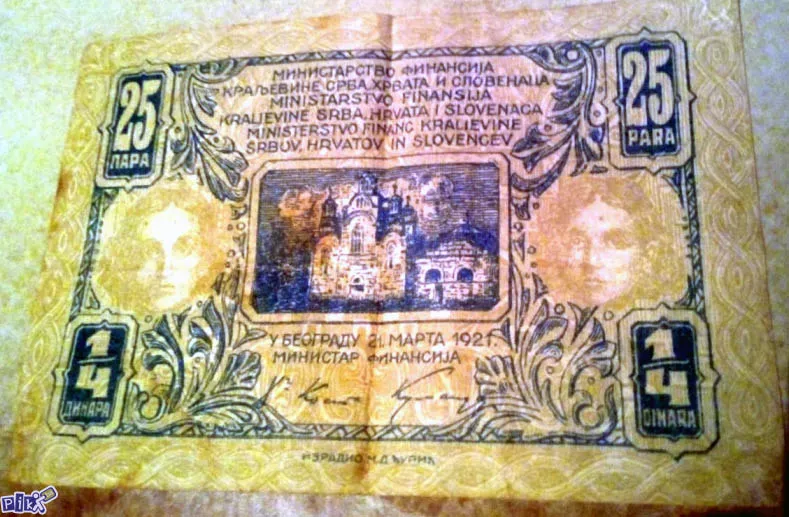
The dinar is certainly the oldest means of payment in the former Yugoslavia, which has changed its form over the years, but has always maintained its basic form. It was used as the currency of the Principality, then during the Kingdom of Serbia from 1868 to 1918, but also during the Kingdom of Serbs, Croats and Slovenes, and thereafter.
The dinar is first mentioned in archival documents at the end of 1214, during the time of Stefan Prvovenčani.
The first Yugoslav paper dinars were issued by the National Bank of the Kingdom of Serbs, Croats and Slovenes in 1920. The ten dinar denomination is the only Yugoslav banknote made in the USA. Its production was ordered from the American Bank Note Company printing works, as the capacity of the Banque de France, which was the traditional partner of the Kingdom of Serbia and later the Kingdom of Yugoslavia, was occupied after World War I.
Nevertheless, cooperation continued later, and the 100 and 1,000 dinar denominations were again produced in France, until 1930, with the support of Banque de France, the Institute for Banknote Production in Topčider - Belgrade (ZIN) was built and started operating, where banknotes and coins were further produced. The first banknote produced at ZIN was the 10 dinar denomination from the 1929 issue.
The domestic designation for the dinar was DIN, din. or d., and one dinar was divided into 100 para.
Today, the dinar is still used only in Serbia. Other countries, members of the former Yugoslavia, have introduced the euro as a means of payment, or their own currencies, writes Patria.
Komentari (0)
Prijavite se za komentiranje
PrijavaJos nema komentara. Budite prvi!
Minuta
Sve →Iz drugih kategorija

High Representative Not Elected: Germans, French and British Sabotaged Americans, New Attempt at End of June

ČOVIĆ WITHOUT MERCY: How Those Who Brought Ademović to Office Created a Political Hell for Him



Sunny Saturday, quite warm



Tragedy in Albanian resort: Two minors drown












