
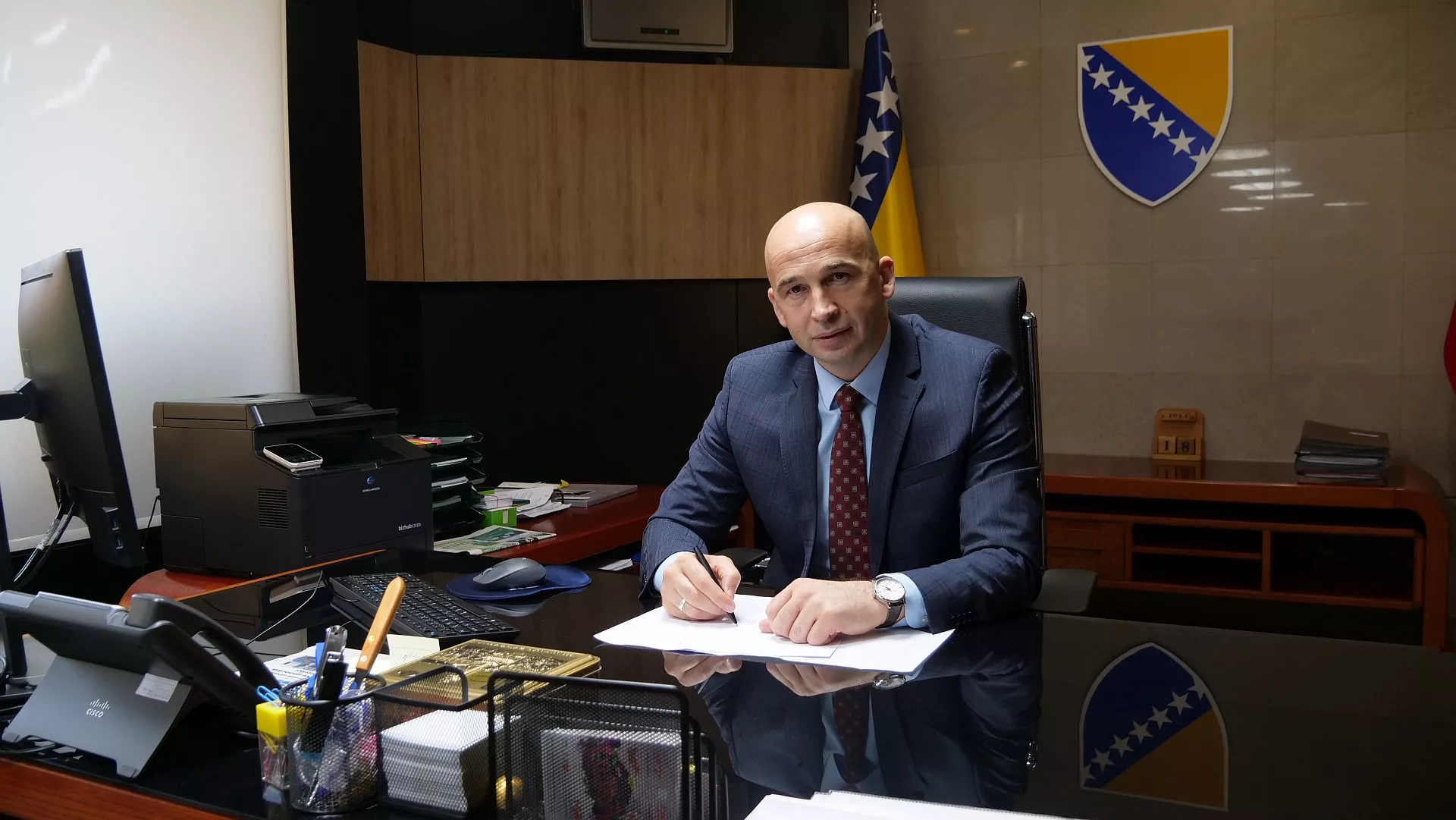
(Patria) - Nezir Pivić, Prime Minister of Zenica-Doboj Canton (ZDK), one of the four cantons that gave a conditionally positive opinion on the Reform Agenda, today responded to the "nebulous claims" made by the Federal Prime Minister and leader of SDP BiH, Nermin Nikšić, in a press release.
"It took Nikšić a full two days to publicly respond, and in doing so, to populistically assert that 'the citizens of Bosnia and Herzegovina are once again victims of ignorance, illiteracy, dilettantism, and the complete degradation of the state by SDA', although I am sure we know much more about the document than he does.
Firstly, the draft Reform Plan contains two tables of submitted projects. The first table, number 145, is 'Draft indicative list of priority investment projects for support through the Reform Agenda', and the second, number 146, is 'Draft list of investment projects requiring additional consultations for inclusion in table 1'.
I remind Nikšić that we did not problematize the first table at any point because these are 'mature', relevant, and confirmed projects. It includes projects from the transport sector worth 2.3 billion euros, the energy sector worth 1.1 billion euros, and the digitalization sector worth 3.135 billion euros. Thus, a total of 6.535 billion euros.
The Growth Plan is worth one billion euros, so it is clear that not all these projects will be financed through this instrument.
We pointed to the second table, number 146, in which we did not problematize the transport sector at any point because it includes projects like the Počitelj-Stolac corridor, Komar Tunnel, Lašva-Nević Polje, Sarajevo Airport, as well as Mostar Airport and Grude, Istočno Sarajevo, the TEN-T network for Republika Srpska, etc.
During the harmonization phase of the Reform Plan, we pointed to the remaining three sectors in table 146: energy, digitalization, and human capital. How is it possible that out of approximately 700 million euros in these three sectors, not a single one is allocated for cantons with a Bosniak majority?
The problematic projects, in our view, are in two sectors: digitalization and infrastructure for human capital, worth 20.6 million KM.
The value of some projects is not stated at all (Introduction of cooling and heating systems in secondary schools in HNK, Unified information system for higher education of Republika Srpska, and Improvement of broadband internet in Republika Srpska).
There are also projects such as 'Provision of minibuses for primary schools in the Republika Srpska entity' (1.5 million euros), 'Equipping primary and secondary schools with ICT equipment and implementation of wireless internet in all schools in the Republika Srpska entity' (7.6 million euros), 'Construction of Paprikovac school in Banja Luka' (2.5 million euros), 'Digitalization of the radio communication system for the Ministry of Internal Affairs of Republika Srpska' (2.8 million euros), 'Creation of a unified GSB (government data bus) for Republika Srpska' (2 million euros), 'Design and implementation of the State eVlada portal of Republika Srpska' (1 million euros), 'State open data portal of Republika Srpska' (0.2 million euros), 'Development of a platform for qualified electronic delivery (e-box) for Republika Srpska' (0.5 million euros), and 'Preparation of the citizen registry of Republika Srpska' (2.5 million euros).
In addition to this, 636.2 million euros should be added for projects in the energy sector – all for Republika Srpska and Elektroprivreda HZ HB.
At first glance, without detailed analysis, it is evident that 700 million euros are planned for Republika Srpska and cantons with a Croatian majority in the energy, digitalization, and human capital sectors.
Let Nermin Nikšić answer how it is possible that in these projects, the entity of Republika Srpska is referred to as a state: 'Design and implementation of the State eVlada portal of Republika Srpska' and 'State open data portal of Republika Srpska', while at the same time Republika Srpska seeks and he agrees to the deletion of the term 'state' with BiH?
It is untrue that, as Nikšić claims, 'SDA objects because cantons were not consulted in evaluating and delegating projects, but only the state and state institutions'.
We object because our cantons were not consulted at all, not even on these projects, while others clearly were.
If, as Nikšić claims, 'state institutions and ministries proposed and implemented the preparation and delegation of projects, making the state practically the only stakeholder, i.e., party and factor in defining priorities', why did those state ministries, headed by his coalition partners, not consult and propose projects from cantons with a Bosniak majority as well?
Nothing was 'done taking into account the needs of different communities and areas', as Nikšić claims, but it was designed so that all 700 million euros from these three sectors go to cantons with a Croatian majority and Republika Srpska.
Let Nikšić answer whether it is a priority for all primary and secondary schools in Republika Srpska to be equipped with ICT equipment and for their children to have wireless internet in all schools, and for secondary schools in HNK to have cooling and heating systems, while in our schools children lack basic school supplies, can only dream of ICT equipment, and are heated by stoves and coal?
Let Nikšić answer whether the digitalization of the radio communication system for the Ministry of Internal Affairs of Republika Srpska is a priority, and if so, why not for the Ministries of Internal Affairs in FBiH as well?
After all, let Nikšić calculate how many residents of the Federation of BiH live in the four cantons that gave a conditionally positive opinion on the Reform Agenda. Our 1,358,042 residents also deserve better living conditions.
We are pleased that after several days, Nikšić realized and admitted that the competent Working Team for the Growth Plan is not part of the coordination mechanism. He should also inform his coalition partners about this, who are demonstrating complete ignorance on this topic these days.
SDA has not blocked anything. If he had engaged more with the substance, rather than unconditionally agreeing with HDZ and SNSD, he would know that we have not disputed the projects from the first table worth over 6.5 billion euros at any point.
We requested that cantons with a Bosniak majority be included in the second table, number 146, wherever projects from education, energy, and digitalization are listed, but we were not allowed to do so. Instead, we received the explanation that Nikšić also mentioned, that these are not 'mature' projects and that they will be discussed later.
If they are not 'mature', then they should not be there. It is clear that they have not been harmonized, and we then requested that this table be deleted from the document until it is harmonized to ensure balanced development and rights for all. However, this request was also rejected.
Did we have to give consent for all 700 million euros planned in these three sectors to go to Republika Srpska and cantons with a Croatian majority without any consultation and without considering our additions?
If this is indeed an unimportant table, why is it a problem to delete it from this Draft and focus on the first one, which no one disputes?
The text of the Draft Reform Agenda does not even record that we problematized this table; there is not even our comment, which was clearly stated.
We were given 90 minutes to comment on 160 pages of text, meaning to review almost two pages per minute. In an atmosphere of distrust, where the document harmonization process was conducted in a non-transparent, biased, and methodologically highly questionable manner, every word is important.
And we ask Ćudić to read our positions more precisely, because we did not dispute the European Commission's methodology, but rather stated that the document harmonization process was conducted in a non-transparent, biased, and methodologically highly questionable manner.
Therefore, the harmonization process was not in accordance with the European Commission's methodology. And it is known who led it, who is the chairperson of the Working Team for the preparation of the Reform Agenda, and by whose dictate Nikšić and others from the 'Trojka' acted.
It would be useful to request a recording of the meeting in accordance with the Law on Free Access to Information to hear with what dismissiveness all our requests were met," Pivić stated in a post on his Facebook profile.
If, as Nikšić claims, 'state institutions and ministries proposed and implemented the preparation and delegation of projects, making the state practically the only stakeholder, i.e., party and factor in defining priorities', why did those state ministries, headed by his coalition partners, not consult and propose projects from cantons with a Bosniak majority as well?
Nothing was 'done taking into account the needs of different communities and areas', as Nikšić claims, but it was designed so that all 700 million euros from these three sectors go to cantons with a Croatian majority and Republika Srpska.
Let Nikšić answer whether it is a priority for all primary and secondary schools in Republika Srpska to be equipped with ICT equipment and for their children to have wireless internet in all schools, and for secondary schools in HNK to have cooling and heating systems, while in our schools children lack basic school supplies, can only dream of ICT equipment, and are heated by stoves and coal?
Let Nikšić answer whether the digitalization of the radio communication system for the Ministry of Internal Affairs of Republika Srpska is a priority, and if so, why not for the Ministries of Internal Affairs in FBiH as well?
After all, let Nikšić calculate how many residents of the Federation of BiH live in the four cantons that gave a conditionally positive opinion on the Reform Agenda. Our 1,358,042 residents also deserve better living conditions.
We are pleased that after several days, Nikšić realized and admitted that the competent Working Team for the Growth Plan is not part of the coordination mechanism. He should also inform his coalition partners about this, who are demonstrating complete ignorance on this topic these days.
SDA has not blocked anything. If he had engaged more with the substance, rather than unconditionally agreeing with HDZ and SNSD, he would know that we have not disputed the projects from the first table worth over 6.5 billion euros at any point.
We requested that cantons with a Bosniak majority be included in the second table, number 146, wherever projects from education, energy, and digitalization are listed, but we were not allowed to do so. Instead, we received the explanation that Nikšić also mentioned, that these are not 'mature' projects and that they will be discussed later.
If they are not 'mature', then they should not be there. It is clear that they have not been harmonized, and we then requested that this table be deleted from the document until it is harmonized to ensure balanced development and rights for all. However, this request was also rejected.
Did we have to give consent for all 700 million euros planned in these three sectors to go to Republika Srpska and cantons with a Croatian majority without any consultation and without considering our additions?
If this is indeed an unimportant table, why is it a problem to delete it from this Draft and focus on the first one, which no one disputes?
The text of the Draft Reform Agenda does not even record that we problematized this table; there is not even our comment, which was clearly stated.
We were given 90 minutes to comment on 160 pages of text, meaning to review almost two pages per minute. In an atmosphere of distrust, where the document harmonization process was conducted in a non-transparent, biased, and methodologically highly questionable manner, every word is important.
And we ask Ćudić to read our positions more precisely, because we did not dispute the European Commission's methodology, but rather stated that the document harmonization process was conducted in a non-transparent, biased, and methodologically highly questionable manner.
Therefore, the harmonization process was not in accordance with the European Commission's methodology. And it is known who led it, who is the chairperson of the Working Team for the preparation of the Reform Agenda, and by whose dictate Nikšić and others from the 'Trojka' acted.
It would be useful to request a recording of the meeting in accordance with the Law on Free Access to Information to hear with what dismissiveness all our requests were met," Pivić stated in a post on his Facebook profile.
Komentari (0)
Prijavite se za komentiranje
PrijavaJos nema komentara. Budite prvi!
Minuta
Sve →Iz drugih kategorija

High Representative Not Elected: Germans, French and British Sabotaged Americans, New Attempt at End of June

ČOVIĆ WITHOUT MERCY: How Those Who Brought Ademović to Office Created a Political Hell for Him



Sunny Saturday, quite warm



Tragedy in Albanian resort: Two minors drown












