
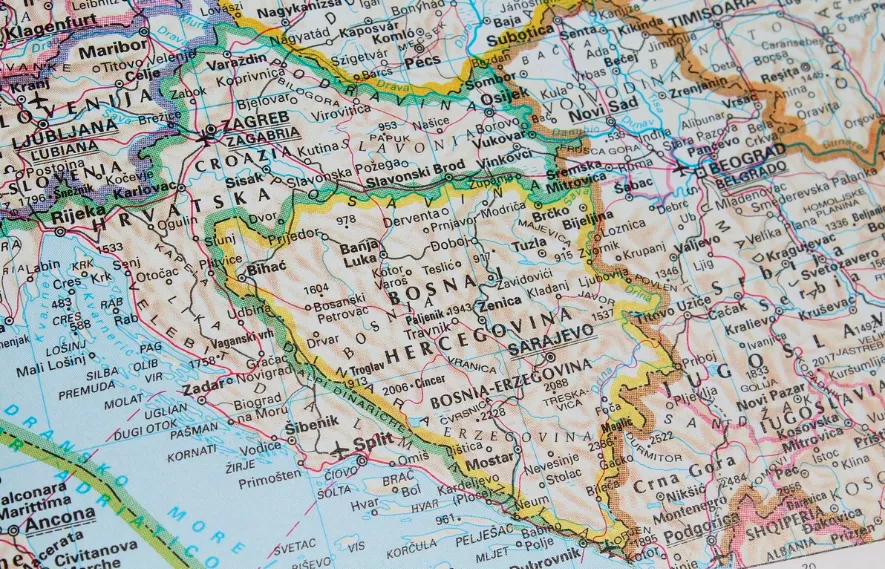
(Patria) - Few issues in Bosnia and Herzegovina carry as much weight for its sovereignty, stability, and Euro-Atlantic future as the issue of control over state property. At first glance, it might seem like a technical or legal matter. In reality, it is a geopolitical battlefield that could determine whether BiH moves closer to Europe or becomes an outpost of foreign powers, writes journalist Erdin Kadunić, as reported by N1.
Kadunić explains at the beginning of the article for New Eastern Europe that state property in BiH encompasses over 53 percent of the country's territory - about 2.7 million hectares of forests, pastures, rivers, mineral resources, and strategic locations, and emphasizes:
"It is the backbone of the state. Whoever controls this property possesses immense political and economic influence".
According to the BiH Constitution and confirmed court decisions, this property belongs exclusively to the state of Bosnia and Herzegovina.
However, political leaders in the BiH entity Republika Srpska (RS), "often with the support of Belgrade and Moscow," persistently try to transfer ownership to the entities.
Such a move would allow local politicians to allocate or sell land without any state oversight.
For Kadunić, the risk here is obvious: strategic property could fall into the hands of actors hostile to BiH's Euro-Atlantic integration.
NATO's Condition Turned into a Political Battlefield
The issue of state property first came into focus in 2010, when Bosnia and Herzegovina was conditionally granted the NATO Membership Action Plan (MAP) – the final step before opening talks on full membership. For the MAP to be activated, 63 potential military locations had to be registered as state property, 23 of which were located in RS. Then-Prime Minister Milorad Dodik agreed to the registration only on the condition that the rest of the state property be transferred to the entities.
Former BiH Presidency member Haris Silajdžić blocked this move, warning that such a transfer would mean the de facto partition of BiH.
"His stance clearly indicated the essence of the dispute: Bosnia and Herzegovina's state property is not just land, but the foundation of state integrity itself," explains Kadunić.
Wider Geopolitical Stakes
He warns that the consequences of this issue extend far beyond BiH's borders.
"If the entities were to take control, foreign powers could gain access to strategic locations alarmingly close to the European Union's territory - just 70 kilometers from Zagreb or 150 kilometers from Vienna".
He points out that this is not mere speculation, given that Bulgaria has already expressed concern over Russia's "humanitarian center" in Niš, which Western analysts describe as a disguised military base. Former Bulgarian Ambassador Elena Poptodorova even warned that the potential deployment of Russian S-400 systems in Niš would cover all of Bulgaria and the Western Balkans.
"Transferring state property to the entities would therefore not only undermine Bosnia and Herzegovina's sovereignty. It would open the door for further strengthening of Russian and Chinese influence in the heart of the Balkans, threatening regional stability and Europe's security architecture".
Corruption and Control
Besides the geopolitical dimension, there is also the issue of corruption.
Kadunić explains that BiH's political landscape is already deeply compromised by scandals involving the misuse of public resources.
"Granting entities independent control over property worth hundreds of billions of euros would give corrupt elites free rein to further enrich themselves and deepen ethnic divisions".
Conversely, when property remains under state control, decisions must be made by consensus at the state level. This ensures a degree of transparency and preserves the country's Euro-Atlantic orientation.
As a positive example, Kadunić cites the sale of land for the construction of the United States Embassy in Sarajevo - this was a decision made by the state, not by the Federation of BiH entity on whose territory the embassy was built.
A Lesson from History
Kadunić quotes American historian Roy Casagrande, who stated that a state does not collapse when its leaders give up, but when it no longer controls its property.
According to him, the Roman Empire did not actually "fall" in 476 AD, but in 1453, when Constantinople - and with it, imperial property - fell to the Ottomans.
For Kadunić, this lesson clearly applies to today's BiH: sovereignty is inextricably linked to ownership of land and resources.
"For Bosnia and Herzegovina, the path is clear: state property must remain in the hands of the state, not be divided among entities or cantons. This is the only way to preserve sovereignty, territorial integrity, and progress towards NATO and European Union membership," he emphasizes.
Consequences for Europe
He believes that the international community, especially NATO and the EU, should recognize the importance of this issue.
"Allowing entities to manage state property would not only weaken Bosnia but also open the Western Balkans to unwanted military presence of foreign powers – thereby directly threatening Europe's security".
Therefore, Bosnia and Herzegovina's state property is not just a legal dispute.
"It is the dividing line between two futures: one rooted in stability, the rule of law, and Euro-Atlantic integration, and another leading to corruption, divisions, and foreign influence. The choice should be clear - for Bosnia, but also for Europe," Kadunić concludes.
Komentari (0)
Prijavite se za komentiranje
PrijavaJos nema komentara. Budite prvi!
Minuta
Sve →Iz drugih kategorija

High Representative Not Elected: Germans, French and British Sabotaged Americans, New Attempt at End of June

ČOVIĆ WITHOUT MERCY: How Those Who Brought Ademović to Office Created a Political Hell for Him



Sunny Saturday, quite warm



Tragedy in Albanian resort: Two minors drown












