
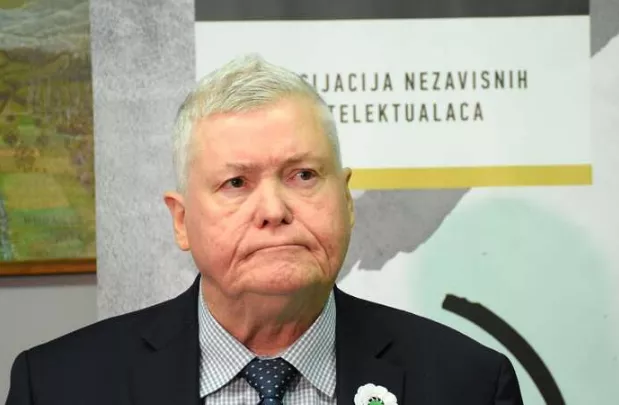
(Patria) - Professor of Holocaust and Genocide Studies at Southern Connecticut State University, member of the governing board of the Genocide Studies Program at Yale University, and a regular member of the Circle 99, Prof. Dr. David Pettigrew issued a statement on the occasion of Bosnia and Herzegovina's Statehood Day.
"While survivors of crimes in Kalinovik are not allowed to erect a memorial plaque at the former site of the Barutni magazin concentration camp (located in the Republika Srpska entity), Bosnian Serb nationalists have erected a plaque in Vidrići commemorating Serb and Russian soldiers who fought and died in the so-called 'war of defense-homeland' from 1992 to 1995.
The plaque in Vidrići is attached to a tall Russian Orthodox cross, located next to a church built in the Russian style. The president of the church construction committee in Vidrići, Milan Jolović, emphasized that the cross and the church are dedicated to Serb-Russian friendship, which was strengthened through two world wars and the last so-called 'war of homeland'.
The message on the plaque represents a form of genocide denial because it glorifies war crimes committed by Bosnian Serb and Russian forces as a 'patriotic' endeavor. The text on the plaque ominously states that the 'blood-soaked land' is nothing less than 'a covenant for sons to defend it through turbulent times'.
This plaque on the Russian Orthodox cross is a clear incitement to the sacred duty of repeating crimes," stated Prof. Dr. David Pettigrew in his reaction.
He points out that the Russian Orthodox cross and the Russian-style church in Vidrići, along with the glorification of the "war of defense-homeland" waged with Russian volunteers, are a hint of the geographical and mythical terrain at the far reaches of the so-called "Russian world".
"Vladimir Putin's 'foreign policy' includes a vision of 'power that unites the Russian people and other peoples belonging to the cultural and civilizational community of the Russian world'. This 'vision' includes the defense of the Russian Orthodox Church and 'ensuring the unity of Orthodoxy'; 'preserving the centuries-old civilizational and spiritual ties between the peoples of Russia' and fraternal peoples."
The plaque erected on the Russian cross in Vidrići, Pettigrew states, can be seen as the point where Putin's "Russian world" overlaps with the "Serbian world", where both worlds, inhabited by "fraternal peoples", strive to identify and persecute the hated "other". In Vidrići, the hated other was Bosniak.
"Such hatred is regularly fueled by politicians in Republika Srpska. Representatives of Republika Srpska in the Parliamentary Assembly of BiH recently sent a letter to the US Senate and Congress stating that 'BiH has long been a haven for radical Islamists and that the nationalist policies of the largest Bosniak parties confirm the intention to rule BiH without Serbs and Croats'.
A few days earlier, Mr. Dodik claimed that those who advocate for a civic state are actually working according to the will of Muslims who want to dominate. In addition, he tweeted that there is no state and that 'there is no statehood day'. He claimed that they were 'invented in the minds of Muslim politicians...'", Pettigrew emphasizes.
In addition to his anti-Muslim and anti-state rhetoric, Professor Pettigrew continues, Dodik confirmed the denial of genocide on the plaque in Vidrići when he recently stated that the "story of the alleged genocide and suffering of Bosniaks" is false.
"This is genocide denial and trivialization of the suffering of victims. He also stated that everything that happened was the result of a 'civil war', which can be considered justification for crimes. With such provocative statements, Mr. Dodik mocks the Criminal Code of BiH with impunity.
While memorials glorifying perpetrators and their crimes, such as the plaque for Russian volunteers in Vidrići, the plaque for Ratko Mladić on Vraca hill at the entrance to Sarajevo, or the mural of Ratko Mladić in Kalinovik, have colonized the Bosnian-Herzegovinian cultural landscape, at the same time, survivors of genocide and other war crimes are prevented from erecting memorials at the sites where atrocities deemed war crimes were committed.
For example, these are Barutni magazin (Kalinovik), Partizan sports hall (Foča), and Vilina Vlas (Višegrad). Survivors are also forbidden to erect a plaque at the warehouse in Kravica, where crimes were committed that were part of Mladić's conviction for genocide.
This discriminatory prohibition of memorials to victims is a denial of the truth about genocide and other war crimes, and a blatant violation of UN guidelines on the right to memorialization. The OHR should support the erection of plaques and museums at these locations without delay," Pettigrew notes.
According to him, the "Serb-Russian friendship" symbolized by the Russian cross and the plaque in Vidrići implies incitement to repeat the atrocities of the 1990s as a sacred mission.
"Dodik's denial of genocide and other war crimes, along with his anti-state and anti-Muslim statements, undermines respect for the rule of law. These provocations jeopardize the possibility of a just social order and a peaceful future for the citizens of BiH.
Dodik's threats of secession and his visits to Moscow aim to block Bosnia's path to the EU and NATO in service of the Serbian and Russian worlds. On the occasion of Bosnia and Herzegovina's Statehood Day, it is imperative that the international community prioritize Bosnia's accession to the EU and NATO to support Bosnia as a democratic, multi-ethnic, and sovereign state," concluded David Pettigrew in his reaction.
Komentari (0)
Prijavite se za komentiranje
PrijavaJos nema komentara. Budite prvi!
Minuta
Sve →Iz drugih kategorija

High Representative Not Elected: Germans, French and British Sabotaged Americans, New Attempt at End of June

ČOVIĆ WITHOUT MERCY: How Those Who Brought Ademović to Office Created a Political Hell for Him



Sunny Saturday, quite warm



Tragedy in Albanian resort: Two minors drown












