
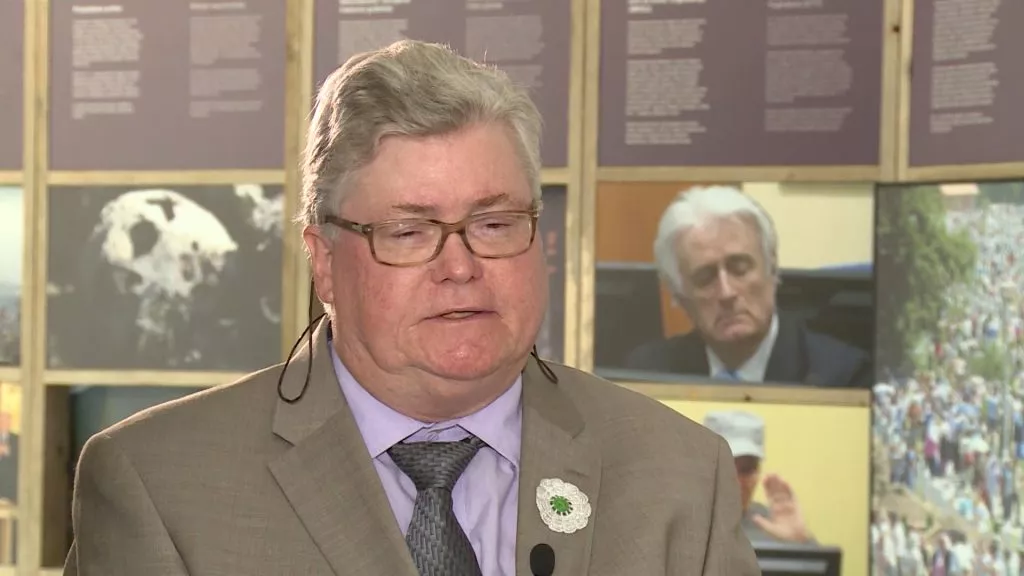
(Patria) - Although I welcome the announcement of the recommendation to open EU accession negotiations, I believe that Bosnia and Herzegovina's approach to the EU should be treated and accelerated as a matter of restorative justice in order to “repair the damage” or “correct the injustice” done to Bosnia, says Prof. Dr. David Pettigrew, professor of philosophy and genocide and Holocaust studies at Southern Connecticut State University and a member of the Steering Committee of the Genocide Studies Program at Yale University.
"Bosnia was a victim of war crimes initiated by joint criminal enterprises driven by the same principles in both Serbia and Croatia. These joint criminal enterprises sought geographic territory, 'Greater Serbia' or 'Herceg-Bosna,' as part of eliminationist projects similar to the National Socialist ideology of Lebensraum that justified territorial conquest and population elimination.
Furthermore, the citizens of Bosnia suffered war crimes from 1992 to 1995, including crimes against humanity and genocide in Srebrenica. War criminals are glorified, war crimes are denied, hate speech has become normalized, and survivors are prevented from erecting monuments to the victims. Survivors are marginalized and retraumatized. Instead of facing obstacles, tests, and 'further steps,' Bosnia should be admitted to the EU as a form of reparation to correct the injustice that people have suffered. The international community must recognize its responsibility for failing to prevent crimes originating from Belgrade and Zagreb.
The announcement by European Commission President Ursula von der Leyen that 'the Commission recommends that the Council open accession negotiations with Bosnia and Herzegovina' pending 'further steps' seems only to delay a process that should be treated with a greater sense of urgency.
Article 1 of the existing Stabilisation and Association Agreement refers to the goal of supporting 'Bosnia and Herzegovina's efforts to strengthen democracy and the rule of law.' Citizens in BiH have bravely advocated for democratic reforms and human rights. The European Court of Human Rights has consistently ruled that the Dayton Constitution is contrary to Article 14 of the EU Convention on Human Rights. Yet, although the rulings of the European Court of Human Rights indeed called for 'democratic arrangements without delay,' Bosnia has not received support in this regard. The EU has not acted with sufficient urgency," Pettigrew emphasized.
Bosnia should be granted the right to democracy and human rights, enabling all citizens to run for office and vote for candidates of their choice.
"Similarly, due to the impasse imposed by Dayton, Bosnia needs support in the process of re-establishing respect for the rule of law. The President of Republika Srpska engages with impunity in genocide denial and hate speech against Muslims. He says the idea of a civic state is a 'Muslim delusion.' Convicted war criminal Ratko Mladić is widely glorified. A four-meter-high mural of Mladić, reading 'hero city,' brazenly greets visitors to the town of Kalinovik. A memorial plaque dedicated to Mladić on Vraca Hill, at the location from which the Sarajevo-Romanija Corps terrorized civilians in Sarajevo, is a cruel provocation that should be removed.
High Representative Inzko made a brave decision criminalizing genocide denial and the glorification of convicted war criminals. However, the prosecution was not prepared to prosecute these crimes. Bosnia should be supported by a transitional team of international prosecutors to bring to justice those who have routinely and with impunity practiced denial and hate speech.
Finally, Bosnia's EU accession should be treated with greater urgency due to the ongoing threats and interference from the Russian Federation. The Russian Federation has repeatedly threatened, opposing Bosnia and Herzegovina's EU accession and its Euro-Atlantic integration.
The Embassy of the Russian Federation in BiH warned that Russia would view BiH's Euro-Atlantic integration as a hostile act to which it would have to respond. The Russian spokesperson sharply criticized the EU for granting Bosnia candidate status for EU membership, calling it part of the EU's eastward expansion.
Russia has emphasized that Bosnia is composed of entities, not a sovereign state. The President of Republika Srpska has traveled to visit Vladimir Putin four times since the start of the Russian Federation's illegal invasion of Ukraine. In May 2023, Dodik emphasized that Republika Srpska 'remains pro-Russian, anti-Western, and anti-American.' This month, he announced that RS would not participate in EU sanctions against Russia.
Putin's official foreign policy seeks to 'unite Orthodoxy,' as he aims to provide full support to 'brotherly peoples.' Russian Orthodox crosses in Vidrići and Višegrad honor Russian mercenaries who died in the so-called 'defensive-homeland war' (1992-1995). The president of the Serbian-Russian Society in Višegrad claims that 'Russian volunteers among Serbs are not new; it is a tradition that has lasted over 200 years. There is no war in which Serbs participated without Russian volunteers, so this time is no different.'
The obvious concern related to Putin's foreign policy goal of uniting 'brotherly peoples' and Milorad Dodik's strategic relationship with Putin is that the entity of Republika Srpska could become another Donbas. Republika Srpska is already a second Donbas in the sense that it serves as a front line of resistance to the EU and NATO," he added.
The NATO Secretary General pointed to the threat the Russian Federation poses to Bosnia. Former High Representatives Inzko and Schwarz-Schilling warned that '...the current aggression against Ukraine could spread to the Western Balkans, primarily to Bosnia and Herzegovina and Kosovo.' Therefore, there is no time to waste.
"Bosnia's EU accession should be accelerated to prevent Republika Srpska from further destabilizing the region and to prevent the spread of Russian imperialism to the Balkans. To achieve everything expected in the EU accession process, Bosnia should be rapidly admitted to the EU, not subjected to 'further steps.' Due to the devastating social damage caused by genocide and other war crimes, and due to the government impasse caused by the Dayton Constitution, EU membership would be a necessary precondition for achieving the very reforms the EU expects. Bosnia's EU membership would finally provide full support—the full weight of Europe—for constitutional reforms and the restoration of the rule of law that has so far been lacking," says Pettigrew.
Professor Pettigrew is the keynote speaker for Circle 99 on the topic "Bosnia and Herzegovina's EU Accession as a Matter of Restorative Justice."
Komentari (0)
Prijavite se za komentiranje
PrijavaJos nema komentara. Budite prvi!
Minuta
Sve →Iz drugih kategorija

High Representative Not Elected: Germans, French and British Sabotaged Americans, New Attempt at End of June

ČOVIĆ WITHOUT MERCY: How Those Who Brought Ademović to Office Created a Political Hell for Him



Sunny Saturday, quite warm



Tragedy in Albanian resort: Two minors drown












