
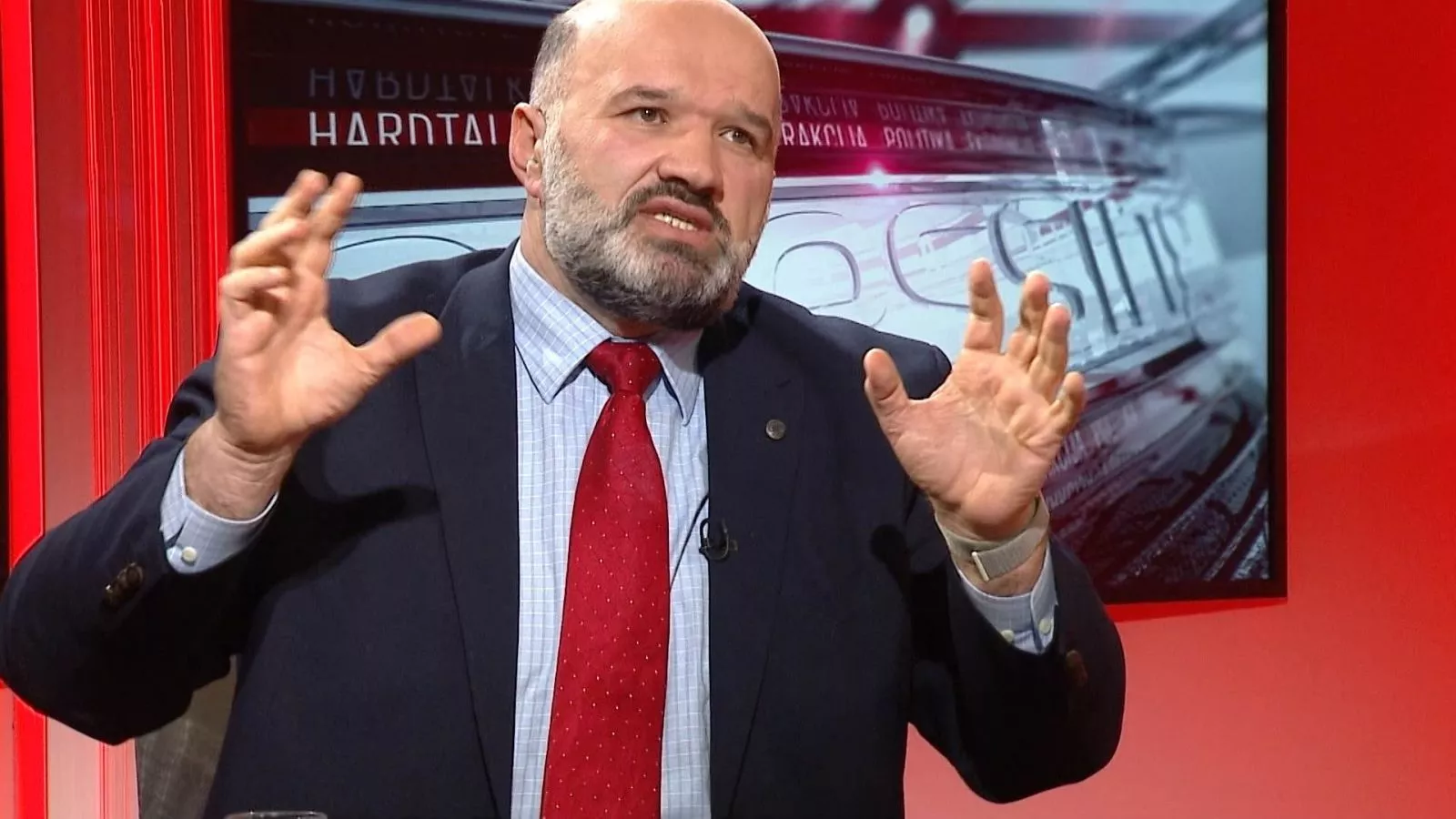
By: lawyer and journalist Senad Pećanin / media.ba
The President of the High Judicial and Prosecutorial Council of Bosnia and Herzegovina, Milan Tegeltija, wrote and published on the BH Journalists Association website, a text titled "Why a journalist does not have the right to publish an illegally made recording."
Tegeltija wrote that he tried to explain the problem of "the conflict between criminal law incrimination of a criminal offense and the public's right to know" in "layman's terms."
The conclusions of the aforementioned text are as follows:
- The right to privacy is a fundamental category of citizens' fundamental rights and freedoms, which can only be violated by special investigative actions authorized by a court;
- Persons who, contrary to this procedure, carry out secret audio and visual recording are covered by the criminal law incrimination of the criminal offense of unauthorized audio or video recording, which constitutes punishable behavior;
- A journalist does not have the right to publish an illegally made recording.
Although he does not cite the legal system and laws on which he bases his conclusions in his text, Tegeltija is wrong, whether it concerns accepted legal standards in many democratic countries and the practice of the European Court of Human Rights, or positive laws in Bosnia and Herzegovina.
If it is the former case, the uninformed Tegeltija could have informed himself about the Criminal Code of the neighboring Republic of Croatia. Namely, Article 143 of this law criminalizes unauthorized audio recording and wiretapping, as well as a qualified form of this offense (if the perpetrator is an official in the performance of their duties or public authority). However, paragraph 4 of the same article states the reason for excluding the unlawfulness of unauthorized recording and wiretapping in situations where it is "done in the public interest or another interest that is predominant over the interest of protecting the privacy of the recorded or wiretapped person." Therefore, it is as clear as it can be: there is no criminal offense if "unauthorized recording or wiretapping is carried out in the public interest or another interest that is greater than the interest of the recorded or wiretapped person." Of course, this also means that there is no criminal liability for a journalist or media outlet that publishes a recording of public interest or another interest that is more important than the interest of the recorded or wiretapped person.
So that laypeople and Mr. Tegeltija can understand what this is about, I will remind you of the case of a secretly made recording that was publicly published, and in which Mr. Tegeltija himself was involved. A citizen of BiH who had been suffering the consequences of the actions of the Chief Prosecutor of the Cantonal Prosecutor's Office in Sarajevo, Dalida Burzić, for years, had been writing and sending complaints to the President of the HJPC, Milan Tegeltija, requesting an official meeting. After several unsuccessful attempts to schedule an official meeting, he managed to arrange a meeting with Mr. Tegeltija - in a cafe. He presented his problem regarding Prosecutor Burzić's actions to him in the cafe, after which he received a promise from Tegeltija that he would "call Dalida," asking the citizen to send him the number under which the investigation had been (not) conducted for years. Upon leaving the cafe, the citizen was escorted by Mr. Tegeltija's friend, who promised him that Tegeltija would "sort things out with Dalida," suggesting that he give him money to "grease the wheels" of Mr. Tegeltija. The citizen reluctantly did so, handing over a certain sum of money to Mr. Tegeltija's friend, secretly recording the conversations with Tegeltija and his friend, as well as the handover of the money.
Before I point out why this citizen is not criminally liable for secret recording even under the positive laws in Bosnia and Herzegovina, I will also point out the practice of the European Court of Human Rights.
This international court is the supreme judicial body for the interpretation and application of the European Convention on Human Rights and Fundamental Freedoms. Namely, regarding interference with privacy, the Court is guided by the principle of proportionality, i.e., seeking an answer to the question: is the interference with an individual's privacy proportional to the purpose for which the interference occurred, i.e., is it justified in terms of public interest, maintaining public order, peace and security, preventing social unrest and crime, and protecting the rights of others? The Croatian legislator has clearly recognized the interpretation and practice of the European Court of Human Rights, and in the explanation of paragraph 4 of Article 143 of the Criminal Code, which excludes the unlawfulness of unauthorized wiretapping or recording, it is stated that "recording made for the purpose of uncovering a criminal offense whose discovery is in the public interest" is a predominant public interest. At the same time, the Explanation states that "another interest that is predominant over the private interest of the recorded or wiretapped person will be determined by weighing these interests in each specific case." From the foregoing, it is clear that, in accordance with the interpretation and practice of the European Court of Human Rights, which the Croatian legislator has incorporated into the Criminal Code, both the public interest and the interest of the citizen who recorded the meeting with Tegeltija in the cafe and the "bribing" are above the private interest of Mr. Tegeltija, and thus the said citizen is not subject to criminal prosecution.
Even under positive laws in Bosnia and Herzegovina, the said citizen is not criminally liable. I say "even" because the criminal codes of neither the Federation of BiH nor Republika Srpska are harmonized (and they should be!) with the European Convention and the practice of the European Court of Human Rights (which is an integral part of the BiH Constitution). Namely, neither Article 188 of the Criminal Code of the Federation of BiH nor Article 155 of the Criminal Code of Republika Srpska, which regulate the criminal offense of unauthorized wiretapping and audio recording, provide for the exclusion of the unlawfulness of the said criminal offense.
However, even this does not mean that Mr. Tegeltija is right and that, according to BiH laws, the citizen who secretly recorded the "bribing" is criminally liable. Namely, in this specific case, general grounds for excluding unlawfulness must be applied, which are regulated even in BiH criminal codes. These are the institutes of necessary defense and extreme necessity. (In the Croatian Criminal Code, the scope of excluding unlawfulness is even broader than in cases of necessary defense and extreme necessity! While extreme necessity covers only cases where the danger of harm to a legal good has not yet materialized, the reason for excluding unlawfulness from paragraph 4 covers cases where the harm to the legal good has already occurred, i.e., where the act has already been completed but not yet discovered, or has been discovered but not yet proven.) In the specific case, it is a matter of necessary defense when a citizen - victim records the words of the perpetrator by which he is extorting them. In the case of a continuous danger (loss of their legal rights due to the actions of prosecutor Burzić and HJPC President Tegeltija), the citizen is undoubtedly in a state of extreme necessity. This is a danger that lasts, as when, for example, a victim who is continuously insulted, blackmailed, or threatened by the perpetrator over the phone is allowed to record phone calls with the perpetrator "as a precaution," even if the insults or threats in a particular conversation have not yet begun or have already ended. Such audio recording is an appropriate way to avert danger when considering the possibility of identifying the perpetrator.
Therefore, the provisions of the general parts of the criminal codes of the Federation of BiH and Republika Srpska exclude the unlawfulness of the act of unauthorized wiretapping and audio recording. Although not explicitly stated, general grounds for excluding the unlawfulness of an act certainly apply to unauthorized wiretapping and audio recording. In the specific case, audio recording is an absolutely appropriate way to avert the danger of continued endangerment of the citizen's rights from whom the "bribing" of Tegeltija was sought, in a situation where the collusion between prosecutor Burzić and HJPC President Tegeltija represents a source of endangerment of his rights. This is especially true when, as in the described situation, audio recording also represents sufficient and irrefutable evidence that allows for the identification of the perpetrator of the criminal act. Moreover, this reason for excluding unlawfulness is broader in scope than extreme necessity, as the existence of simultaneous danger is not required. (In this specific case, there is no reference to Article 189 of the Criminal Code of the FBiH - "Unauthorized optical recording" - because it criminalizes the recording of another person "in their premises" only; the provisions of the general part of the law apply to Article 156 of the Criminal Code of Republika Srpska - "Unauthorized photography" - in the same way as to Article 155.)
The issue of public interest is usually linked to the issue of media freedom. Regarding the importance of media freedom, the European Court of Human Rights states: "Although the media must not cross certain boundaries, especially regarding the protection of reputation and the rights of others, their task is to provide - in a manner consistent with their obligations and responsibilities - information and ideas on all matters of public interest. Not only do the media have the task of providing such information and ideas, but the public has the right to receive them. Otherwise, the media would not be able to perform their role as 'public watchdog.'"
In the specific case of unauthorized recording and media publication of "bribing," the question arises: is Mr. Tegeltija's interest in the recording not being published and thus preserving his right to privacy stronger, or is the public interest in prosecuting criminal offenses and other punishable behaviors stronger? The interests of prosecution include the interests of uncovering and proving criminal offenses. It is interesting that all members of the High Judicial and Prosecutorial Council of BiH, as well as the Management Board of the Bar Association of FBiH, after the publication of the "bribing" recording in the media, prioritized the alleged "right to privacy" of the HJPC president. Based on this fact, it would be wrong to draw conclusions about the legal knowledge of the members of these forums, but other types of conclusions could certainly be drawn about them. Of course, about Mr. Tegeltija as well, and not only based on his text which is the reason for this review.
Komentari (0)
Prijavite se za komentiranje
PrijavaJos nema komentara. Budite prvi!
Minuta
Sve →Iz drugih kategorija

High Representative Not Elected: Germans, French and British Sabotaged Americans, New Attempt at End of June

ČOVIĆ WITHOUT MERCY: How Those Who Brought Ademović to Office Created a Political Hell for Him



Sunny Saturday, quite warm



Tragedy in Albanian resort: Two minors drown












