
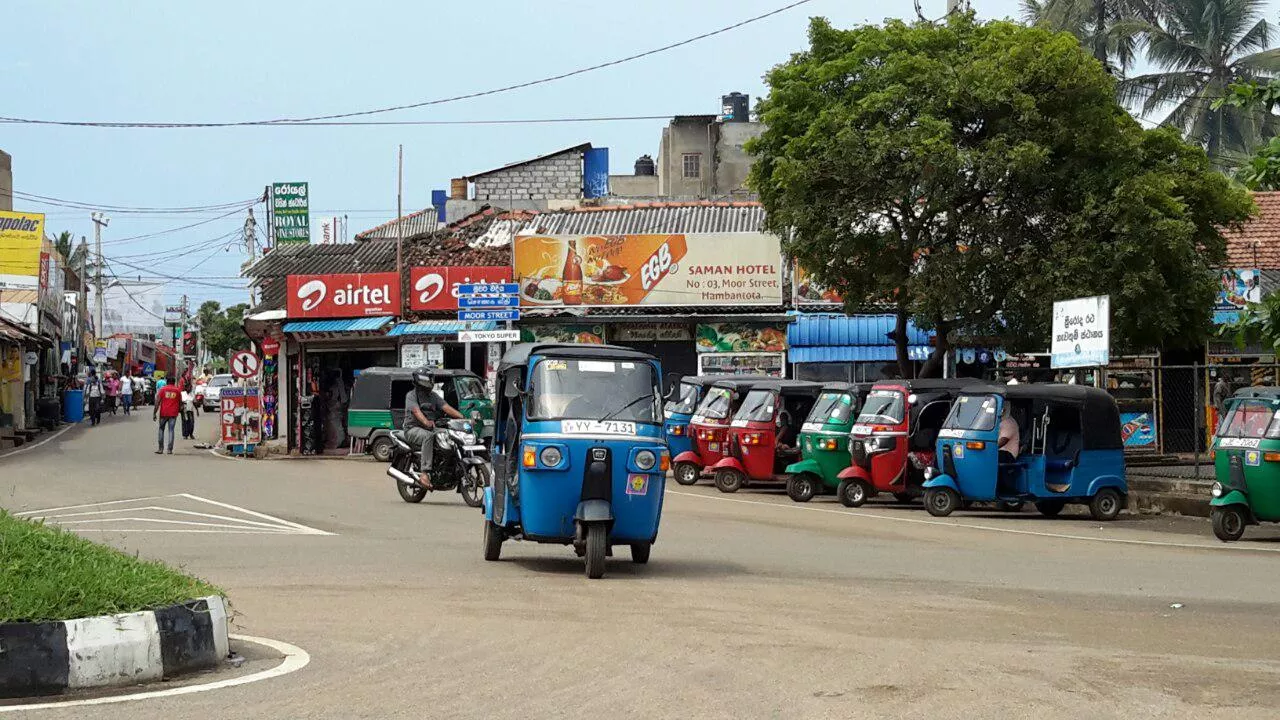
Sri Lanka is certainly one of the most relaxed places in the world, where any stress or tension, even if you wanted it, would actually clash with Buddhist beliefs, which is the main religion on this island, along with a larger Muslim community, making up about ten percent of the total population.

A contributor to the Bosnian news agency Patria, who spent two weeks in this island country in South Asia, describes that people in Sri Lanka live like in Bosnia and Herzegovina, and the former Yugoslavia in general, somewhere in the 1980s.
Finally, tourists from the countries of the former Yugoslavia enjoy a special welcome in Sri Lanka, because of the tree planted by Josip Broz Tito during his visit to this country, which still stands in its place today.
On the island, which according to the 2002 census numbers nearly 20 million people, everyone is doing something. There are almost no unemployed. People are mainly engaged in agriculture and tourism. Technology, or rather – robotics – is not very prevalent, so there is work for everyone.
- What a machine would do in an hour in the West, in Sri Lanka three people do all day, but because of that there is work for everyone. That is one of the ways the government maintains social stability – explained one of the interlocutors of Patria.
Only after the liberalization and privatization of the economy, which began about 20 years ago in Sri Lanka, did the textile industry and food production come to the fore, as well as a strong service sector such as finance and telecommunications. However, even after that, the majority of the island's population did not give up the plantations where they grow tea, rubber, and cinnamon, and where, for example, women earn two or three KM for a whole day's work.

Sri Lanka is officially called the Democratic Socialist Republic of Sri Lanka. It occupies the island of Sri Lanka (historically also called Ceylon) and several smaller islets in the Indian Ocean, southeast of the Indian subcontinent.
Most of the country consists of plains and hilly areas. Mountains are found only in the interior of the island, with the highest peak being Pidurutalagala (2,524 m).
The two largest communities in Sri Lanka are the Sinhalese, mostly Buddhists (75%), and the Tamils, whose religion is traditionally Hinduism (18%). There is also a significant Sunni Muslim community on the island (7%).
After Buddhism was introduced to India more than 2,000 years ago, significant civilizations arose in the areas of today's cities of Anuradhapura and Polonnaruwa. Tamils also migrated from the Indian mainland to the island, settling mainly in the north and along the coasts.
The first European colonizers, the Portuguese, arrived in 1505 and founded the city of Colombo, which is today the capital of Sri Lanka. Later, in the 17th century, the Dutch arrived, but the colonizers limited themselves to occupying only the coastal areas, while the interior remained largely independent with its capital in Kandy, which today is one of the main tourist attractions of Sri Lanka.
Until 1948, the country was a colony of Great Britain, after which it gained independence.
Tourists visiting Sri Lanka mostly want to eat kothu – a mixture of flatbread and various vegetables chopped into thin strips (as well as many other traditional dishes of this country), ride a tuk-tuk, visit Buddhist temples, and attend the Esala Perahara festival in the city of Kandy. Esala Perahara is a Buddhist festival – a parade of elephants, dancers, jugglers, pilgrims... It takes place every year in August, to invoke rain but also as a tourist attraction.
The main attraction of the festival is a golden bell on an elephant, under which supposedly hides the upper left canine tooth of the Buddha. The festival lasts ten days and changes its route through the city every day. Thousands of people and dozens of elephants are eventually joined by the president of the country.

Sri Lanka has been shaken in recent years by two major disasters: a war that lasted from the 1980s, started by the so-called Tamil Tigers because they wanted secession. The war finally ended in 2009 with the victory of the Sri Lankan army.
Unfortunately, in 2004, the island was hit by a tsunami, which claimed tens of thousands of lives. The consequences are still visible, but life is slowly returning.
Komentari (0)
Prijavite se za komentiranje
PrijavaJos nema komentara. Budite prvi!
Minuta
Sve →Iz drugih kategorija

High Representative Not Elected: Germans, French and British Against Americans, New Attempt at End of June

ČOVIĆ WITHOUT MERCY: How Those Who Brought Ademović to Office Created a Political Hell for Him



Sunny Saturday, quite warm



Tragedy in Albanian resort: Two minors drown












