
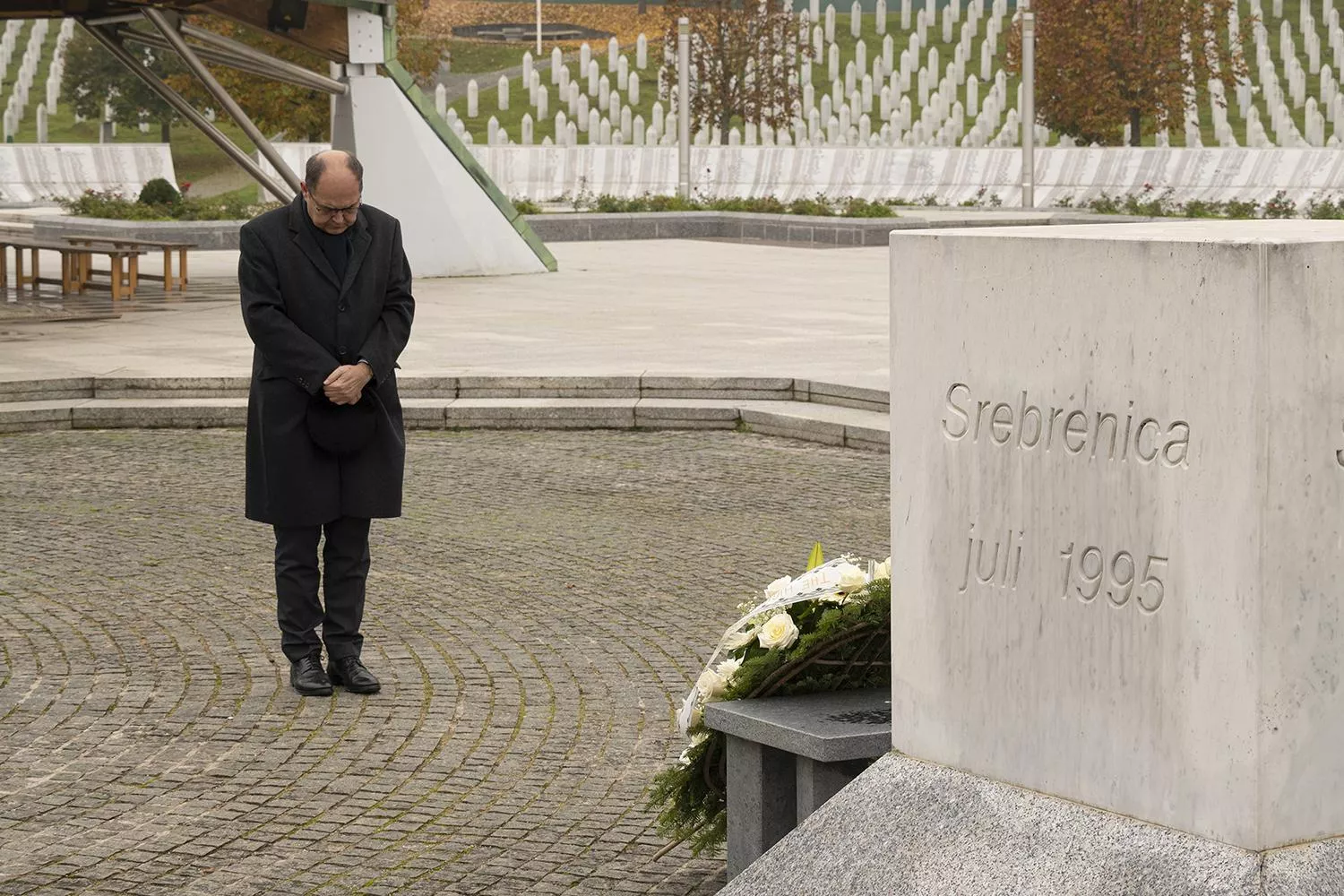
SARAJevo, (Patria) - In the decision by which he enacted the Law on Amendments to the Criminal Code of BiH on July 22, 2021, then High Representative Valentin Inzko, before leaving BiH and Christian Schmidt taking over the duty, clearly specified what is expected from the Parliamentary Assembly of BiH regarding the prohibition of genocide denial, war crimes by judicially convicted persons.
"The law that follows and which forms an integral part of this Decision enters into force as provided for in Article 2 of that Law, on a provisional basis until the Parliamentary Assembly of Bosnia and Herzegovina adopts it in the same form, without amendments and additions and without additional conditions," Inzko stated.
After the amendments to the Criminal Code of BiH came into effect, there may have been a reduction in cases of genocide denial, but there has also been a blockade of state institutions initiated by Milorad Dodik, one of the biggest deniers of genocide in Srebrenica. The blockade has been ongoing for five months, and the political situation in the country is further complicated by amendments to the Election Law of BiH.
By the decree of the President of Republika Srpska, Željka Cvijanović, from mid-October, amendments to the Criminal Code of BiH are not applicable in the BiH entity of Republika Srpska. The Official Gazette of Republika Srpska published the decree on the promulgation of two laws in Republika Srpska. The first relates to the non-application of Inzko's law in Republika Srpska, and the second relates to the prohibition of "belittling and mocking" Republika Srpska.
From Republika Srpska, an offensive was then launched, announcing the withdrawal of Republika Srpska's consent from numerous agreements on the establishment of state institutions, including the Court of BiH, the Prosecutor's Office of BiH, the Indirect Taxation Authority of BiH, the Armed Forces of BiH, SIPA, OSA, and the HJPC.
The National Assembly of Republika Srpska (NSRS) has already passed an entity law on medicines and medical devices, through which it will establish an entity agency for medicines within six months, even though the Agency for Medicines and Medical Devices of BiH exists. This decision was sharply condemned but not punished in any way.
Tomorrow, a session of the NSRS will be held to consider the Information on the return of competencies to the entity of Republika Srpska. Representatives of the OHR have not been allowed to attend the session, and the authorities of that entity do not recognize High Representative Schmidt. The President of SNSD and member of the Presidency of BiH, Milorad Dodik, calls Schmidt "a foreigner who is falsely representing himself." Russia also does not recognize Schmidt, which further encourages Republika Srpska in its plans.
Although Republika Srpska is demanding the withdrawal of Inzko's law in order to return to BiH institutions and unblock processes, Schmidt will not withdraw the law until it is adopted by the Parliamentary Assembly of BiH.
He also stated this in a letter sent to the Speakers of both Houses of the BiH PS.
"I would appreciate the Parliament's intention to replace the amendments to the Criminal Code adopted by the High Representative's Decision with a law that will be passed by the Parliamentary Assembly of Bosnia and Herzegovina. I will be ready to repeal the existing Law when a new law, aligned with European and international standards adopted by the Parliamentary Assembly of Bosnia and Herzegovina, enters into force. The law enacted in July 2021 would then become redundant and would be withdrawn. Until such a decision is made by the people and their representatives, the existing law remains in force throughout Bosnia and Herzegovina," he emphasized.
The letter to the parliamentarians stated that the existing law should be interpreted as a regulation containing two concepts:
"First, the Law applies to individuals who have committed war crimes, not to peoples or ethnic groups as a whole. There is no other possible interpretation. Second, the Law does not differentiate based on the ethnicity of the victims – every victim and their family deserve unconditional respect. The Law also does not differentiate based on the ethnicity of the perpetrator. Any new law regulating this issue should also include these concepts," the High Representative stated in the letter.
However, two key issues arise here. Why did Schmidt leave the possibility in the letter for the law to be passed by the PS BiH without specifying that it must be passed in the same form as Inzko stated in his decision, and by mentioning compromise? And second, why would Republika Srpska accept Schmidt repealing the existing Law if they do not recognize him as High Representative?
Komentari (0)
Prijavite se za komentiranje
PrijavaJos nema komentara. Budite prvi!
Minuta
Sve →Iz drugih kategorija

High Representative Not Elected: Germans, French and British Sabotaged Americans, New Attempt at End of June

ČOVIĆ WITHOUT MERCY: How Those Who Brought Ademović to Office Created a Political Hell for Him



Sunny Saturday, quite warm



Tragedy in Albanian resort: Two minors drown












