
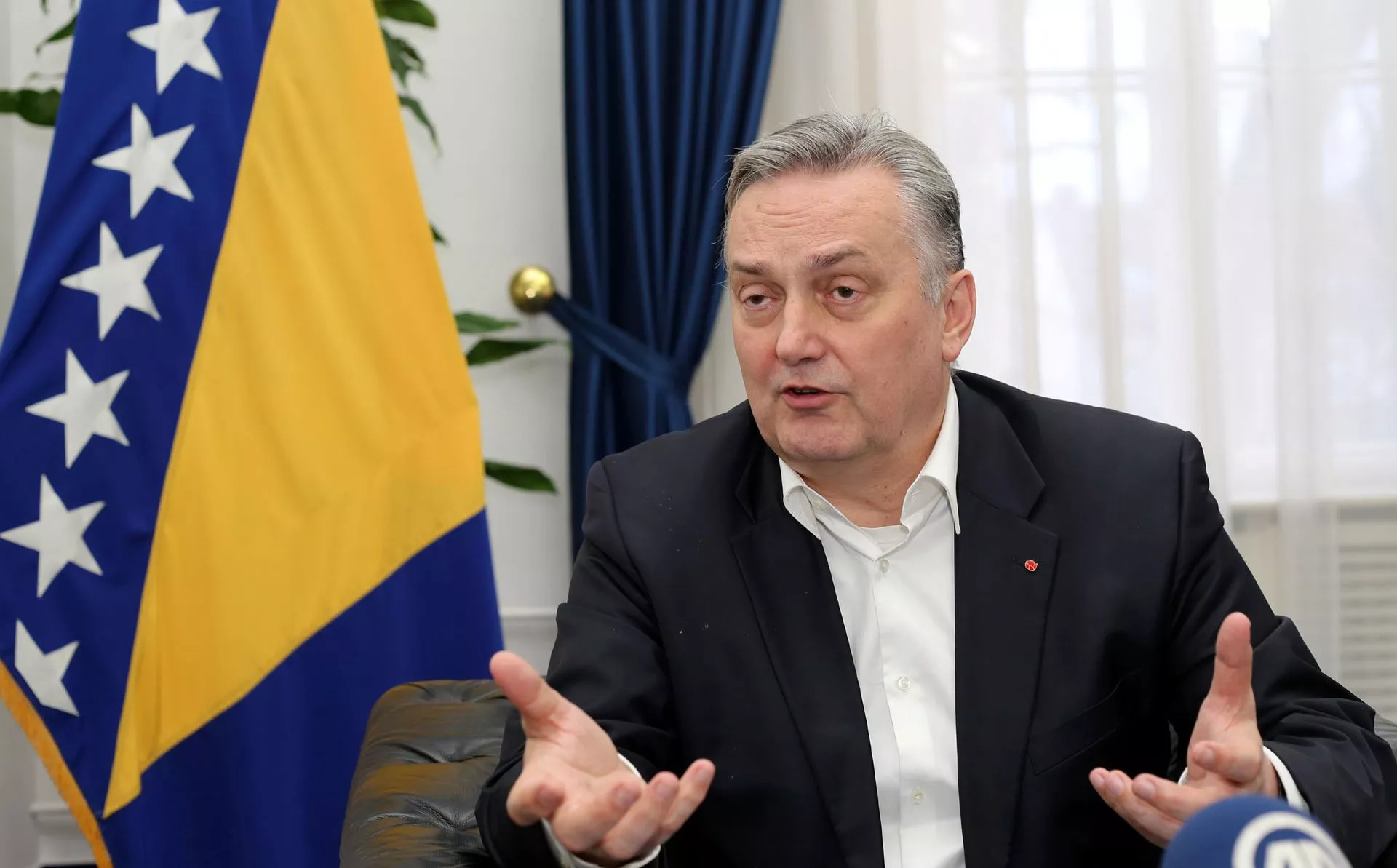
For the public, the international conference “International Decision-Making in the Century of Genocide: Srebrenica 1993–1995”, organized by the US Holocaust Memorial Museum and the Hague Institute for Global Justice, was closed, and among others, Zlatko Lagumdžija, former Minister of Foreign Affairs of Bosnia and Herzegovina, and Hasan Muratović, university professor, participated... writes the Patria News Agency.
A stain on the conference was the fact that Hasan Nuhanović, a former UN interpreter in Srebrenica, was initially invited to this conference, and then his invitation was cancelled with the explanation that some people would feel uncomfortable in his presence.
Nuhanović is one of the key witnesses to the failures of the international community in Srebrenica, where he lost his closest family members, including his mother, father, and younger brother.
Lagumdžija also wrote a reflection on the conference held, and Patria publishes the reflection in its entirety:
“7 Questions and 1 Answer: Yes – Never Again”
The three-day closed session of the Hague Conference “International Decision-Making in the Century of Genocide: Srebrenica 1993–1995”, organized by the “US Holocaust Memorial Museum” and the “Hague Institute for Global Justice”, with the participation of about 50 key actors of that era, survivors, and experts, concluded with a public panel debate titled “International Decision-Making and the Srebrenica Genocide”.
.jpg)
July 2015 marks the 20th anniversary of the murder of about 8,000 Bosnian Muslims trapped in the UN “safe zone” of Srebrenica. The crime defined as “genocide” by the International Criminal Tribunal for the former Yugoslavia, the Srebrenica massacre, was the largest crime against civilians in Europe since the end of World War II.
On July 1, 2015, the Hague Institute and the US Holocaust Museum organized a public debate on the lessons learned from the role of the international community in the events that led to the genocide in July 1995.
The questions discussed also related to the establishment of “safe zones”, the UN mandate, the peacekeeping mission of Dutch troops, and the role of the media.
After the President of the Hague Institute, Dr. Abiodun Williams, moderator David Rohde led the panel in which I participated, along with Yasushi Akashi, Special Representative of the Secretary-General for the former Yugoslavia 1993-1997, Dr. Joris Voorhoeve, Minister of Defence of the Netherlands 1994-1998, General Rupert Smith, UNPROFOR Commander in BiH 1995, Carl Bildt, EU Special Representative for the former Yugoslavia 1995, and Muhamed Duraković, a Srebrenica survivor who worked for international organizations during the war.
In my closing remarks, I posed 7 questions that motivated me to participate in this event. I received and gave one clear answer. The Srebrenica genocide, the last crime of this magnitude at the end of the 20th century in Europe, was not the last battlefield of the clash of civilizations, but a war against Civilization.
Civilization was, and I hope still is, defined through the concept of a Society of shared values on one side, and segregated, exclusive societies driven by greed on the other.
First question. Was it possible to protect the victims or even prevent the crimes in all of Bosnia and Herzegovina and ultimately in Srebrenica?
Second. Do we know, not only who is guilty, but also who is responsible for the massacres, because civilians were not protected, or at least who could be named for the final outcome due to the confluence of circumstances that arose?
Third. Regardless of the heroic presence of individuals and organizations who saved numerous lives, can the overall conduct of the international community and its key actors be declared their “Bankruptcy” in Bosnia and Herzegovina, as well as in Srebrenica, due to gross errors and poor management of processes?
Fourth. Was it legally clear and unequivocally necessary, militarily, in a timely manner, to punish the perpetrators, based on UN Security Council Resolutions 819 and 836 (UNSC), in the first half of 1993, and were these resolutions politically, factually, suspended on the ground where the UN had a legal obligation to protect the victims?
Fifth. Regardless of the international community's failure in the “protected areas”, were “protected areas” and “rapid reaction forces” necessary as an alternative to the ineffectiveness of peacekeeping missions?
Sixth. Do we have enough elements, experience, and expertise to create a new paradigm and tools for the “Responsibility to Protect victims”, as well as to redefine the concept of neutrality – neutral means being where the values on which Civilization rests, not standing at a point that is the geometric mean between innocent victims and brutal perpetrators?
Seventh. For now, the last question. Were the Bosnian-Herzegovinian war crimes, which culminated in Srebrenica, part of a comprehensive vision and strategy that was planned and brutally executed, as opposed to theories claiming it was a simple 4M Model of crime – (Mad Man Milošević and Mladić) Crazy People Milošević and Mladić did it themselves through a confluence of circumstances that happened out of the blue?
After the three-day Conference, having for the first time some previously confidential and inaccessible documents from that period, listening and discussing with some of the key actors of that era, survivors, and experts, I am able to provide the simplest and truest answers to all seven questions.
Yes. Seven times – Yes!
And – Never Again!
For the sake of historical truth, as a prerequisite for justice and reconciliation, at least briefly, only the last question and answer should be elaborated: Srebrenica was only the final phase of a strategically planned project of segregated exclusive societies, based on ethnic cleansing that could have been seen and stopped as early as 1992. By the only possible means that were used for the first and only time from the end of August to mid-September 1995. Military force.
(1).jpg)
These days, we are witnessing the discovery and opening of mass graves around Prijedor. Tomašica and Jakarina Kosa, to mention only two as symbols, are being discovered, and so far, about 400 victims have been identified at the first site and about 700 at the second crime scene.
In June 1992, all non-Serb residents, mostly Bosniaks, were first forced to wear white armbands, so that they would be clearly identified as “different” in every situation. After a few weeks, they ended up in mass graves, some of which we are identifying today.
The world watched and prepared for a “humanitarian” peacekeeping mission. No one stopped or punished the war criminals. Omarska and Keraterm concentration camps were discovered by brave journalists in those areas, and the world was shocked by images that looked like color reprints from the World War II era. No one stopped or punished the war criminals.
In January 1993, Hakija Turajlić, acting President of the BiH Government, was brutally killed in a UNPROFOR armored vehicle while going to Sarajevo Airport for a meeting related to humanitarian aid and was “protected” by French soldiers under the UN flag. No one stopped or punished the war criminals.
In March 1993, General Morillon declared besieged Srebrenica “under UN protection”. Around the same time, Karadžić accepted the Vance-Owen peace plan. After long debates, it was adopted by the BiH authorities, and then Karadžić rejected it.
Although the authorities were promised that if they accepted the Vance-Owen plan and Karadžić rejected it, the arms embargo would be lifted so they could defend the country and the people, this did not happen. Karadžić rejected the plan, the arms embargo on the BiH authorities remained, and Milošević, Mladić, and Karadžić – the (MMK) Trio clearly read the message from the international community: Don't worry – be happy, the international community will not stop you by force, as it threatened, if you do not respect international obligations.
On April 16, 1993, based on Chapter VII of the UN Charter, the UN Security Council (UNSC) adopted Resolution 819, calling on the warring parties to treat Srebrenica as a “safe area free from all armed attacks”.
A week later, a UNSC delegation, led by the UNSC President, Venezuelan Ambassador Diego Arria, visited Srebrenica, calling it and warning that a “Slow Motion Genocide” was taking place there.
On May 16, 1993, the UNSC adopted Resolution 824, declaring Sarajevo, Tuzla, Žepa, Goražde, and Bihać as safe areas, along with Srebrenica. France, Russia, Spain, Great Britain, and the USA adopted a “Joint Action Program” supporting the “safe areas” in BiH. The international community expected these to be messages after which the MMK Trio would take them seriously.
On May 22, 1993, international negotiator David Owen called the concept of safe zones “complete madness” and “a Muslim ploy to draw us into conflict”. The MMK Trio read this as a clear message that they could continue with their plan. Heavy shelling of Sarajevo center that day alone killed 3 civilians, while dozens were seriously injured. I was among the lucky ones who were not killed that day, but I was among the seriously injured. 12 months and 12 critical surgeries later, I was back at work among the surviving Sarajevans.
On June 4, 1993, the UNSC adopted Resolution 836, expanding the mandate of UNPROFOR to include the obligation to “deter attacks against the safe areas”. The resolution called for the withdrawal of all military units “except for the military units of the Bosnian authorities”. A few days later, NATO decided to provide the necessary air support for UNPROFOR to ensure the regime of safe areas.
The legal system and adequate military force were ready to punish anyone who continued to attack civilians and free zones: from Srebrenica and Tuzla, through Žepa and Goražde, to Sarajevo and Bihać.
On February 5, 1994, shelling of Sarajevo at Markale killed 68 people. The military force of the international community did not move. The MMK Trio read the message: To be continued.
During 1994, the army of the MMK Trio continued to attack safe zones, from Goražde to Bihać, and took hundreds of UN personnel hostage in various situations.
On May 24, 1995, General Janvier asked the UN to consider withdrawing from the safe zones. The MMK Trio read this message in their usual way.
On the evening of May 25, 1995, a shrapnel shell from Mladić's army killed 71 and wounded 240 civilians, the vast majority between the ages of 18 and 25, at Kapija, in Tuzla. Shelling of the Tuzla region continued for days.
On May 25 and 26, 1995, NATO bombed ammunition depots of Mladić's army in response to their bringing artillery into the Sarajevo safe zone. Mladić's army, in addition to the crime at Tuzla's Kapija, shelled safe zones throughout BiH and took about 400 UNPROFOR personnel hostage with the intention of deterring NATO from further air strikes.
The next three steps by the international community on May 29, June 4, and June 9, 1995, the MMK Trio read in the same way as usual: To be continued.
On May 29, 1995, the UN Secretary-General issued new instructions for the use of air power, removed General Smith's authority to approve close air support, and stated that “the implementation of the mandate is of secondary importance compared to the safety of UN personnel”.
On June 4, 1995, Generals Janvier and Mladić held a secret meeting in Zvornik regarding the hostage crisis, during which Janvier agreed to abandon threats of air strikes in exchange for the release of hostages. In this way, UN Resolutions 819 and 836 were practically illegally suspended on the ground.
On June 9, 1995, Akashi stated that the UN would strictly adhere to the “principle of peacekeeping” and warned UNPROFOR not to cross the “Mogadishu line”. UN hostages were released.
The MMK Trio once again read this in the same way they had learned to treat the international community: as a weak player that, time and again, left the door open for them to finish their job. The job they started in 1992 by marking “different” people with white armbands.
No one has and no one will stop or punish the war criminals. To be continued.
In July 1995, the “Slow Motion Genocide” was brought to an end by the organized killing of about 8,000 captured Bosniaks and refugees at several different locations. This happened before the eyes of the whole world, and complete documentation about it is available to us.
Regardless of all this, this short list of events clearly shows that every normal person had the right to be surprised and shocked by what happened. But at the same time, it clearly shows that the MMK Trio knew, from beginning to end, what they had planned, led, and executed. During that project, they were certainly not always alone, nor were they the only ones who knew what was happening.
From August 30 to mid-September 1995, General Smith was authorized to issue the order for “Operation Deliberate Force” regarding the “safe zones”, an air combat campaign carried out by about 400 NATO aircraft in cooperation with UNPROFOR ground troops.
What should have been done morally and politically as early as 1992, what should have been done legally at any time from mid-1993, and anytime in 1994 and 1995, before Srebrenica – was done after Srebrenica.
After “Operation Deliberate Force”, the MMK Trio finally understood and read the message: The big boys said, “Enough is enough!”
On September 15, 1995, Mladić accepted the withdrawal of heavy weapons around Sarajevo.
On November 1, 1995, the Dayton peace talks began.
Komentari (0)
Prijavite se za komentiranje
PrijavaJos nema komentara. Budite prvi!
Minuta
Sve →Iz drugih kategorija

High Representative Not Elected: Germans, French and British Sabotaged Americans, New Attempt at End of June

ČOVIĆ WITHOUT MERCY: How Those Who Brought Ademović to Office Created a Political Hell for Him



Sunny Saturday, quite warm



Tragedy in Albanian resort: Two minors drown












