
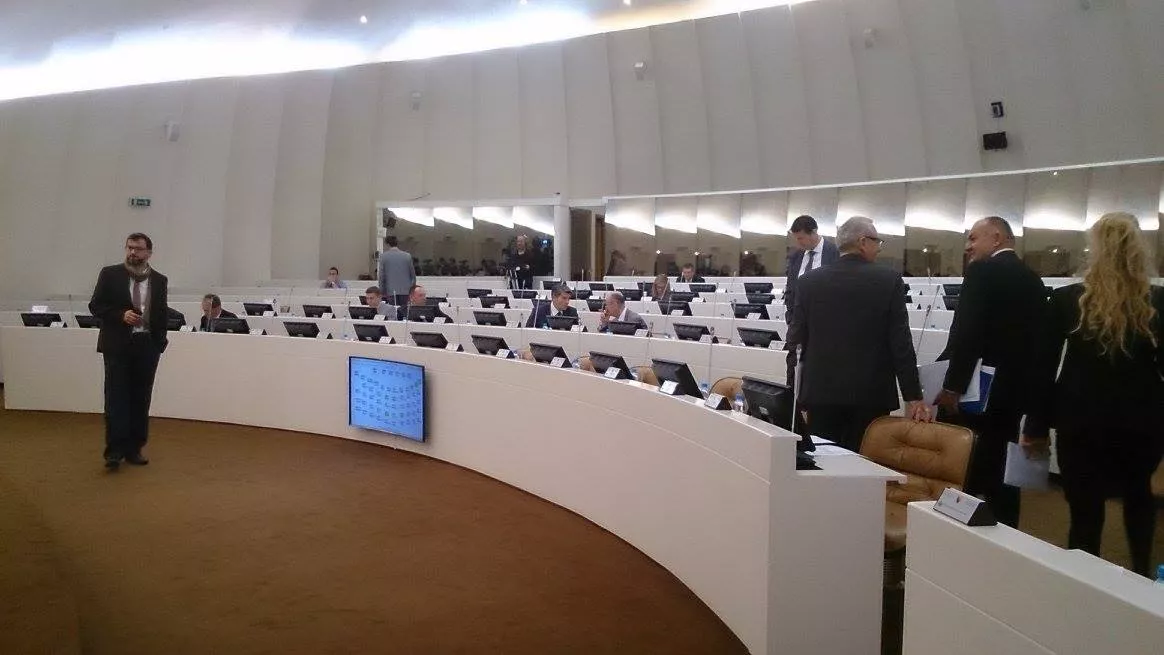
2:20 The Joint Session of both houses of the Parliamentary Assembly of Bosnia and Herzegovina has concluded, during which deputies and delegates posed questions to the Council of Ministers of Bosnia and Herzegovina. A total of 28 questions were asked and answered. The session passed peacefully and without major tensions due to the impossibility of rebuttals, and among the ministers, Dragan Mektić, the Minister of Security, was absent, justified by a business trip.
2:01 Damir Bećirović, a deputy of the Democratic Front (DF) at today's session, asked what is the amount of money that Bosnia and Herzegovina must pay to plaintiffs based on final court rulings against the institutions of Bosnia and Herzegovina.
- What are the interest rates due to non-compliance and disregard of court rulings, and whether the Ministry of Justice of Bosnia and Herzegovina and the Ministry of Finance and Treasury of Bosnia and Herzegovina have made any payment plan for plaintiffs, or will they continue to allow default interest to accumulate through non-payment according to court rulings, thus damaging the budget of Bosnia and Herzegovina – asked Bećirović.
Josip Grubeša, Minister of Justice of Bosnia and Herzegovina, stated that the Ombudsman submits rulings to the Ministry of Finance, which then immediately makes payments. Grubeša did not specify figures, although he referred to audits, which bothered Bećirović, who called on the minister and the Ministry of Justice to take greater responsibility.
12:33 Dragutin Rodić was interested in details regarding the Census of Population, which was conducted back in 2013.
As we all know, both in the Parliamentary Assembly of Bosnia and Herzegovina and the general public in Bosnia and Herzegovina, after many years of different views on legal solutions regarding the population census, the Law on the Census of Population, Households, and Dwellings in Bosnia and Herzegovina was finally adopted in 2011. Legal prerequisites were created to finally carry it out.
This was necessary for many reasons, primarily for a strategic approach and planning in many areas of economic and social life, and for implementing various policies (economic, social, health, pension, returnee, displaced persons, etc.).
One of the most dangerous possible manipulations in a country like Bosnia and Herzegovina is manipulation with numbers. The population census was conducted in October 2013. Today, two years after the census was conducted, we still do not have the final results of the census.
In the meantime, we adopted the principles of Bosnia and Herzegovina's approach to the European Union, the Reform Agenda for Bosnia and Herzegovina for the period 2015-2018.
What is the current status of activities related to the census and when can the final results be expected? What are the unresolved issues within the Central Census Bureau due to which a unified data processing program has not been adopted – asked Rodić.
Adil Osmanović, Minister of Civil Affairs, told Rodić the following:
- The data processing process is not going according to plan. There is no consensus among institutions. The Agency for Statistics, in cooperation with entity institutes, has jointly harmonized all books for publication. The unresolved issues are the derivation of the total population and resident population. Statistical institutions have no agreement on this – Osmanović pointed out, stating that the Institute of Statistics of Republika Srpska insists that, in addition to questions 1 to 7, question 40 be included in the P 1 form.
Rodić said he expected to know when the census results would be published. Osmanović said that the census results will not be published in 2015.
12:10 Amir Fazlić, a deputy of the Party of Democratic Action (SDA) in the House of Representatives of the Parliamentary Assembly of Bosnia and Herzegovina, is interested in “how many diplomatic and consular missions Bosnia and Herzegovina has abroad (embassies, permanent missions to international organizations, consulates general), and besides their usual tasks, what is their role in strengthening economic ties with the countries where these missions are located.
From that aspect, which missions would the competent ministry, the Ministry of Foreign Affairs, particularly highlight (with a concrete example of the embassy's impact on economic cooperation), and how much is spent annually on rent for the embassies in Belgrade and Zagreb – asked Fazlić.
Igor Crnadak, Minister of Foreign Affairs, when answering this question, said that Bosnia and Herzegovina has 56 diplomatic and consular missions, including 44 embassies, 6 permanent missions, and 6 consulates general.
- Economic diplomacy is a priority in the ministry. There are many concrete examples, because very few bilateral meetings take place without including economic cooperation. Our network and diplomats can achieve real effects if we successfully carry out reforms. A total of 234,699 KM is allocated for the rent of embassies in Belgrade and Zagreb – Crnadak pointed out.
11:53 Denis Bećirović, a deputy of the Social Democratic Party (SDP), asked what the Council of Ministers of Bosnia and Herzegovina specifically undertook towards international and domestic institutions and authorities with the aim of ensuring respect for the elementary human right of citizens who speak the Bosnian language, as one of the three equal languages throughout the entire state territory of Bosnia and Herzegovina, and what are their concrete results in this regard.
He added that it did not stop only with removing the prefix “Bosnian” from the names of cities. Bećirović said that every nation can democratically declare itself as it wishes and speak whichever language it wants.
Semiha Borovac, Minister for Human Rights, said that all three languages are in an equal position.
- The ministry has registered only one case, which is before the ombudsmen, and which concerns the use of the Bosnian language. We have a problem with the use of the Bosnian language in the education system, and it has been established that there is segregation in some schools. Regarding the violation of human rights for the use of the Bosnian language, the members of the Peace Implementation Council (PIC) have also been informed – Borovac pointed out.
Bećirović said that he addressed the question to the Chairman Zvizdić, and that he is dissatisfied with the answer.
- It does not occur to me to say that someone in the Council of Ministers is to blame for the denial of the Bosnian language. But I expected you to address where the problem comes from, and it is not from the territory of Bosnia and Herzegovina. It comes from the Serbian Academy of Sciences and Arts in Belgrade – says Bećirović.
11:41 Hazim Rančić, a deputy in the House of Representatives of the Parliamentary Assembly of Bosnia and Herzegovina, asked what measures and actions have been taken by all levels of government to fulfill the Reform Agenda, reports a Patria reporter.
- As is known, the House of Representatives of the Parliamentary Assembly of Bosnia and Herzegovina adopted the Reform Agenda at its 16th session on 27.08.2015. Point 5 of the Reform Agenda states that implementation will begin immediately without delay. A broad set of medium-term priorities will be translated into concrete initial measures and undertakings that will be prepared and implemented in the coming months of 2015 and early 2016, with each institution individually. Given that two months have passed since the adoption of the Reform Agenda, please state the measures and actions taken to implement the Reform Agenda – Rančić pointed out.
This question was answered by Prime Minister Denis Zvizdić, who said that the agenda will help resolve all problems in a short time.
- The text of the reform was adopted by all levels of government. All measures aim to stimulate economic activity in Bosnia and Herzegovina. Since everyone aimed to immediately start implementation and the development of action plans, and they all did so. Through symbiosis, it will enable valid monitoring. Activities have already begun and we can speak of satisfactory implementation. Everything is proceeding at the planned pace – said Zvizdić.
11:20 The joint session of both houses of the Parliamentary Assembly of Bosnia and Herzegovina has begun in Sarajevo, reports a reporter from the Patria news agency.
Deputies of the House of Representatives and delegates of the House of Peoples of the Parliamentary Assembly of Bosnia and Herzegovina (PABiH) will be able to ask questions to members of the Council of Ministers today at the first special joint session of both houses.
28 questions were submitted to members of the Council of Ministers of Bosnia and Herzegovina. Ognjen Tadić at the beginning of the session asked that the time limit of three minutes allocated for asking a question be respected.
Komentari (0)
Prijavite se za komentiranje
PrijavaJos nema komentara. Budite prvi!
Minuta
Sve →Iz drugih kategorija

High Representative Not Elected: Germans, French and British Sabotaged Americans, New Attempt at End of June

ČOVIĆ WITHOUT MERCY: How Those Who Brought Ademović to Office Created a Political Hell for Him



Sunny Saturday, quite warm



Tragedy in Albanian resort: Two minors drown












