
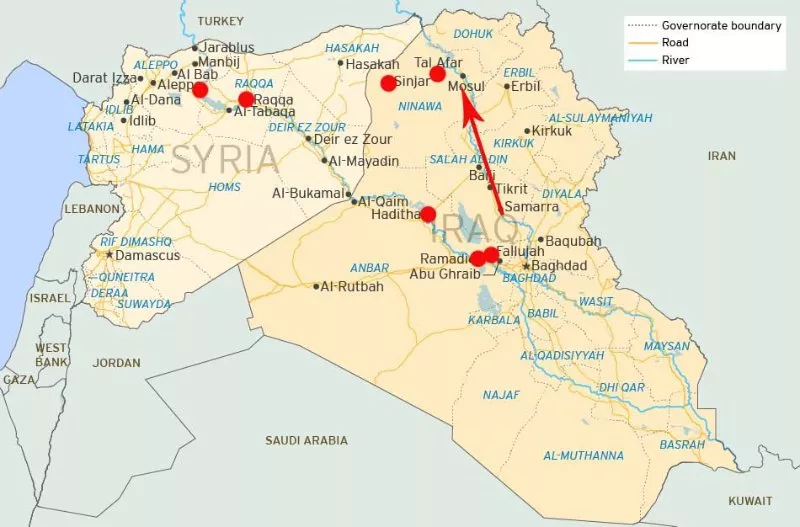
The International Institute for Middle Eastern and Balkan Studies (IFIMES) from Ljubljana, Slovenia, regularly analyzes events in the Middle East and the Balkans. From an extensive analysis of events surrounding the so-called Islamic State (ISIL) titled "Mosul Operation Crucial for ISIL," we are publishing the most interesting parts, reports the Patria News Agency.
The city of Mosul is the capital of the Nineveh province in northern Iraq. It is the second-largest city in Iraq with 2.5 million inhabitants. The majority of the population are Sunni Arabs, there are about 400,000 Kurds in the city, and besides them, Assyrian Christians, Chaldean Catholics, Yazidis, Turkmens, Armenians, etc., live there.
Near Mosul are rich oil fields and the Qayyar refinery. The city developed on the banks of the Tigris River. Only 50 kilometers north of Mosul is the largest dam (Mosul Dam), which is the fourth largest in the Middle East.
Mosul is, among other things, a historical city where several Old Testament prophets are buried: Jonah, Daniel, etc. Prophet Abraham also resided there for some time.
After World War I and the establishment of the state of Iraq in 1921, Mosul was the subject of a dispute between Turkey, as the successor to the Ottoman Empire, and Great Britain, as the mandatory power in Iraq.
Only after the agreement with official Ankara in 1926 did the province of Mosul become part of Iraq, on the condition that for 25 years it would give up 10% of its oil share to Turkey. According to the same agreement, Turkey has the right to protect the Turkmens in Mosul. Thus, Turkey can intervene, however, it should be emphasized that the Turkmens in that area (Mosul, Talafar) are adherents of the Shiite branch of Islam, loyal to the Shiite government in Baghdad and Iran, and not to Sunni Turkey at all.
During the Kingdom of Iraq from 1921 to 1958 and the Republic of Iraq from 1958 to 2003, most officers and generals in the Iraqi army came precisely from Mosul. They were a very strong support for the Sunni government from 1931 to 2003.
Sunnis Left to Themselves
With the fall of Saddam Hussein's regime and the disbandment of the Iraqi army and security apparatus, Sunnis were largely left on the streets without any income. The Sunnis of Mosul became potential sympathizers of Al-Qaeda and were a symbol of resistance against the American occupation and the Shiite government in Baghdad. Their resistance spread from the north to the provinces of Tikrit in the central part of the country, Diyala in the east, and Anbar in the west.
In 2007, after a fierce sectarian war between Shiites and Sunnis, the Americans established Sunni militias called Sahwa. Thus, 60,000 men in the Sunni areas got jobs and regular salaries. Their status was not regulated in the agreement (SOFA) between the US and Iraq on the withdrawal of American forces. By the end of 2012, they fell out of favor with the Shiite government of Prime Minister Nouri Al-Maliki. Not only did funds for the population decrease, but the Iraqi Prime Minister even accused some Sunni tribes of participating in the overthrow of the central Iraqi government. The withdrawal of the last American soldier was effectively the beginning of the second Sunni uprising, which continues to this day. The patrons of these uprisings were Al-Qaeda, various radical organizations, and finally ISIL.
After a two-year political crisis between the Shiite government in Baghdad and the Arab Sunni minority between 2012 and 2014, Prime Minister Nouri Al-Maliki's government violently suppressed peaceful demonstrations in those provinces. The Iraqi government used planes and helicopters to attack the tent settlement of demonstrators in Fallujah and Hawija (50 km from Kirkuk). In April 2013, this was the fiercest attack on civilians, in which 221 demonstrators were killed.
Concurrently with these attacks, a political war was taking place in Baghdad between the government and the democratically elected representatives of the Sunnis. The Prime Minister and the Court issued arrest warrants for the Vice President of the Republic of Iraq, Tariq Al-Hashimi, in 2012, for the arrest of the Deputy Prime Minister and Minister of Finance, Rafi Al-Issawi, and in 2013, an attack was carried out on the house of a member of the Iraqi parliament, Ahmed Al-Alwani, in which his brother and five of his bodyguards were killed. The representative was arrested on November 23, 2014, and sentenced to death, which has not yet been carried out.
The witch hunt continues. Anyone who opposed the Baghdad government's policies was branded as being connected to Al-Qaeda and remnants of the former regime.
Sunnis now have representatives and several ministers who, in fact, have no power because they have become ordinary officials who have no right to represent their voters. At the same time, with the arrival of ISIL, they lost contact with their base and loved ones in the areas they come from.
Sunnis Joyfully Accepted ISIL?
In that violent polarization and political-social distrust, Sunnis joyfully accepted ISIL, which filled the void of their exclusion from the political process and began to represent their interests. Sunnis found a savior in Abubakr Al-Baghdadi, who had previously led the military wing of Al-Qaeda. Since 2010, he managed to unite several rebel and radical groups in the areas of Syria and Iraq. Later, he broke all ties with the Al-Qaeda branch called the Al-Nusra Front. On April 8, 2013, Al-Baghdadi formed the Islamic State in Iraq and the Levant (historical Syria) with its capital in Raqqa, Syria.
In early 2014, ISIL managed to recruit and spread like cancer through the Sunni areas of Iraq, from Ramadi in the west to Mosul in northern Iraq.
Later, the largest coordinated attack and a great victory for ISIL followed, when in a week-long offensive from June 4 to 10, 2014, they captured the city of Mosul. Only 1,500 ISIL members forced 30,000 Iraqi soldiers, armed with modern American weapons, to abandon their barracks and flee towards the Kurdistan region (30 km from Mosul). North of Mosul, ISIL continued its fight towards Baghdad and on June 11, 2014, they captured Iraq's largest oil refinery, Baiji, 200 km from Baghdad.
On June 29, 2014, Abubakr Al-Baghdadi announced the establishment of a caliphate and declared himself caliph. In doing so, he erased all state borders and internationalized his state, which would unite all Muslim countries of the world and liberate Rome and Mecca (not Jerusalem), which have symbolic significance for Christians and Muslims. By internationalizing the state, he opened the door for all radical Islamist elements from around the world.
In Mosul, ISIL acquired heavy weapons of the 2nd Corps of the Iraqi army, several helicopters, four billion USD in the treasury of the central bank in Mosul, and the entire state infrastructure and administration.
The Iraqi parliament later formed an investigative committee to investigate the cause of the fall and the flight of 30,000 trained soldiers in front of 1,500 ISIL members. Some commanders accused Prime Minister Al-Maliki of issuing the order to abandon their positions. The committee never concluded its work due to fierce government pressure, and such an unbelievable defeat was never clarified.
Offensive on Mosul
The international operation against ISIL led by the US began on October 10, 2014, under the name Combined Joint Task Force - Operation Inherent Resolve (CJTF-OIR), which unites 67 countries.
In the 18 months of this operation, ISIL has lost or been forced to withdraw from 40% of Iraq's territory. ISIL still controls part of the border with Syria and a large part of the desert in the west of the country. Of the major cities, only Mosul remains under their control, which is why the Mosul operation has primarily psychological importance for the coalition, the Iraqi government, and ISIL.
The Iraqi government, in agreement with the US, launched Operation Fatah (conquest) on March 24, 2016. The greatest success of this operation was the capture of the city of Qayyarah and the nearby airport, 60 km from Mosul. The US sent an additional 560 soldiers to rebuild the airport and prepare for the Iraqi army's attack from the south towards Mosul. Meanwhile, American soldiers and instructors from coalition countries in Makhmur trained two brigades of Kurdish units (Peshmerga) and the 15th and 16th brigades of the army for a simultaneous attack on Mosul from the north and northeast. The western part of Mosul is connected to the desert and Syria, so it is theoretically impossible to encircle the city from the west as well.
The main Iraqi attack would be led by two Peshmerga brigades with 10,000 members, the 15th and 16th divisions of the Iraqi army with 20,000 members, and 6,000 members of pro-government Sunni tribes trained by the US, 200 Marines, and about 500 foreign military advisors and instructors who will advise these forces.
The possible participation of Shiite militias called Hashid in these operations, as well as the Turkish army, which has its soldiers 30 km from Mosul without the permission of the federal Iraqi government, remains controversial. Analysts expect the attack on Mosul to begin in October 2016, or at the latest by the end of 2016.
ISIL put up strong resistance in some areas, for example in Fallujah (50 km from Baghdad) in May 2016; the fighting lasted 76 days.
In the city, they held 70,000 civilians as human shields, thus hindering the actions of aviation and artillery. Their withdrawal from the city was strategically planned, as they managed to evacuate people and equipment without major losses. Some cities like Ramadi, Baiji, and Tikrit were abandoned almost without a fight.
The Mosul operation has sparked debate about how ISIL will behave. Will they withdraw from the city towards the western desert and the Iraqi-Syrian border after the first attack? Will they resist to the end in the city? Will they use civilians as human shields as in Fallujah?
In early September 2016, ISIL began digging a two-meter-wide trench around the city of Mosul, and near it, they placed large tanks filled with oil. With these tanks, they would cause a fire during the attack, which would certainly stop or at least slow down infantry units. Dense smoke would hinder reconnaissance activities and effective bombing by aircraft.
Iraqi generals expect a very difficult battle for Mosul, which is home to over a million people. They are mostly Arab Sunnis, who are not at all enthusiastic about the arrival of the Iraqi army and the Americans.
Any irresponsible action and indiscriminate attacks on civilian targets in the city can harm the entire operation. The Iraqi army needs to win the sympathy and favor of the population first; this is important not only for expelling ISIL but also for the future coexistence in the city. Any other or retaliatory action will trigger resistance that will encompass the entire Sunni region. The Iraqi government and the Americans have never had full control over Mosul since 2003.
ISIL, largely composed of former trained soldiers, officers, and intelligence agents of the overthrown Saddam regime, are aware of the military and psychological weaknesses of the Iraqi army and will therefore fight to the end. They will use civilian casualties in their media war, which is quite successful. In the worst-case scenario, they will leave Mosul from the west towards the desert and the Syrian border.
ISIL's Military (Im)possibilities
In Iraq, ISIL has over 500 artillery pieces and several thousand mortars, 2,300 light military vehicles, several thousand off-road vehicles, about 100 tanks (T-55, T-72, M1A1M Abrams), more than 20 Gvozdika rocket systems, BM-21 Grad, Drone Mohajer, etc.
Their unconventional weapons include car bombs, suicide attackers, improvised roadside bombs, chemical weapons, and especially mustard gas, which they have already used in Iraq and Syria, most recently on September 22, 2016, in an attack on the Qayyarah airport.
The UN Security Council estimates in its report that ISIL has 22,000 foreign fighters from 100 different countries. Estimates of the number of members vary. The CIA's estimate is perhaps the most realistic, stating a number between 19,000 and 25,000 members in Iraq and Syria.
According to Kurdish data, there are about 15,000 local fighters and an additional 10,000 foreign fighters in northern Iraq, including Mosul. This does not include their police, religious police, tax service, and other administrative staff.
The International Institute IFIMES believes that Mosul will be liberated. It is important how the victors (the Iraqi army and Kurdish units) will behave afterward. The Americans have already warned them that they must be very careful with civilians, especially at checkpoints, where they will need to distinguish civilians from ISIL members. In the past, serious human rights violations and mass executions of innocent civilians have occurred precisely at checkpoints.
The Iraqi government must finally start including Sunnis in the political process. The battle for Mosul must not be a battle for territorial conquest but primarily a battle for winning the favor of the people (Arab Sunnis). This is the only formula for expelling ISIL and for the unity of the state of Iraq, which is now strongly divided in all segments.
Komentari (0)
Prijavite se za komentiranje
PrijavaJos nema komentara. Budite prvi!
Minuta
Sve →Iz drugih kategorija

High Representative Not Elected: Germans, French and British Sabotaged Americans, New Attempt at End of June

ČOVIĆ WITHOUT MERCY: How Those Who Brought Ademović to Office Created a Political Hell for Him



Sunny Saturday, quite warm



Tragedy in Albanian resort: Two minors drown












