
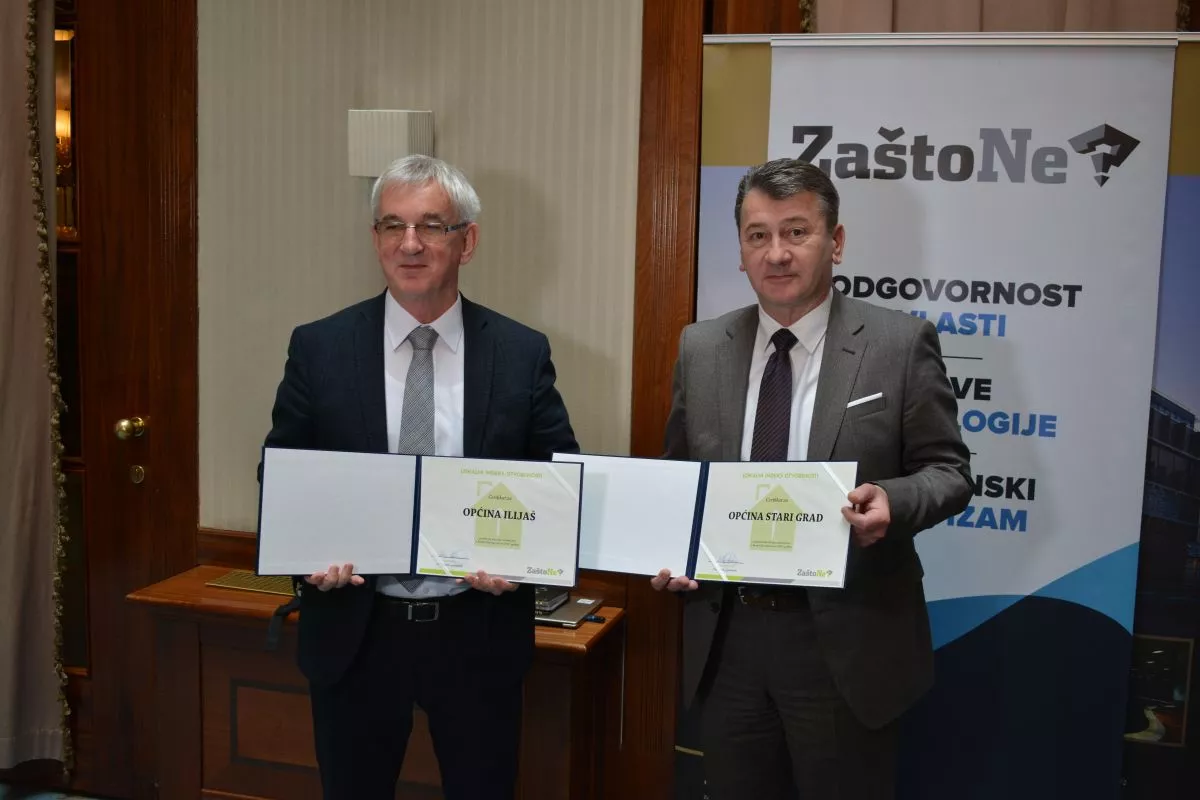
SARAJEVO, (Patria) - The Old Town Sarajevo Municipality ranked first in the analysis of the openness of local self-governments in Bosnia and Herzegovina with 66.95% of indicators met. The monitoring was conducted in a total of
145 municipalities in BiH, as well as the City of Sarajevo, the City of East Sarajevo, and the Brčko District. At today's press conference of the Association "Why not", the research results were presented, and the mayor, Mr. Ibrahim Hadžibajrić, was presented with the certificate THE OLDEST TOWN MUNICIPALITY – the most open local self-government in Bosnia and Herzegovina for 2019.
"This is a great recognition, especially considering that the research covered all municipalities in BiH, although we were also declared the most transparent municipality last year, only on a smaller sample. I would like to take this opportunity to thank my associates and employees who contributed to such good results with their work. I am aware that there is still room for improvement, but there is also a lot that we are unable to do due to unclear laws that burden local self-government and hinder us. I hope this will be an incentive for other local self-government units in BiH as well, and that the five of us who ranked highest on this list
will be an example for other municipalities in BiH," said the mayor after receiving the certificate.
He added that efforts will continue to raise the level of transparency in order to increase this percentage by at least 15-20%.
The analysis covered four principles: transparency, accessibility, integrity, and efficiency, and assessed budget transparency, public procurement, public debates, access to information, reporting on the Municipal/City Council, and more. The monitoring was conducted for the fourth consecutive year by the Association "Why not", and as stated by Selma Aščerić from this association, local authorities in BiH in 2019 met a total of only
34% of the set indicators.
"The Old Town Municipality had a truly good result of 67%, the City of Tuzla met 60% of the indicators, the City of Bijeljina 59%, the Municipality of Ilijaš 58%, and the Municipality of Tešanj with a result of 58%. These municipalities and cities had the best results in terms of the measurement for 2019," said Aščerić.
Researchers checked websites, some municipalities still don't have them
The monitoring results were also presented through an accompanying brochure, which shows the ranking of all 145 local self-government units and the mentioned cities and districts. Speaking about the Sarajevo city municipalities and the City of Sarajevo, the Old Town Municipality ranks first with 66.95% of fulfilled indicators, Novo Sarajevo Municipality is in seventh place with 53.53%, followed by Centar Municipality in 22nd place with 44.75%, the City of Sarajevo in 28th place with 42.07%, and Novi Grad Sarajevo Municipality in 68th place with 35.35% of fulfilled indicators.
Aščerić also pointed out that the monitoring showed chronic deficiencies in certain data, such as: inadequate implementation of the Law on Free Access to Information, planning and spending of budget funds, i.e., publication of decisions related to the spending of budget funds, outdated websites of municipalities and cities, and more.
Danira Karović from the Association "Why not" spoke about the method of conducting this monitoring.
"Our researcher opens the municipal website and goes through 80 or more indicators, checking whether the municipality, city, or district has that data on its website. Some are very simple data, such as: whether the municipality publishes its statute, work plan, rules of procedure, etc., while some are more complex," said Karović, explaining that the set of indicators they evaluate was created based on the methodology, i.e., recommendations of international institutions.
"These include budgets, budget execution reports, work plans, work reports, public procurements, strategic documents, competencies, etc.," she explained.
Goal: Easier access to information
The goal of the project is to achieve proactive transparency, a way of working in which an institution publishes plans, programs, and documents it has created within seven days, and to enable easier public access to information without invoking the Law on Free Access to Information, it was stated at the press conference. Unfortunately, there are still cases of municipalities and cities that do not have websites or whose websites are inadequately and untimely updated, and local communities in most cases do not even have monthly bulletins about their work and current events in those local communities.
Slightly less than half of the institutions, 48% of those covered by the research in 2019, did not conduct any form of public consultations regarding the draft budget for that year, and only 18 local self-government units in BiH have a document called "Budget for Citizens".
In the Old Town Municipality, the monitoring was conducted at the end of last year when a questionnaire sent by the Association "Why not" was completed, with affirmative answers to most of the questions asked. In addition, it was necessary to provide links to documents and information claimed to be public and located on the municipal website. Among these were links leading to publications of budgets, public debates, public calls and tenders for non-governmental organizations, the municipal bulletin, etc.
See the results here ( http://starigrad.ba/userfiles/file/2020/2/Otvor_lok_samouprave.pdf ) for all local self-government units in BiH.
Komentari (0)
Prijavite se za komentiranje
PrijavaJos nema komentara. Budite prvi!
Minuta
Sve →Iz drugih kategorija

High Representative Not Elected: Germans, French and British Sabotaged Americans, New Attempt at End of June

ČOVIĆ WITHOUT MERCY: How Those Who Brought Ademović to Office Created a Political Hell for Him



Sunny Saturday, quite warm



Tragedy in Albanian resort: Two minors drown












