
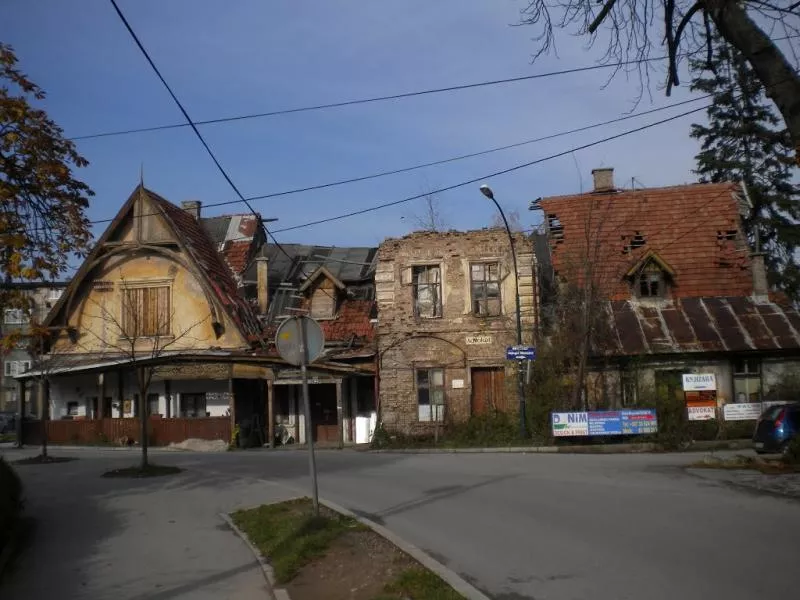
(Patria) - The Ilidža Municipal Council on Wednesday adopted a decision granting consent to the municipal mayor, Nermin Muzur, to conclude a property purchase agreement for the purpose of restoring and rehabilitating the historic building - the Old Railway Station building in Ilidža, Sarajevo.
In this way, the Municipality of Ilidža continues its activities towards creating prerequisites for the restoration of the Old Railway Station, an object of great historical importance which was declared a national monument of Bosnia and Herzegovina in 2007. The first important step in that direction was made at the end of 2022, when the Mayor of Ilidža Municipality, Nermin Muzur, also with the consent of the Municipal Council, signed agreements for the purchase of two apartments located in the Old Railway Station building.
History of the Ilidža Railway Station
The Ilidža Railway Station building is located at the western exit of the city of Sarajevo, in the center of the Ilidža settlement, at Muhameda Mehmedbašića Street number 22. The building is oriented east-west with its longer side, and the main entrance is on the south side. The building was accessed from an access road (today's Muhameda Mehmedbašića Street). The railway line was located on the north side of the building, at the site of the present-day Sarajevo–Mostar highway, where the platform exit was.
The construction of the railway line also included the construction of accompanying facilities. Thus, during the construction of the Sarajevo–Brod railway line in 1882, Sarajevo got its first city railway station, about three kilometers from the city center. This main railway station was connected to Ilidža by the local Sarajevo–Ilidža line, which was built on May 25, 1890. In 1892, the local Ilidža–Banja Ilidža line was also built, 1.3 km long, which was connected to the Sarajevo–Metković line. In the same year, the railway station in Ilidža was built, according to the project of the Technical Department of the Bosnian-Herzegovinian State Railways. The station building in Ilidža is the first building of its kind from the Austro-Hungarian period and the only railway transport facility in Ilidža.
The building was most likely built according to the project of Franjo Blažek, a Czech architect who worked in the Construction Department of the Provincial Government in Sarajevo between 1889 and 1903.
The building served its purpose until the abolition of the narrow-gauge railway Sarajevo–Metković–Ploče on November 26, 1966, when it was converted into residential space. The building was in good structural condition until 1996, when the roof structure of the eastern part of the building was completely destroyed due to a fire. Due to atmospheric influences and the lack of repair work on the damaged roof, the building is rapidly deteriorating. The eastern wing and the central tract are particularly endangered.
The Old Railway Station building in Ilidža, with its prominent sloping roofs and richly decorated wooden eaves, represents a typical example of the "Alpine architecture" of the Austro-Hungarian period. The building has architectural forms characteristic of most buildings of this purpose (station buildings), and they are also found in residential buildings. The main characteristic of the "Alpine" construction style is the extensive use of wood for both structural and decorative purposes. The construction style applied to this building was "imported" from the Alpine region, and due to its great similarity to indigenous architecture, it was well accepted, especially in residential and public building architecture.
The station building has two wings, east and west, connected by a communication tract. The entrance area consisted of a vestibule (hall) on the south side of which was the main entrance to the building, and on the north side, the exit to the platform. On the south and north sides of the vestibule, there were covered communication areas - verandas (porticos), which were connected to the porticos on the south and west sides of the building. On the ground floor of the west wing, there were originally two waiting rooms for 1st, 2nd, and 3rd class. On the ground floor of the east wing, there were office spaces, a staircase, and sanitary facilities, and later an apartment for the manager was added to the southeast part. Vertical communication was achieved via a two-flight staircase. The upper floor was intended for living. After the abolition of the narrow-gauge railway in 1966, the station building space was converted into residential space with several housing units.
The Ilidža railway station building was constructed from traditional materials, wood and brick. The structural elements of the building consist of foundations, brick walls, floor structures, and roof structures.
The structural walls of the building are made of brick, with a thickness of 50 cm on the ground floor and first floor, and 70 cm in the basement. The internal partition walls are made of brick, approximately 35 and 15 cm thick. All walls, both inside and outside, are plastered and painted. At the corners of all facade walls, there are decorative blocks approximately 40 cm wide.
The thickness of the floor structure on the ground floor and first floor is approximately 30 to 45 cm, made of wooden beams with a wooden floor laid over them.
The station building is covered with gable roofs, originally with beaver tiles and later with channel tiles. The roofs are high, steep, made of massive wooden roof structures with large, richly decorated eaves that had carved wooden ornaments.
The roof has seven dormer windows and five high brick chimneys.
The north facade has fourteen window openings of various sizes, three of which are dormer windows. The windows are wooden, made in six or nine panes, and have decorative frames made of facade bricks on the facade. Five double wooden doors with glazed panes and transoms were also installed on this facade. The south facade has eleven windows of various sizes and six double wooden doors. The west facade has five, and the east facade has six window openings. The west facade also has one double door.
After the Bistrica station is renovated, the revitalization of the old railway station in Ilidža will surely be another tourist attraction in Sarajevo.
Komentari (0)
Prijavite se za komentiranje
PrijavaJos nema komentara. Budite prvi!
Minuta
Sve →Iz drugih kategorija

High Representative Not Elected: Germans, French and British Sabotaged Americans, New Attempt at End of June

ČOVIĆ WITHOUT MERCY: How Those Who Brought Ademović to Office Created a Political Hell for Him



Sunny Saturday, quite warm



Tragedy in Albanian resort: Two minors drown












