
In the state Agency for Medicines and Medical Devices, nearly 90,000 KM were spent on representation over three years, i.e., on catering services that the state paid for employees and their guests.
The director of this agency, Nataša Grubiša, allowed journalists from the Center for Investigative Journalism (CIN) from Sarajevo to view the documentation to check if the spending of public money was justified. However, her assistant, Zoran Josipović, tried to limit access to information. He separated a part of the documentation for the journalist, which he thought she could look at: "That will be enough for you!"
He changed his mind when the journalist pointed out that the director had approved everything requested. "I will give you this now because it has already been approved for you, but no one will ever get this again," he threatened. When the journalist reminded Josipović that according to the Law, she had the right to view information held by public institutions, he said: "Don't try to talk to me about law, you are weak!"
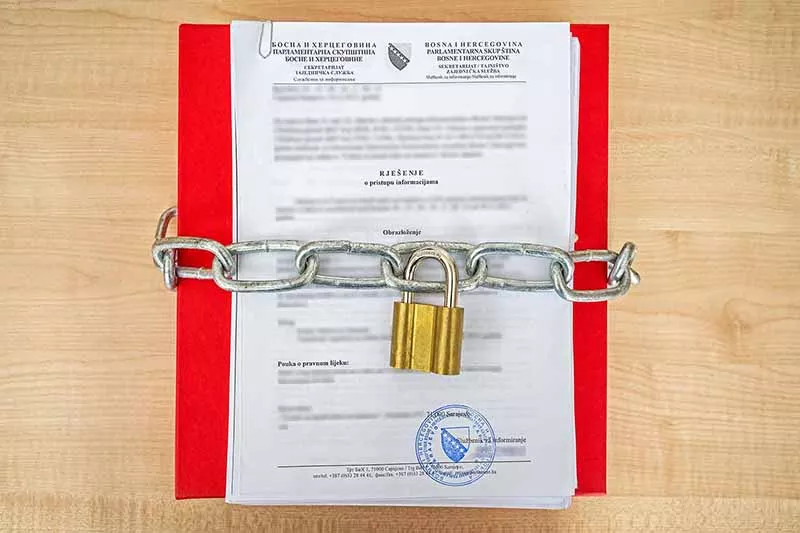
Although laws exist in Bosnia and Herzegovina (BiH) that allow citizens free access to information, in practice, this freedom is limited. According to CIN's research, data on the spending of state money is often hidden, and unfounded reasons are given to deny access to information of public interest. Approval of access to information is left to individuals within institutions who arbitrarily interpret the laws.
From Request to Document
The Law on Freedom of Access to Information in Bosnia and Herzegovina (ZOSPIBiH) was adopted in 2000 at the initiative of the international community. The following year, similar laws were adopted by both entities – the Federation of Bosnia and Herzegovina (FBiH) and Republika Srpska (RS). The laws were adopted to make information held by public institutions accessible to citizens, thereby increasing transparency and accountability of institutions.
- Such an approach strengthens public trust in government bodies - says Mehmed Halilović, a media law expert.
According to existing laws, all citizens and legal entities have the right to information held by public institutions, unless it concerns information whose disclosure could harm state security or jeopardize the right to protection of personal and confidential commercial data. If institutions do not have the requested data, they must forward the request to the correct address, but they are not obliged to collect the data themselves.
In order for citizens to obtain certain information, they must write a request to the institution that holds it, specifying as precisely as possible what data they are requesting and in what form: whether they want a copy of the information sent to their address, to be allowed direct inspection, or to personally pick up a copy of the document. Institutions must not ask for reasons or question why the request was made. Citizens are also not obliged to state reasons in their request.
To facilitate the right to access information, administrative bodies and public enterprises are obliged to appoint information officers who process incoming requests, as well as to create and publish a guide to accessing information and a list of information under their control on their website. However, according to research by the Center for Social Research "Analitika", as many as a third of the 66 state institutions, even after almost 15 years since the adoption of the Law, did not have these documents on their website.
According to the Law, institutions in BiH must respond to a request within 15 days. If they fail to do so, citizens can complain about administrative silence to administrative inspectors.
Unlike entity laws, under the state ZOSPI, inspectors have had the right to impose a fine of up to 15,000 KM for administrative silence since the end of 2013. However, this has never happened so far. During that period, they received eight complaints, but the institutions provided the requested data after a warning.
If the request concerns information containing personal and confidential commercial data or data whose disclosure could harm state security, the institution may provide only part of the information to citizens or completely reject the request, stating the reasons why it must withhold the information.
However, before making a final decision, institutions must conduct a so-called "public interest test." This means that when making a decision, they must consider all circumstances why certain data would be kept secret and check whether the public interest in their disclosure prevails.
The Institution of Ombudsmen for Human Rights of BiH, which monitors the application of ZOSPI, states that in practice, even judicial institutions issue decisions rejecting requests without having conducted a "public interest test" and that institutions do not understand its meaning. "Without this segment, all decisions made are flawed and as such are subject to review through the appeal procedure," says Ombudsman for Human Rights of BiH, Jasminka Džumhur.
Submitting requests for free access to information is free, but the requested information is not always. According to entity laws, up to ten pages of requested data are not charged, while the state law allows the first 20 pages to be free. Each page beyond that costs up to half a KM.
Copying documents on property or company registration is charged according to the price lists of administrative or court fees, which significantly increases the costs of accessing information.
Arbitrary Interpretation of the Law
According to CIN's research, granting access to information depends on the officer, i.e., the institution that received the request, as well as the information requested. It happens that for the same request, some institutions provide information, while others deny it, citing protection of personal or commercial data.
This happened when CIN journalists decided to check whether the citizens' suspicion that job competitions in public administration are only formally announced, while the jobs are actually intended for people already working on a fixed-term basis in those institutions, was founded.
Journalists sent requests to 54 state institutions, asking for the names and surnames of employees, their positions, and the basis of their employment contracts. Thirty-three institutions responded, and 21 institutions ignored or rejected the request due to alleged protection of employees' personal data. From the collected data, it was clear that over five years, at least 260 people had already worked in positions for which competitions were announced, after which they were permanently hired for those positions.
Institutions often, upon receiving a request, seek an opinion from the Personal Data Protection Agency of BiH to know whether providing certain data is contrary to the Law on Personal Data Protection, but they are not obliged to act on it.
The Secretariat of the Parliamentary Assembly of BiH also sought an opinion from the Agency when CIN requested the amounts of salaries and other benefits received by 57 parliamentarians over a three-year period. Since they did not receive an opinion, they proceeded as follows: instead of the requested data, they sent a list of legal, statutory, and sub-statutory regulations governing the entitlements to which MPs and delegates are entitled, and an explanation that they do not have ready information on their individual amounts.
"There were varying interpretations as to whether salaries are an individual's personal right or not. The Law on Personal Data Protection has protected certain things, and we acted out of inertia," says Zlatko Vukmirović, information officer for the Parliamentary Assembly.
However, journalists obtained the same data from the Ministry of Finance and Treasury of BiH. The data shows that professional parliamentarians, with average salaries of 4,500 marks, are entitled to additional benefits that increase their monthly income to up to 8,000 KM.
According to the opinion of the Personal Data Protection Agency of BiH, officers handling requests must distinguish between information that must be provided upon request and personal data that needs protection, such as someone's personal identification number, address, or phone number. However, even such data must be disclosed if it is determined that there is a public interest in doing so. "Public interest is most easily recognized. In fact, it is fully contained in employment in public service. Their salaries and everything else concerning public officials, citizens should know by inertia," says Samira Čampara, Assistant Director of the Agency, for CIN.
There are a number of excuses that officials within institutions find to reject requests for free access to information, which are often submitted by journalists on behalf of citizens. Then officials demand that the request be on letterhead, have a stamp and signature of an authorized person, and so on. Citing the protection of commercial interests is the most common excuse for refusing access to contracts with private companies, such as public procurement contracts and concession agreements for natural resources.
From Complaint to Court
Institutions that do not want to provide the requested information often justify this by limitations from other laws adopted after ZOSPI, but not harmonized with it, such as the Law on Taxes, the Law on Classified Information, or the Law on Personal Data Protection.
For example, the Public Enterprise "Elektroprivreda Hrvatske zajednice Herceg Bosne" from Mostar refused to explain to the public why they did not collect about one million marks in debt for electricity from three private companies. They rejected the journalists' request for access to data, explaining it by the rules from the Law on Public Enterprises of FBiH, the internal statute, and the code of ethics, which consider the requested information a business secret.
Media law expert Halilović believes that the government, which quickly and easily voted for ZOSPI 15 years ago, did not fully understand that it grants great freedom and rights to citizens to monitor what the government is doing. Therefore, they have changed their minds in the meantime: "The issue is that these governments have consciously violated and reduced these rights with new laws," he says.
In practice, this means, for example, that any request for data on salaries and benefits of politicians and officials in RS is rejected because the Labor Law states that this is not public data.
Transparency International BiH (TIBiH), which has been fighting for respect for freedom of access to information for years, believes that such a response is unacceptable because the institution must act according to ZOSPI and its rules for rejecting requests in such cases, and not solely according to the Labor Law. Therefore, citizens who receive such a response have the right to appeal.
According to the laws, the decision to deny access to information must indicate to whom and within what period the appeal should be filed. Usually, it is the head of the same institution or the Appeals Council within the Council of Ministers. At the same time, citizens can seek advice and assistance from the Institution of Ombudsmen for Human Rights of BiH. This institution received 218 complaints last year from citizens whose right to access information was denied by other institutions.
If the appeal is not accepted, citizens can initiate legal proceedings before the competent courts: the Court of BiH, district courts in RS, and cantonal courts in the Federation, due to the denied right to access information. If the court rules against the institution, it will reconsider its decision, which does not necessarily mean it will provide the requested data.
Over the past six years, TIBiH has filed 73 lawsuits at all levels of government in BiH, except in the Brčko District: 34 judgments were in their favor, they lost four cases, and 28 proceedings are ongoing. In seven cases, the institution decided to provide the data while the case was in court.
Mehmed Halilović says that as an assistant to the Federal Ombudsman for Media, he recommended filing lawsuits to all parties whose rights he believed were denied. He believes that ombudsmen and the media must guide citizens to exercise their right to access information, thereby drawing the authorities' attention to the need to act in accordance with the law.
"There is no government that will automatically act fully in accordance with the law if it is not forced to. Therefore, we must force them!"
Written by: Center for Investigative Journalism (CIN)
Komentari (0)
Prijavite se za komentiranje
PrijavaJos nema komentara. Budite prvi!
Minuta
Sve →Iz drugih kategorija

High Representative Not Elected: Germans, French and British Sabotaged Americans, New Attempt at End of June

ČOVIĆ WITHOUT MERCY: How Those Who Brought Ademović to Office Created a Political Hell for Him



Sunny Saturday, quite warm



Tragedy in Albanian resort: Two minors drown












