
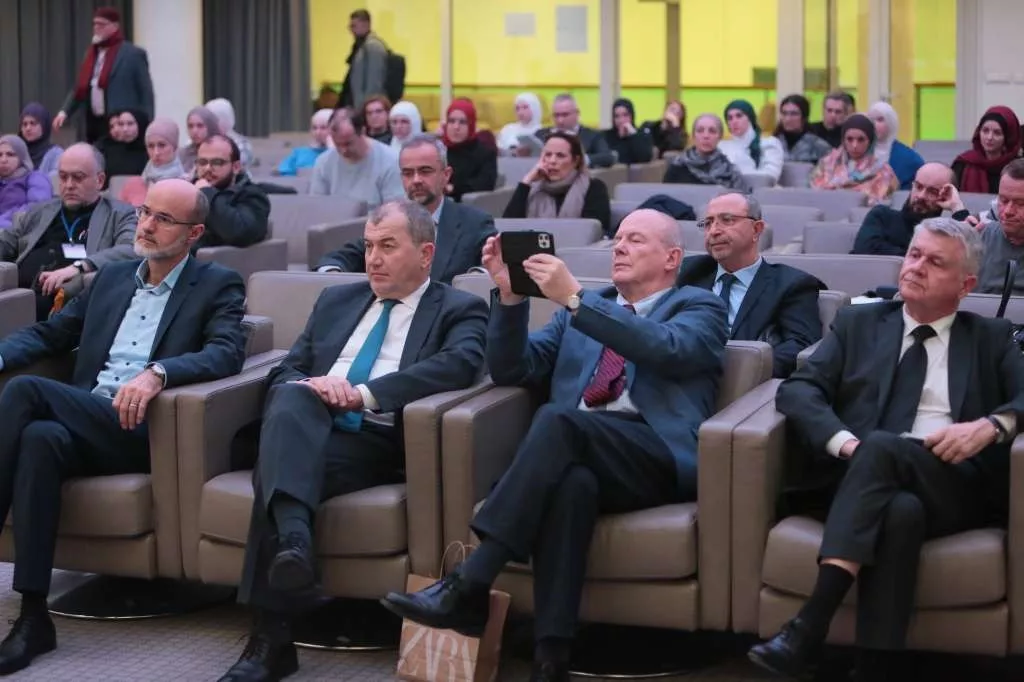
(Patria) - The forum "Islam and the Challenge of Pluralism in a Globalized World," organized by the Faculty of Islamic Sciences, Gazi Husrev-beg Library, the international initiative ResetDoc, and the Moulay Hicham Foundation, was held today at the Gazi Husrev-beg Library in Sarajevo, reported MINA agency.
This forum is part of a conference of the same name, which aims to present the research of a working group on Islam and pluralism, as a component of the multireligious and comparative project "Theologies and Practices of Pluralism" by the international initiative ResetDoc.
Opening remarks were delivered by Prof. Dr. Ahmet Alibašić from the Faculty of Islamic Sciences, Executive Director and co-founder of Reset DOC Giancarlo Bosetti, as well as founder and president of the Prince Moulay Hicham Foundation.
- Pluralism today in the world, and also in our region, is under pressure, as are many liberal values. This is largely a result, in our case, of the traumas we have experienced and, in fact, our failure to manage our differences. Both our experience and science teach us that plurality is good; however, if we do not know how to manage our differences, we suffer traumas from it. Thus, we have reached a situation where a blessing has been turned into a source of our curse. What we are trying to achieve here today is to put that process back on the right track, so that we can begin to appreciate our differences again - said Alibašić.
He added that there are several important steps on that path.
- One of them is to accept and recognize each other as human beings who have the right to seek salvation in accordance with their conscience. Second, that God is the judge for all of us in our differences, and that will be on the Day of Judgment, not here. And third, until that Day of Judgment, we should prepare ourselves by competing in good deeds, who will be better, who will be faster, rather than understanding our competition as a boxing round in which we must knock the other down. This is easier said than done. These experts have gathered here to help us think about how to achieve that goal - Alibašić stated.
Hicham said that for a long time he thought religion was retreating from the global stage in secular states.
- But I think we see that people are very connected to faith and want to live within their faith, but they want to live in a way that fits their needs in the modern world, and that is on a personal level. On a state level, the state must adapt to faith, but at the same time, a democratic balance must be struck, maintaining the independence of faith and state. On the regional scene, where we see the return of faith, I am not an advocate of a clash of civilizations; faith is also present. For all these reasons, citizens of all countries must be involved in these issues, seeking ways to live their faith in a way that suits them, but also to accept others and show tolerance towards them - he said.
The panel included Jose Casanova, Jocelyne Cesari, Prince Moulay Hicham, Prof. Dr. Ahmet Alibašić, Prof. Dr. Nedžad Grabus, Mohsen Kadivar, and Jerusha Rhodes.
- We are pleased that the Faculty of Islamic Sciences, led by Dean Dr. Mustafa Hasani and colleague Alibašić, has managed to organize such a significant conference in Sarajevo. Sarajevo, by its structure, has been a pluralistic and diverse place for five or six centuries within our region. Islam is extremely important to us as Bosniaks, as a people living in Bosnia and Herzegovina, but it is a great world religion, a civilization. Islam communicates with other religions, and it is important for us in Bosnia and Herzegovina to understand these processes, what is happening in the world. Everyone says that new recompositions of the world are happening. If we want to talk about that, then, of course, it is important that we in our country also understand what these processes are, that we open up some critical evaluations, theology, ethics - stated Prof. Dr. Nedžad Grabus, Sarajevo Mufti.
There are products that people produce, the Mufti added, emphasizing that these products, or ways of thinking or practice, can be problematized.
- We as humans have an obligation to particularize and verify them, and when we do this with people who deal with this issue, who come from the advanced part of the world to which we aspire, in terms of Bosnia and Herzegovina's accession to the European Union, where there will be even greater challenges in incorporating Islam into the broader community, into the European one, especially for us indigenous Muslims, it is important to see how people in Europe, academic citizens, think about this. This is an opportunity to meet some people. Science knows no borders; people in all academic fronts and institutions are asking questions, and we in Sarajevo are also asking questions and hope that, God willing, we will have good answers - Prof. Dr. Grabus concluded.
Casanova assessed that "for 30 years now we have been witnessing the deprivatization of religion; religion is entering the public sphere of life and participating in public issues and moral questions. This is good."
- At the same time, globalization connects all religions. They must accept each other, and this is a process. I call this a global denomination of religions where they call each other by their proper names. This is a very important process. Today, religious groups are often better at conducting inter-religious dialogues than secular political groups - he emphasized.
Panelists discussed the results of the working group on Islam and pluralism, referring to both internal and external diversity, focusing on Sunni-Shia relations, gender, blasphemy, and apostasy.
They also delved into comparisons of similar challenges in Catholic, Orthodox, and Jewish traditions.
Komentari (0)
Prijavite se za komentiranje
PrijavaJos nema komentara. Budite prvi!
Minuta
Sve →Iz drugih kategorija

High Representative Not Elected: Germans, French and British Sabotaged Americans, New Attempt at End of June

ČOVIĆ WITHOUT MERCY: How Those Who Brought Ademović to Office Created a Political Hell for Him



Sunny Saturday, quite warm



Tragedy in Albanian resort: Two minors drown












