
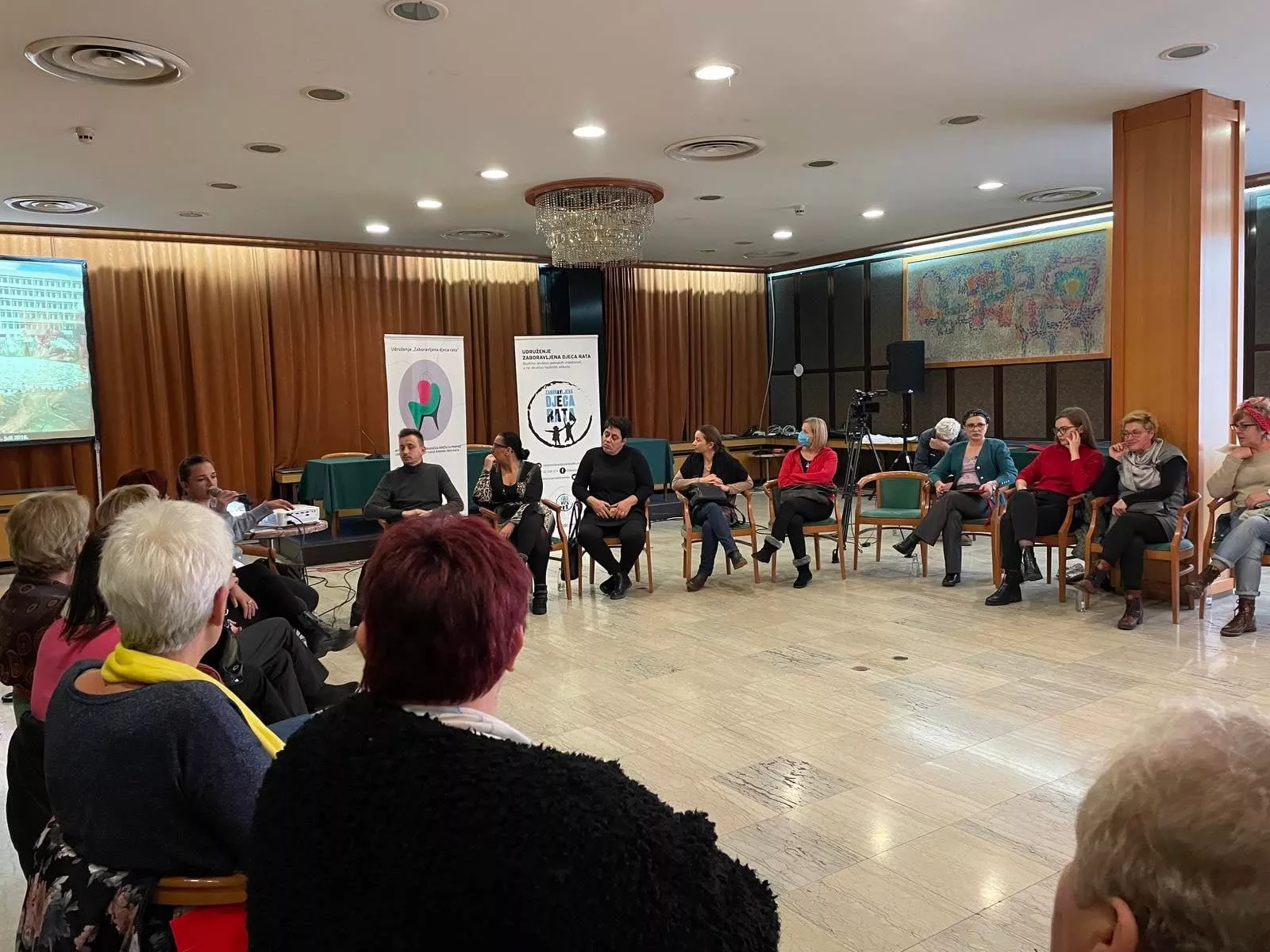
SARAJevo, (Patria) - The association „Forgotten Children of War“ organized a three-day conference titled „Visibility of Children Born of War“ which was held from November 24 to 26, 2021, in Sarajevo. The conference aimed to, in cooperation with related organizations in BiH and other actors, ensure the participation of women survivors and children born of war in the processes of developing strategies, policies, and processes that affect their status, thereby contributing to the improvement of the position of women survivors and the equality of children born of war in BiH society and globally.
The conference opened with a panel „Legal Recognition of Children Born of War“ which took place at the Historical Museum of BiH. The panel featured Ajna Jusić, president of the Association „Forgotten Children of War“; Dr. Amra Delić, researcher at the international network CBOW; Lejla Arnaut, lawyer and external associate of the Forgotten Children of War Association, and Mirela Spahović from the Federal Ministry of Labour and Social Policy.
The panelists presented the issue of systemic and social non-recognition of the vulnerable group of „children born of war“. In terms of human rights and legally, this category is not recognized, resulting in an unequal and unfair status compared to other citizens of Bosnia and Herzegovina. Mirela Spahović from the Federal Ministry of Labour and Social Policy pointed out that the current Law on Protection of Civilian War Victims does not include the category of „children born of war“, that a new Law including this category has been pending since 2019, and its adoption is planned by the end of the current or the beginning of next year.
Dr. Amra Delić, among other things, emphasized that every child has the right to know their origin, and referred to a study conducted in 2016 by the Association „Forgotten Children of War“ according to which „more than 50% of children stated that they had been discriminated against, stigmatized, and rejected“. She also highlighted the importance of recognizing needs and risks, developing specific protection protocols for working with children born of war, and stated that it is devastating that there are no training programs for psychologists and psychiatrists on working with survivors of wartime sexual violence. The recommendation from the panel is the necessity of training mental health professionals in working with traumatized categories.
During the second day of the conference, two panels were held. The first panel „The Status of Women Survivors of Wartime Sexual Violence and Their Right to Reparation“, featured Midheta Kaloper Oruli, president of the Association of War Victims Foča 92-95; Mirsada Tursunović from the Association for Assistance to Victims and Survivors of Sexual Violence in War „Our Voice“ Tuzla; Adila Suljević from the Association for Assistance to Victims of Sexual Violence in War „SUZE“ Brčko, and Selma Korjenić, „TRIAL International“ from Sarajevo.
The panel discussed the current situation in BiH regarding the Law on Protection of Civilian War Victims. The panelists emphasized that equal criteria for acquiring rights for women survivors of wartime sexual violence are needed at all levels of government, and that it is essential for survivors to be included in the processes of developing policies and strategies on this topic. They should be recognized as a separate category in the Law, specific programs with clearly defined needs of this category should be created, and it is extremely important for survivors to be systematically and rehabilitatively empowered to speak about their experienced trauma. Selma Korjenić from Trial International pointed out that it is devastating that there are restrictive provisions regarding the proof of wartime sexual violence, that special rules are necessary in dealing with survivors, as well as the abolition of the 5-year statute of limitations for reporting violence and an increase in monthly compensation for victims of wartime sexual violence. A very important message from the panel is the crucial joint strength of the civil and public sectors, as well as international support in the fight for the rights of women survivors of wartime sexual violence.
The second panel „Stigma and Discrimination - Consequences of Violence on BiH Society - From the Perspective of Youth“ addressed the role of youth in peacebuilding. The panel featured: Medina Mujić from the CURE Foundation, who discussed discriminatory textbook policies in the Sarajevo Canton; Azra Frlj from the Association for Psycho-Social Support and a Better Future „Progres“, who spoke about stigma, discrimination, and transgenerational trauma, and its transmission to the next six generations; Edna Haznadarević from the Pedagogical Institute of the City of Mostar, who highlighted the importance of an approach in working with young people and raising their awareness of the (non)recognition of violence and conflict within families, schools, and society as a whole; and Layla Mulić from the Association of High School Students in Bosnia and Herzegovina, who, through her personal example, emphasized the importance of generational transmission of positive narratives to young people, with the aim that they too feel supported by society and the system.
The third day of the conference opened with the panel „Transitional Justice - Process and Peacebuilding in BiH“. It was concluded that the right to justice; the right to truth; memorialization, compensation, reparation, and institutional reform, as well as the guarantee of non-repetition, represent the four fundamental pillars of transitional justice, without which we cannot even consider further progress in building a better and healthier society. The panelists also touched upon the strong influence of the media on transitional justice and their role in creating a healthier society, but also the fact that some media outlets shape their reporting according to the interests of ruling political elites. The importance of a culture of remembrance, memorialization of places of suffering, and honoring victims and survivors was emphasized. The panel included Denis Džidić from the Balkan Investigative Reporting Network of Bosnia and Herzegovina – BIRN BiH, Benjamin Sabljica from the Association for Transitional Justice, Accountability, and Memory – TPOS, and Marijana Toma, an expert in the field of transitional justice from Serbia.
The conference concluded with an interactive lecture by artist Aida Šehović titled „The Role of Art in Peacebuilding“, on the topic of the monument „What Is Not There“, which is a monument to the memory of the genocide in Srebrenica.
At the very end of the conference, the president of the Association, Ajna Jusić, concluded that just as trauma is transmitted, so is the fight for justice. United in empathy, solidarity, and struggle, we are ready to create a stronger society for all future generations. The entire conference program can be viewed by citizens on the Facebook page of the Association Forgotten Children of War at https://www.facebook.com/zaboravljenadjecarata/
Forgotten Children of War (ZDR) is a Bosnian-Herzegovinian global organization advocating for the legal and social recognition of children born of war based on positive practice from BiH. In order to achieve legal and social recognition and respect for children born of war, through activism, public advocacy, research, networking, and art, we contribute to the elimination of stigma and discrimination against this social category. We desire a solidarity-based and inclusive society without violence, in which the rule of law is respected.
Komentari (0)
Prijavite se za komentiranje
PrijavaJos nema komentara. Budite prvi!
Minuta
Sve →Iz drugih kategorija

High Representative Not Elected: Germans, French and British Sabotaged Americans, New Attempt at End of June

ČOVIĆ WITHOUT MERCY: How Those Who Brought Ademović to Office Created a Political Hell for Him



Sunny Saturday, quite warm



Tragedy in Albanian resort: Two minors drown












