
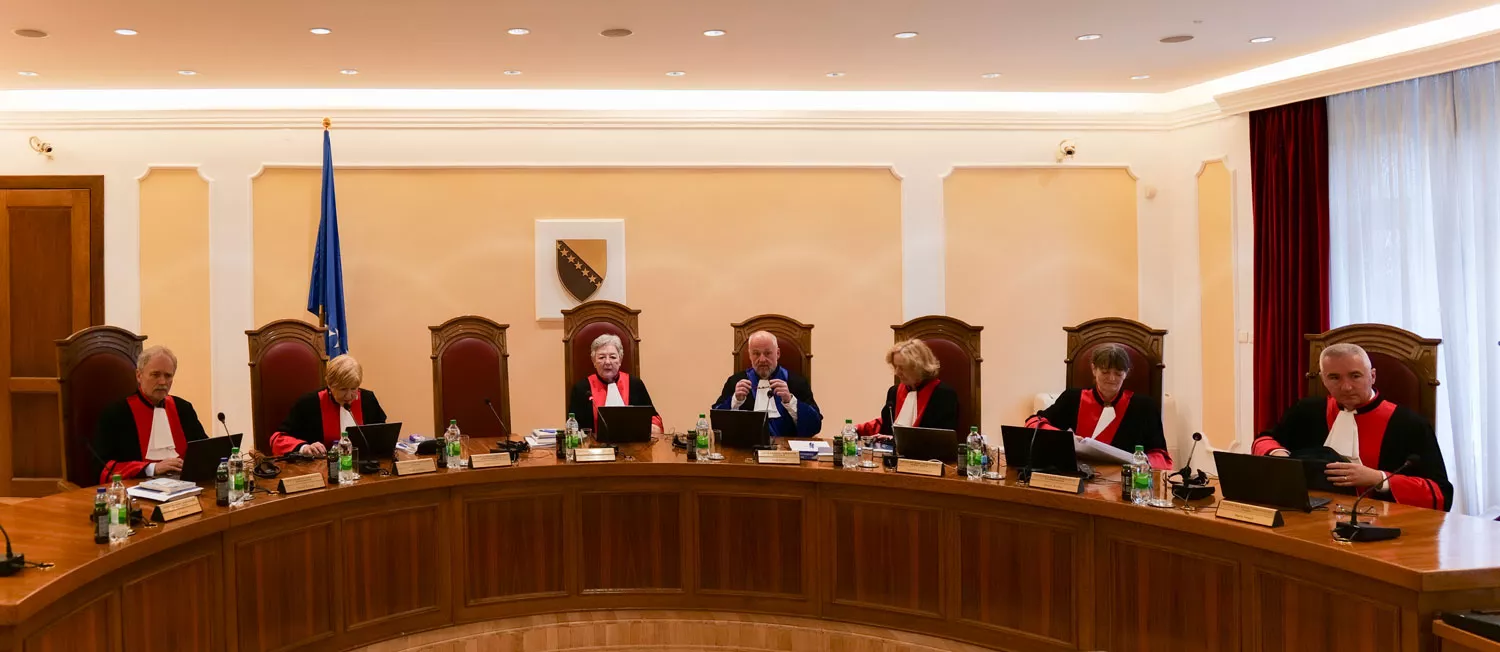
(Patria) - The Constitutional Court of BiH has made a final decision - laws adopted by the National Assembly of RS (Law on Non-Application of Laws and Prohibition of Activities of Unconstitutional Institutions of Bosnia and Herzegovina, Law on Special Register and Public Transparency of Non-Profit Organizations, Law on the High Judicial and Prosecutorial Council of Republika Srpska) are not in accordance with the Constitution of BiH and cease to be valid.
These laws were temporarily suspended until this decision.
During the current session, the Constitutional Court has, among other things, made decisions no. U-6/25, U-7/25, and U-8/25.
By decision no. U-6/25, the Constitutional Court determined that the Law on Special Register and Public Transparency of Non-Profit Organizations ("Official Gazette of Republika Srpska" no. 19/25) is not in accordance with Article II/3.i) of the Constitution of Bosnia and Herzegovina and Article 11 of the European Convention for the Protection of Human Rights and Fundamental Freedoms. Therefore, the contested law has been declared invalid ab initio and it ceases to be valid from the date of its publication in the "Official Gazette of Republika Srpska" no. 19/25.
In its reasoning, the Constitutional Court pointed to the general principles from the case law of the European Court of Human Rights regarding the essential role of associations in a democratic society. It further referred to relevant case law where the European Court of Human Rights examined the Law on Foreign Agents of Russia, which is substantively almost identical to the contested law, and concluded that this law is not in accordance with the freedom of association under Article 11 of the European Convention for the Protection of Human Rights and Fundamental Freedoms. Following this practice, the Constitutional Court concluded that the contested law, which introduced new categories of "non-profit organizations" and "agents of foreign influence" with specific obligations and restrictions, completely excludes the possibility for non-profit organizations to influence public authorities and thus prohibits them from carrying out their core activities. It was also pointed out that the broadly formulated concepts of "non-profit organizations" and prohibited "political activity" and "political actions" are not in line with the requirement of foreseeability, as they prevent civil society organizations from anticipating the limits of their permissible activities. This formulation, on the other hand, allows public authorities to classify any activity of civil society organizations as prohibited and to sanction it. It was further emphasized that labeling associations engaged in "political activity" or "political actions" that are financially or otherwise supported by foreign entities as "agents of foreign influence" has a strong deterrent and stigmatizing effect, significantly hinders their work, and creates a negative public perception of these associations. In this regard, it was pointed out that the right of associations to receive foreign donations stems from the Basic Principles on the Status of Non-Governmental Organizations in Europe and Recommendation CM/Rec(2007)14 of the Committee of Ministers of the Council of Europe to member states on the legal status of non-governmental organizations in Europe, as well as the United Nations Declaration on the Rights and Responsibilities of Individuals, Groups and Organs of Society in the Promotion and Protection of Universally Recognized Human Rights and Fundamental Freedoms. However, despite this, the contested law subjects foreign donations to a rigorous reporting regime and regular and extraordinary controls, with the obligation for associations receiving such donations to mark all materials they distribute with a "non-profit organization label," regardless of whether there is any connection between foreign funding and alleged "political activity" or "political action."
Furthermore, the contested law does not contain provisions guaranteeing access to effective legal remedies to challenge or seek review of decisions made under this law, as noted by both the Venice Commission and the ODIHR in their joint opinion on the draft contested law. Finally, the Constitutional Court emphasized that the contested law prescribes the prohibition of operation and criminal liability of responsible persons as the exclusive sanction for "political activities" or "political action." Given the aforementioned reasons, the Constitutional Court concluded that the introduction of the new legal categories of "non-profit organizations" and "agents of foreign influence," as well as the rigorous reporting regime, the possibility of regular and extraordinary controls, and the obligation to mark distributed materials with a "non-profit organization label," along with the prescribed exclusive sanction of prohibition of operation and criminal liability of responsible persons, did not correspond to an "urgent social need," nor was it necessary in a democratic society.
By decision no. U-7/25, the Constitutional Court determined that the Law on Non-Application of Laws and Prohibition of Activities of Unconstitutional Institutions of Bosnia and Herzegovina ("Official Gazette of Republika Srpska" no. 19/25), the Law Amending the Criminal Code of Republika Srpska ("Official Gazette of Republika Srpska" no. 19/25), the Decision on Measures and Tasks Arising from Unconstitutional Decisions and Actions of Unconstitutional Institutions of Bosnia and Herzegovina ("Official Gazette of Republika Srpska" no. 19/25), and points 3, 5, and 6 of the Conclusions of the National Assembly of Republika Srpska adopted at its 17th special session held on February 26, 2025, are not in accordance with Articles I/2 and III/3.b) of the Constitution of Bosnia and Herzegovina. Therefore, the Constitutional Court declared the contested laws and decision invalid ab initio and stipulated that they cease to be valid from the date of their publication in the "Official Gazette of Republika Srpska" no. 19/25, and points 3, 5, and 6 of the contested conclusions from the date of their adoption.
In its reasoning, the Constitutional Court pointed to its own case law regarding the division of competencies between the entities and the state of Bosnia and Herzegovina, which indicates that matters not explicitly listed in Article III/1 are not necessarily within the exclusive competence of the entities, as the Constitution of Bosnia and Herzegovina also prescribes state competencies in other provisions (e.g., Articles I/1, II/7, III/1.a), III/5.a), IV/2, V/1, and V/3.a)). It also referred to case law according to which the competencies of Bosnia and Herzegovina in the areas of judiciary and security established based on Article III/5 of the BiH Constitution are in accordance with the Constitution of Bosnia and Herzegovina. Finally, it was pointed out that the procedure for "returning" competencies to the entities that were previously established as competencies of Bosnia and Herzegovina based on Article III/5 of the BiH Constitution is not per se contrary to the Constitution of Bosnia and Herzegovina, but the Parliamentary Assembly of BiH has exclusive competence for this matter.
Analyzing the constitutionality of the contested Law on Non-Application of Laws and Prohibition of Activities of Unconstitutional Institutions of Bosnia and Herzegovina, the Constitutional Court emphasized that this law completely excludes the application of the Law on the High Judicial and Prosecutorial Council of BiH, the Law on the State Investigation and Protection Agency, the Law on the Court of BiH, and the Law on the Prosecutor's Office of BiH. It was pointed out that this effectively and de jure abolishes the sovereignty of Bosnia and Herzegovina in a part of its territory and "returns" competencies in the areas of judiciary and security to the entity of Republika Srpska. However, the procedure for "returning" competencies to the entities that were previously established as competencies of Bosnia and Herzegovina based on Article III/5 of the BiH Constitution is, as stated earlier, within the exclusive competence of the Parliamentary Assembly of BiH. The Constitutional Court emphasized that unilateral actions by one of the entities (withdrawing previously given consent, adopting laws regulating the same matter, etc.) cannot establish entity competence in an area where state competence has been previously established based on Article III/5 of the BiH Constitution. Therefore, by adopting the contested Law on Non-Application of Laws and Prohibition of Activities of Unconstitutional Institutions of Bosnia and Herzegovina, the National Assembly of Republika Srpska acted beyond its authority.
For the aforementioned reasons, the Constitutional Court concluded that the contested entity law must be declared unconstitutional from a formal aspect because it normatively regulates matters that, according to the Constitution of Bosnia and Herzegovina, do not fall under the competence of that entity, and therefore there is no constitutional basis for adopting such a law. For the same reasons, the Constitutional Court concluded that points 3, 5, and 6 of the contested Conclusions of the National Assembly of Republika Srpska adopted at its 17th special session held on February 26, 2025, and the Decision on Measures and Tasks Arising from Unconstitutional Decisions and Actions of Unconstitutional Institutions of Bosnia and Herzegovina, which are legal acts that initiated the adoption of the contested Law on Non-Application of Laws, are in full contradiction with Articles I/2 and III/3.b) of the Constitution of Bosnia and Herzegovina.
Examining the constitutionality of the contested Law Amending the Criminal Code of Republika Srpska, which prescribes a new criminal offense of "disrespecting or failing to implement decisions of the institutions or bodies of Republika Srpska," the Constitutional Court pointed out that prescribing criminal liability for violating general societal values is an ultima ratio (last resort) if the protection of these values cannot be achieved otherwise. The Constitutional Court accepted the view that respecting decisions of institutions represents a general value of a democratic society whose realization might, in certain cases, require criminal law enforcement. However, it was emphasized that prescribing criminal liability for failing to implement these decisions must be compatible with the principle of the rule of law from Article I/2 of the Constitution of Bosnia and Herzegovina, which implies that all entity and cantonal constitutions, laws, and other regulations must be harmonized with constitutional principles. The Constitutional Court pointed out that the contested legal provision is formulated so broadly that it implies criminal liability for failing to implement any decision of any institution or body of Republika Srpska, regardless of which societal values are threatened in a specific case. This derogates from the existing ways of resolving non-compliance with decisions of institutions or bodies of Republika Srpska, which is contrary to the principle of legal certainty.
Furthermore, it was pointed out that the formulation of the contested legal provision implies that decisions of bodies and institutions of Republika Srpska are binding regardless of whether they are final and conclusive decisions, and ultimately, regardless of whether these decisions are constitutional and legal, which also undermines the principle of separation of powers by excluding judicial and constitutional court review of decisions of Republika Srpska. Finally, the contested provision introduces the supremacy of decisions of the entity of Republika Srpska over decisions of state bodies and institutions, which are hierarchically above entity bodies in legal nomenclature, and regulates the issue of the conduct of persons employed in the institutions of Bosnia and Herzegovina, which is within the exclusive competence of Bosnia and Herzegovina. Given the above, the Constitutional Court concluded that the contested legal provision does not meet the standard of quality of law and is contrary to the principle of the rule of law from Article I/2 of the Constitution of Bosnia and Herzegovina.
By decision no. U-8/25, the Constitutional Court determined that the Law on the High Judicial and Prosecutorial Council of Republika Srpska ("Official Gazette of Republika Srpska" no. 19/25) and the Rulebook on the Procedure for Candidacy and Election of the First Members of the High Judicial and Prosecutorial Council of Republika Srpska ("Official Gazette of Republika Srpska" no. 25/25) are not in accordance with Articles I/2, III/3.b), and VI/5 of the Constitution of Bosnia and Herzegovina. Therefore, the Constitutional Court declared the contested law and rulebook invalid ab initio and stipulated that they cease to be valid from the date of their publication in the "Official Gazette of Republika Srpska" no. 19/25 of March 5, 2025, and no. 25/25 of March 21, 2025.
In its reasoning, the Constitutional Court, referring to its own case law, pointed out that when an entity competence has been transferred to the state level based on consent, it becomes part of the exclusive competence of the state, and, in accordance with the principle of the rule of law from Article I/2 of the Constitution of Bosnia and Herzegovina, only based on decisions made in the institutions of Bosnia and Herzegovina (Parliamentary Assembly of Bosnia and Herzegovina) can these previously transferred competencies be returned. It was further pointed out that the contested Law on the High Judicial and Prosecutorial Council of Republika Srpska and the Rulebook on the Procedure for Candidacy and Election of the First Members of the High Judicial and Prosecutorial Council of Republika Srpska regulate the same matter that is already regulated by the state Law on the High Judicial and Prosecutorial Council of Bosnia and Herzegovina. It was pointed out that the entities concluded an Agreement on the transfer of certain entity competencies by establishing the High Judicial and Prosecutorial Council of BiH. In this way, with the consent of the entities, state competence was established in the area of the judiciary based on Article III/5.a) of the Constitution of Bosnia and Herzegovina. This simultaneously meant the competence of the Parliamentary Assembly of Bosnia and Herzegovina to, in accordance with Article IV/4.a) of the Constitution of Bosnia and Herzegovina, adopt the Law on the High Judicial and Prosecutorial Council of Bosnia and Herzegovina, which established the High Judicial and Prosecutorial Council of Bosnia and Herzegovina as an independent and autonomous body tasked with ensuring an independent, impartial, and professional judiciary. However, the contested Law on the High Judicial and Prosecutorial Council of Republika Srpska and the Rulebook on the Procedure for Candidacy and Election of the First Members of the High Judicial and Prosecutorial Council of Republika Srpska exclude the judiciary in the territory of the entity of Republika Srpska from the competence of the High Judicial and Prosecutorial Council of BiH and place it under the competence of the newly established High Judicial and Prosecutorial Council of RS.
In this way, it is de facto and de jure attempted to usurp the competence of Bosnia and Herzegovina in the area of the judiciary in the territory of the entity of Republika Srpska and to "return" the competence in this area to the entity of Republika Srpska. The Constitutional Court has repeatedly emphasized that the procedure for "returning" competencies to the entities that were previously established as competencies of Bosnia and Herzegovina based on Article III/5 of the BiH Constitution is within the exclusive competence of the Parliamentary Assembly of BiH. It was pointed out that unilateral actions by one of the entities (withdrawing previously given consent, adopting laws regulating the same matter, etc.) cannot (re)establish entity competence in an area where state competence has been previously established based on Article III/5 of the BiH Constitution.
Therefore, considering the undisputed content of the Law on the High Judicial and Prosecutorial Council of BiH, the content of the contested Law on the High Judicial and Prosecutorial Council of RS and the Rulebook by which competencies of the institutions of Bosnia and Herzegovina are assumed, as well as its own case law, the Constitutional Court concluded that there are no provisions in the Constitution of Bosnia and Herzegovina that could justify the constitutionality of the contested legal acts adopted by the National Assembly of Republika Srpska.
Komentari (0)
Prijavite se za komentiranje
PrijavaJos nema komentara. Budite prvi!
Minuta
Sve →Iz drugih kategorija

High Representative Not Elected: Germans, French and British Sabotaged Americans, New Attempt at End of June

ČOVIĆ WITHOUT MERCY: How Those Who Brought Ademović to Office Created a Political Hell for Him



Sunny Saturday, quite warm



Tragedy in Albanian resort: Two minors drown












