
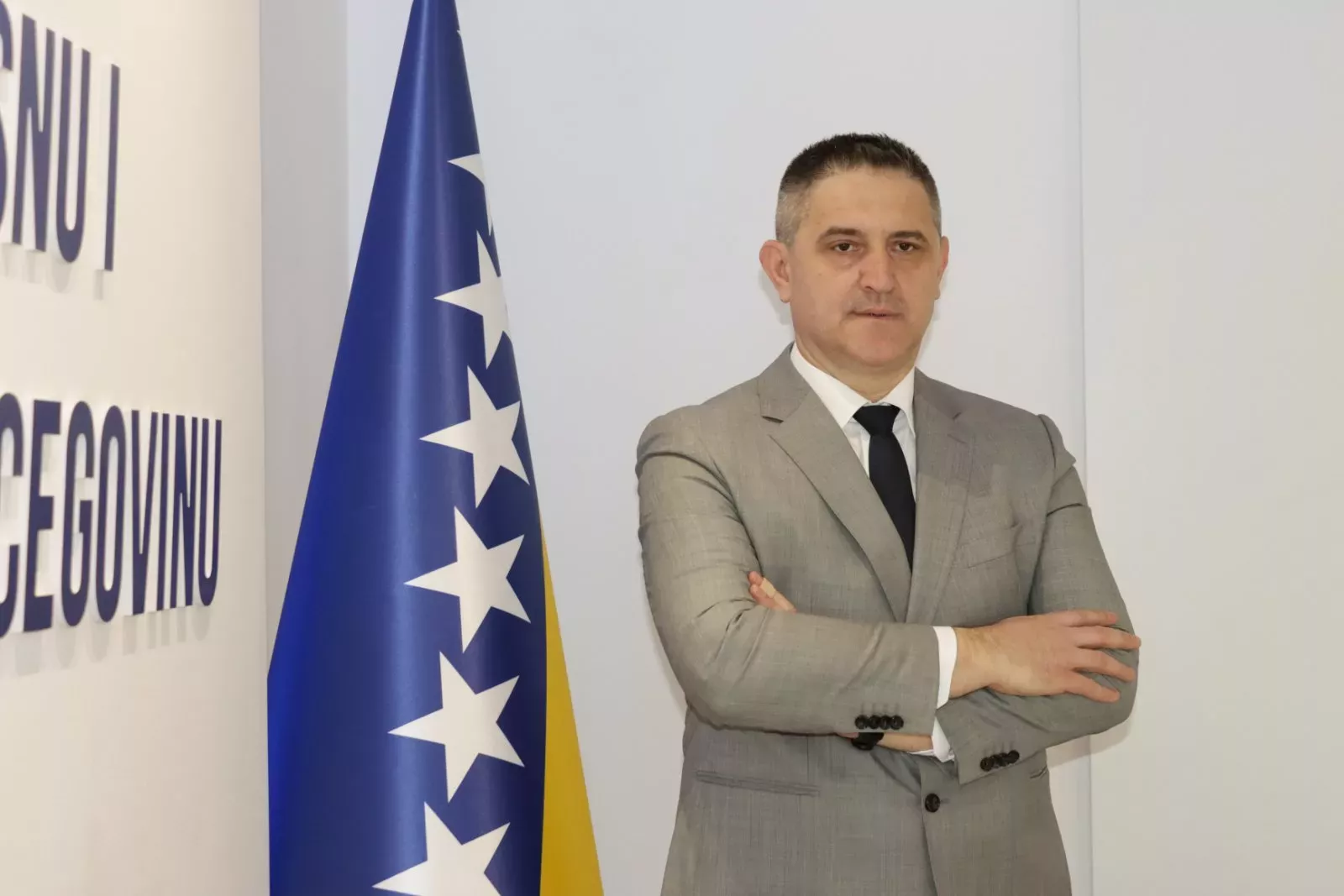
(Patria) - Sabina Ćudić's statement, which attempts to deny the legitimate and reasoned criticism of the President of the Party of BiH Semir Efendić, is deeply problematic from both a political and a state-building perspective.
It is particularly dangerous because it comes from a person who currently participates in state-level government, believes the delegate of the Party of BiH in the House of Peoples of the Federation of BiH Parliament Enes Peštek.
Peštek points out that, legally speaking, the Court of Bosnia and Herzegovina is the highest judicial institution at the state level. For its work to be independent, secure, and effective, it must operate in an environment that respects the legal order of BiH.
- Placing the appellate division of that Court in an entity whose political leadership currently denies its legitimacy represents a legal absurdity and a security risk.
In the legal systems of stable countries, institutions are not moved to places where their existence is questioned. On the contrary, they are strengthened in areas where they have the support of the constitution, laws, and the public - says Peštek.
He notes that, institutionally speaking, this issue is not just about geography, but about substance.
- The current political leadership of Republika Srpska, through the actions of its leaders, has been systematically dismantling the institutions of Bosnia and Herzegovina for years, from not recognizing the state prosecutor's office, through attacks on the Constitutional Court, to passing laws that derogate from the Dayton framework.
In that context, locating the appellate division in RS is not a symbol of unity, it is a symbol of capitulation to blackmail. It is a political message from Sabina Čudić that the denial of the state can be rewarded with concessions - emphasizes Peštek.
Historically, he adds, Bosnia and Herzegovina survived aggression and genocide precisely because of people who believed in the state, in institutions, and in truth.
- Today, when an attempt is made to impose a narrative that "BiH institutions should be evenly present" even where that state is denied, it is historical revisionism and moral humiliation. This is not building a state, it is building a false image of multi-ethnicity.
Semir Efendić, unlike many who talk about the state only in front of cameras, shows principledness, clarity, and consistency. He does not pursue a policy of division, but a policy of preserving the sovereignty of BiH.
He is not fighting against entities, but against a policy that attacks the state from entities. He does not accept that state institutions should be "evenly" distributed geographically, while at the same time being denied in spirit and substance.
His fight is not against citizens, but against the policy of denial, and that is the fundamental difference between genuine statehood and populist balancing - states Peštek.
Sabina Ćudić and her party, as part of the government, Peštek further points out, have a responsibility to defend institutions, not to find ways to appease structures that are destroying those very institutions.
- Not everything in politics is "unity". There are also red lines. And if Sabina Ćudić does not know how to draw them, the state will draw them itself, at the cost of its own survival.
Bosnia and Herzegovina is not an entity. It is not a compromise. It is not a favor. It is not a sum of entities, but a state of all its citizens. And precisely because of that, we must not remain silent when an attempt is made to undermine its sovereignty under the guise of "balance" - concludes Enes Peštek.
Komentari (0)
Prijavite se za komentiranje
PrijavaJos nema komentara. Budite prvi!
Minuta
Sve →Iz drugih kategorija

High Representative Not Elected: Germans, French and British Sabotaged Americans, New Attempt at End of June

ČOVIĆ WITHOUT MERCY: How Those Who Brought Ademović to Office Created a Political Hell for Him



Sunny Saturday, quite warm



Tragedy in Albanian resort: Two minors drown












