
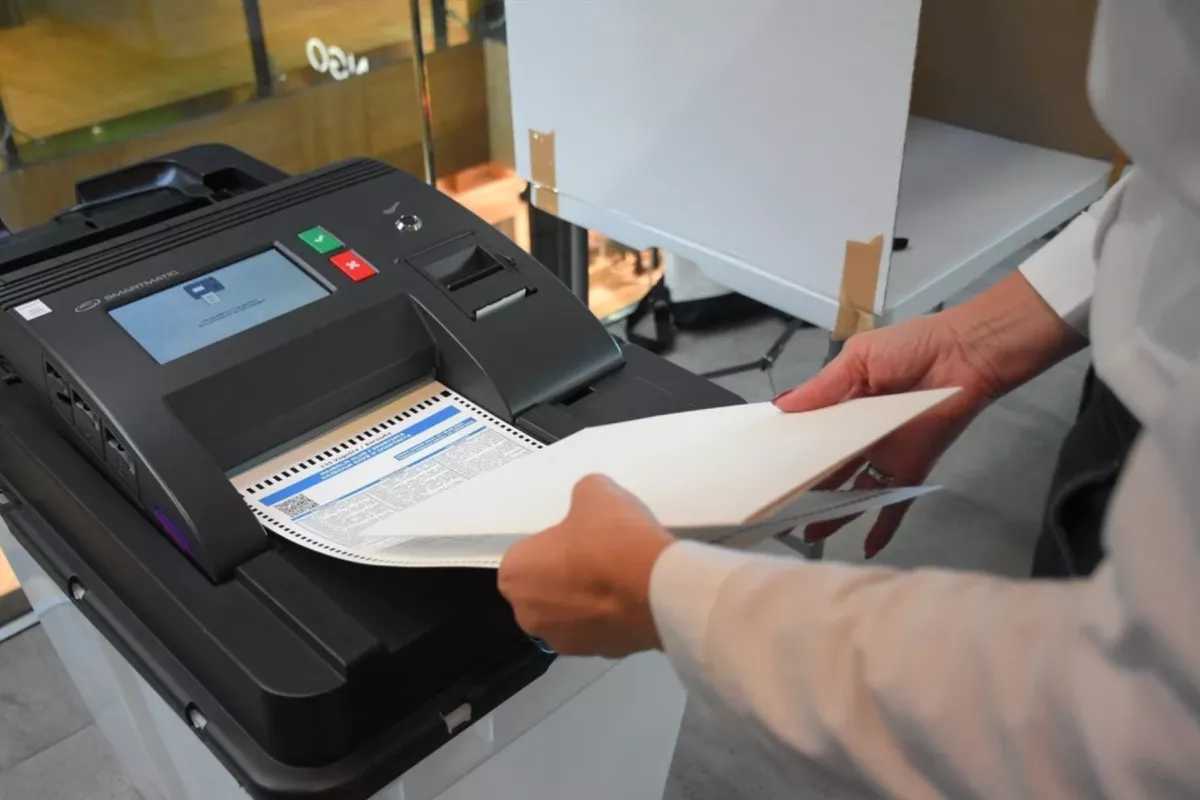
(Patria) - The BiH Appellate Review Office (URŽ) rejected Planet Soft's appeal against the Central Election Commission (CEC) of BiH's decision to award the contract for the procurement of election technologies to the American company Smartmatic, Istraga.ba has learned.
The URŽ made this decision this afternoon, but it has not yet been delivered to the CEC of BiH. Following this decision by the URŽ, the path is almost clear for the CEC to conclude a contract worth 74.5 million convertible marks with the American company Smartmatic.
Admittedly, there is another appeal pending at the URŽ, filed by the company Provis from Bijeljina, but their arguments, as Istraga has learned, are even weaker than those presented by Planet Soft. Provis, in fact, exceeded the estimated value of the contract in its offer, so according to the Public Procurement Law, the URŽ would have to reject their appeal.
We remind you that on March 19 this year, the CEC of BiH decided to award the contract for the procurement of biometric equipment and ballot scanning in elections, worth 74.5 million KM, to a consortium of companies led by the BiH branch of the American company Smartmatic.
The decision was supported by six members, and only Vlado Rogić, a member of the CEC close to HDZ BiH, was against it, stating that the Commission had changed the minutes regarding the procurement three times. He added that during the Commission's work, information from the CEC about the selection process of the best bidder had "probably" leaked.
- Some media outlets published what happened during the Commission's proceedings. Now we see that these media outlets explained and influenced. To what extent they managed to influence the work of the CEC and the Commission, then we come to the conclusion that there was an intention for pressure.
To what extent the Commission resisted it is for us to examine. That the process went from this institution to the media is very painful for us - Rogić said at the time, objecting that the consortium around the company Planet Soft from Banja Luka did not get the job.
The CEC's Commission for the procurement of equipment for the biometric voter identification system and for scanning ballots at polling stations proposed the three most favorable bidders. In first place, thanks to dumping prices, was a consortium of IT companies connected to HDZ and SNSD, and a Korean company that organized elections in Russia.
The consortium consisting of Planet Soft from Banja Luka, Katarina d.o.o. from Mostar, Core d.o.o. from Sarajevo, and the South Korean company Miru Systems submitted the most favorable offer for this job at first glance. Their offer was as much as 17 million marks cheaper than the next bidder.
The American Smartmatic, which is second on the list, asked for 74.5 million marks (plus VAT). The delivery time for the equipment is 139 days from the date of signing the contract, and the extended warranty is five years. The third offer was submitted by the company Artco Group. They are asking for 79.7 million marks plus VAT for this job, and their delivery time is 170 days from the date of signing the contract.
However, CEC members assessed that the Planet Soft consortium's offer was unreasonably low, and their delivery times were unrealistic. This was followed by a campaign by the Planet Soft consortium through media close to HDZ and SNSD.
"Planet Soft: We will challenge the CEC's decision due to irregularities in new election technologies," announced Večernji list, close to HDZ, while RTRs, citing Planet Soft officials, stated that the "chosen company Smartmatic" did not provide valid references nor did it adequately prove technical compliance with the requirements. Furthermore, they announced that the CEC of BiH favored the American company at the expense of the consortium led by Planet Soft.
Who are the companies that make up the Planet Soft consortium and who are they connected to?
Katarina d.o.o. Mostar is an IT company owned by Milenko Čović, a distant relative of the president of HDZ BiH, Dragan Čović. Katarina has received most of its contracts from state institutions and companies managed by HDZ BiH cadres.
"Čović's company again received a multi-million tender for prisoner bracelets," read the headline of the portal Fokus published on July 1, 2024.
You can find similar headlines by searching for the company Katarina and the name Milenko Čović. This company has received contracts from the General Secretariat of the Council of Ministers of BiH, managed by HDZ BiH cadre Robert Vidović, then from BHANSA after Dragan Čović's son-in-law Davorin Primorac took over management of that company. Furthermore, the son-in-law of Katarina's owner, Milenko Čović, Marko Laco, was a representative of Abraham Group, which is backed by Amir Gross Kabiri.
Planet Soft is a company owned by Serbian businessman Vedran Jarić. The company is headquartered in Banja Luka and Belgrade. According to Capital's reporting, Planet Soft received a multi-million contract from Željeznice Republike Srpske, managed by the government under Milorad Dodik's control, at the end of last year.
"The companies Planet Soft from Banja Luka and Belgrade have received the contract for the three-year maintenance of the SAP information system at Željeznice Republike Srpske, worth 2.3 million KM with VAT. Specifically, the companies Planet Soft, with addresses in Banja Luka and New Belgrade, will maintain this system for the next three years, and the annual value of the contract is around 800,000 marks with calculated VAT.
As stated in the contract award notice, only one offer was received for the tender, and it was acceptable to the Railways. It is important to note that this is the first such contract that Planet Soft will undertake for a public enterprise in RS since they obtained the SAP license," reported Capital.
The South Korean company Miru Systems, as part of this consortium, has had numerous scandals and controversies related to election technologies in several countries. Here are specific examples. This South Korean company supplied election technologies to the Democratic Republic of Congo for the 2018 and 2023 elections. The devices, according to local media reports, had numerous technical problems, which led to chaos during voting.
International observers described the situation as "catastrophic." U.S. authorities even sanctioned the leaders of the election commission in Congo due to suspicions of corruption related to contracts with the South Korean company Miru. This company also organized elections in Iraq, where about 70% of the devices failed in the 2018 elections.
In addition to Iraq, Congo, and the Philippines, the South Korean company Miru also supplied hardware for the elections in the Russian Federation in 2018.
CEC experts estimated that this consortium cannot realize the job of introducing new technologies into BiH's electoral process.
General elections in BiH, according to the Law, should be held on October 4, 2026. The CEC must announce them in May. At the latest by the end of April, the CEC could, and should, sign the contract with Smartmatic. Because, if the delivery deadline is 170 days from the date of signing the contract, a later signing of the contract could jeopardize the introduction of new election technologies.
Also, it should be kept in mind that Planet Soft will likely initiate administrative proceedings before the Court of BiH. If, for example, the Court of BiH ruled in their favor, everything would go back to the beginning. However, Planet's appeal to the Court of BiH does not postpone the signing of the contract.
Komentari (0)
Prijavite se za komentiranje
PrijavaJos nema komentara. Budite prvi!
Minuta
Sve →Iz drugih kategorija

High Representative Not Elected: Germans, French and British Against Americans, New Attempt at End of June

ČOVIĆ WITHOUT MERCY: How Those Who Brought Ademović to Office Created a Political Hell for Him



Sunny Saturday, quite warm



Tragedy in Albanian resort: Two minors drown












