
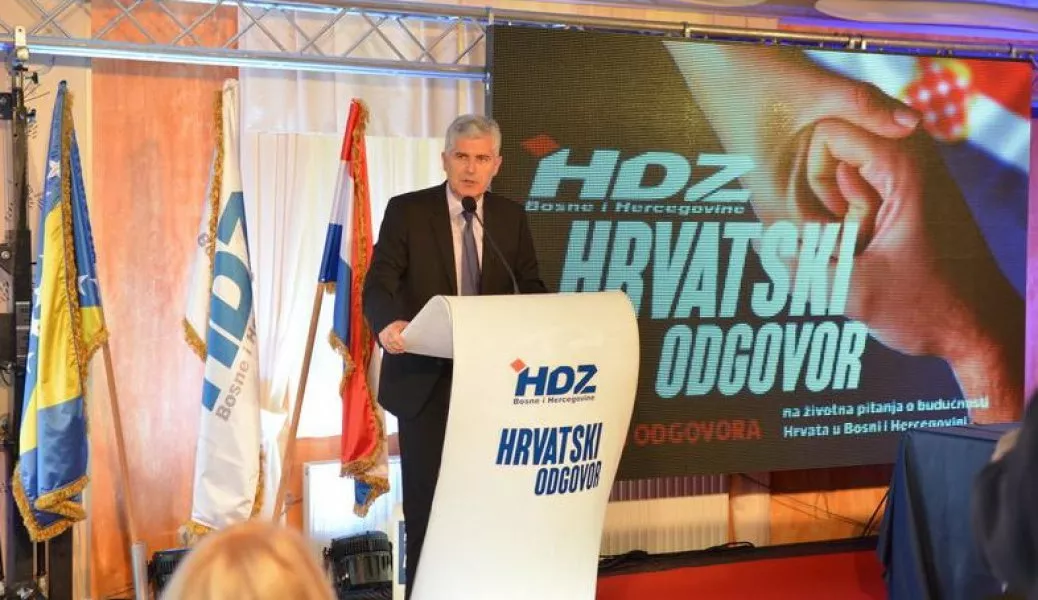
By Edina Latif
Although federalization is mentioned in just one sentence in the recently adopted European Parliament Resolution on Bosnia and Herzegovina's progress, and amendments by Croatian MEPs were rejected, this is enough of a basis and a "strong argument" for the president of HNS and HDZ BiH, Dragan Čović, to continue with his political narrative of a new internal restructuring, but exclusively of the Federation of BiH, writes Patria.
Last week, Čović played naive, calling on anyone who possessed it to show a document about the establishment of a third entity, or any of his statements mentioning this mythical entity.
It is from Čović, but it is too much even from him. The president of HDZ BiH has given hundreds of statements about the third entity, starting 11 years ago when he was first elected to this position. At one of the party rallies, he stated that he would fight for a third entity, and last year, veteran associations asked him to fulfill the pre-election promise made in 2014.
Over the years, the politically cunning Čović has changed his rhetoric, sometimes speaking more intensely about an entity with a Croat majority, i.e., a third one, and sometimes about a unified BiH.
What he has never mentioned in all these years is federalization that would encompass the territory of Republika Srpska; instead, he has exclusively advocated for resolving the so-called Croatian question only within the Federation.
This is his tacit political deal with Milorad Dodik, and a continuation of the policies initiated by Tuđman and Milošević in the early 90s, continued by Karadžić and Boban, and now taken over by him and the SNSD leader.
HDZ BiH began speaking about nationally defined territories as early as February 1992. At that time, at a session of the Central Committee of this party, the Livno Question was adopted, which was a condition for Croats to participate in the independence referendum on March 1.
The Livno Question was a rephrased question about BiH's independence and read:
Are you in favor of a sovereign and independent Bosnia and Herzegovina, a state community of constituent and sovereign peoples – Croat, Muslim, and Serb – in their national areas (cantons)?
The referendum question on which the citizens of BiH voted was:
Are you in favor of a sovereign and independent Bosnia and Herzegovina, a state of equal citizens, peoples of BiH – Muslims, Serbs, Croats, and members of other nations living in it?
The Livno Question excluded the category of citizens, and the peoples were promoted as bearers of sovereignty in their national areas.
The explanation stated: "The referendum question formulated in this way, unlike the one adopted at the session of the Assembly of the SR BiH on January 25, 1992, unequivocally defines the future independent BiH as a complex state community legally based on the national sovereignty of the constituent peoples – Croat, Muslim, and Serb.
It follows from the proposed question that the future independent BiH is not a unitary state but a state community, which will consist of national cantons – Croat, Muslim, and Serb – whose territories will be determined after the referendum by a special constitutional act."
Although the Livno Question was never considered in the Assembly of the Republic of Bosnia and Herzegovina, the international community accepted it and it was later offered in various plans during peace negotiations.
Just as then, a quarter of a century ago, the Livno Question is being attempted to be realized on the political scene here today.
At the end of October 2000, the first session of the Croatian National Assembly was held in Novi Travnik. The then-leader of HDZ BiH, Ante Jelavić, was elected president.
A Declaration on the Rights and Status of the Croat People in BiH was also adopted. Soon after, a declaration on Croatian Self-Government was adopted, which ended ingloriously. An indictment was filed against Jelavić, and he then fled to Croatia, where he still lives freely and has never been held accountable for undermining the constitutional and legal order of the state of BiH.
Jelavić's departure from the political scene opened the way for the then almost unnoticed Dragan Čović, who is tirelessly working on the third entity.
The last session of the HNS in January this year caused a storm of indignation from pro-Bosnian parties.
The president of the Main Council of HNS BiH, Božo Ljubić, stated at the time that this assembly was an opportunity for the HNS to re-establish itself as the bearer of non-territorial autonomy for Croats in BiH, adding:
"If BiH wants to become self-sustaining, then its administrative-territorial restructuring, which would include a federal unit with a Croat majority, is also necessary. And this remains the permanent aspiration of the Croat people in BiH."
However, the Catholic Church does not favor Čović's and Ljubić's policy at all. The message from the Bishops' Conference is clear – restructuring is possible, but only if it also applies to the territory of Republika Srpska.
Komentari (0)
Prijavite se za komentiranje
PrijavaJos nema komentara. Budite prvi!
Minuta
Sve →Iz drugih kategorija

High Representative Not Elected: Germans, French and British Sabotaged Americans, New Attempt at End of June

ČOVIĆ WITHOUT MERCY: How Those Who Brought Ademović to Office Created a Political Hell for Him



Sunny Saturday, quite warm



Tragedy in Albanian resort: Two minors drown












