
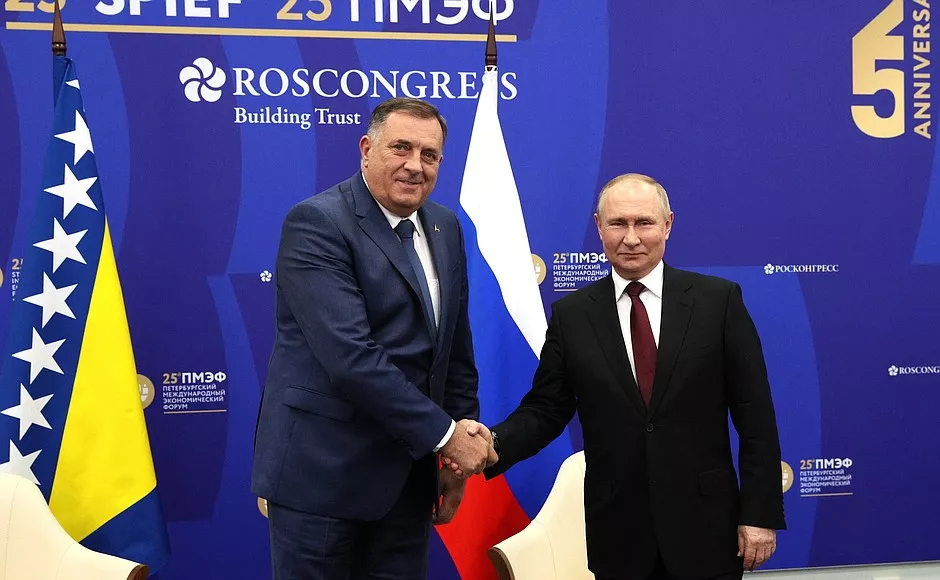
By: Fuad Đidić, diplomatic analyst
Putin and Dodik have the same, well-known matrix. They refer to the "original agreement" or "original constitution".
Neither Moscow has been silent about this so far, nor has Belgrade. After the historic summit in Riyadh on February 18, 2025, both sides announced and spectacularly strengthened these calls. Moscow has strengthened the call for a "revision of Yalta", which, admittedly, it has been discreetly discussing for a decade.
On the other hand, following the same matrix, Dodik has brought the calls for the "original Dayton" to a boiling point. In this game, both sides – Moscow and Belgrade – are shooting past the target to hit the mark.
Putin, under the guise of redefining Europe, actually wants to break up the European Union, while Dodik, under the pretext of a "new" BiH, actually wants to break up and divide Bosnia and Herzegovina, but also to break the Western alliance embodied in the OHR office.
Putin advocates for a new concept of a "multipolar world", which is essentially based on a new territorial redistribution of the world and the creation of at least six new blocs. Here, Putin primarily targets Europe, which would be reorganized in accordance with the agreement at Yalta, when, with Stalin's dominance, Europe was divided into two large blocs. Putin's demands, spoken only on special occasions, are based on the belief that it is possible to return to the 20th century.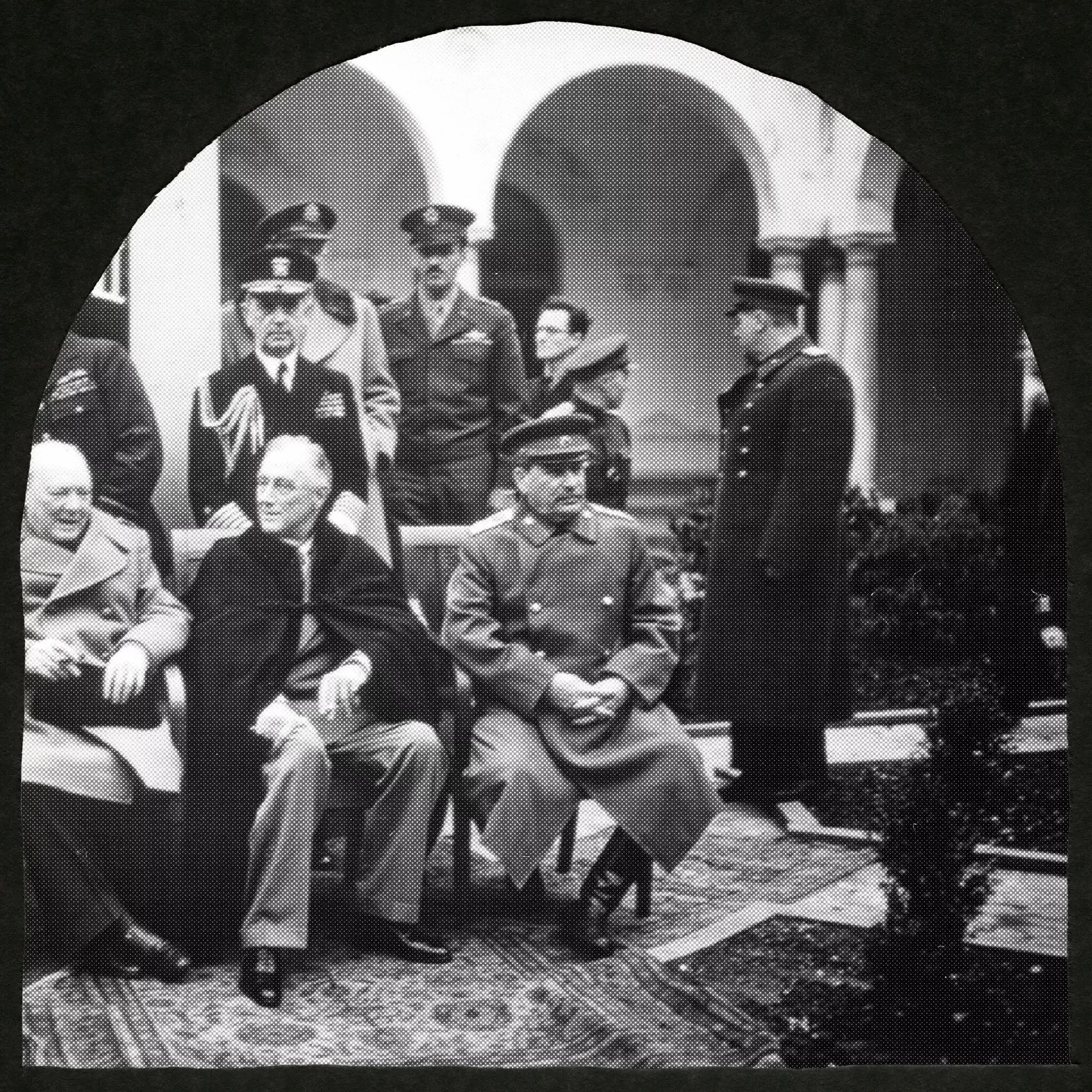
In other words, to return to the "original agreement" from Yalta in 1945. Therefore, achieving peace in Ukraine is merely a facade for Putin, behind which lies the realization of a much broader project – the old dream of establishing a "pro-Russian Europe".
The impression is that Dodik faithfully follows this Putin matrix. For Dodik, the return to the "original constitution" is also a facade that covers his dream of dividing Bosnia and Herzegovina and establishing a "Serbian world" on its ruins.
This "turning back the clock" by Putin and Dodik has the character of returning to a bygone world of the 20th century.
And precisely because of this, they need a new myth, a new point of mass mobilization to reclaim the lost past. That is why they invoke the character of victimhood with the same pathos. Dodik states that Serbs in Bosnia and Herzegovina are victims of "Muslims", the "OHR", and "foreigners" who have changed the "original Dayton". Putin, on the other hand, says that Russia is a "victim of the West", that it is a "victim of Nazism" which, above all, comes from Ukraine. With this terminology borrowed from World War II, Putin justifies all his military campaigns with "denazification", as well as plans to return to the "sources" of the Yalta agreement, according to which the victors of the war divided the world.
***
We know almost everything about Dodik and we know what he is aiming for. He has never wanted any reform or upgrade of Dayton, nor any kind of reforms. Inspired and encouraged by Putin, he very cunningly sows the seeds for a new war.
Just as Putin's vision never ended with the return of the Crimean region as an age-old "Russian possession", neither has Dodik's vision ever ended with Republika Srpska as one of the two entities of Bosnia and Herzegovina.
Just as Putin wants the return of "Russian land", Dodik also wants the return of "Serbian land".
However, Dodik carefully builds his "war vocabulary". He constantly refers to the "Constitution" and thus creates great confusion in the eyes of the world. In one of his many posts on network X, Dodik says:
"All problems in BiH are precisely the result of disrespecting the Constitution and acting contrary to the law... All problems are the result of the fact that the sovereignty of BiH is threatened, because it has a guardian in the form of Christian Schmidt... The problem is that the Constitution was destroyed by those who call for its respect."
***
Putin's call for "original Yalta" and all that this call entails can be considered an example of "diplomatic mastery". On the occasion of the 70th anniversary of Yalta, Putin unveiled an impressive, ten-ton monument to the three Yalta leaders – Churchill, Roosevelt, and Stalin – in the Crimean port city of Simferopol in June 2015.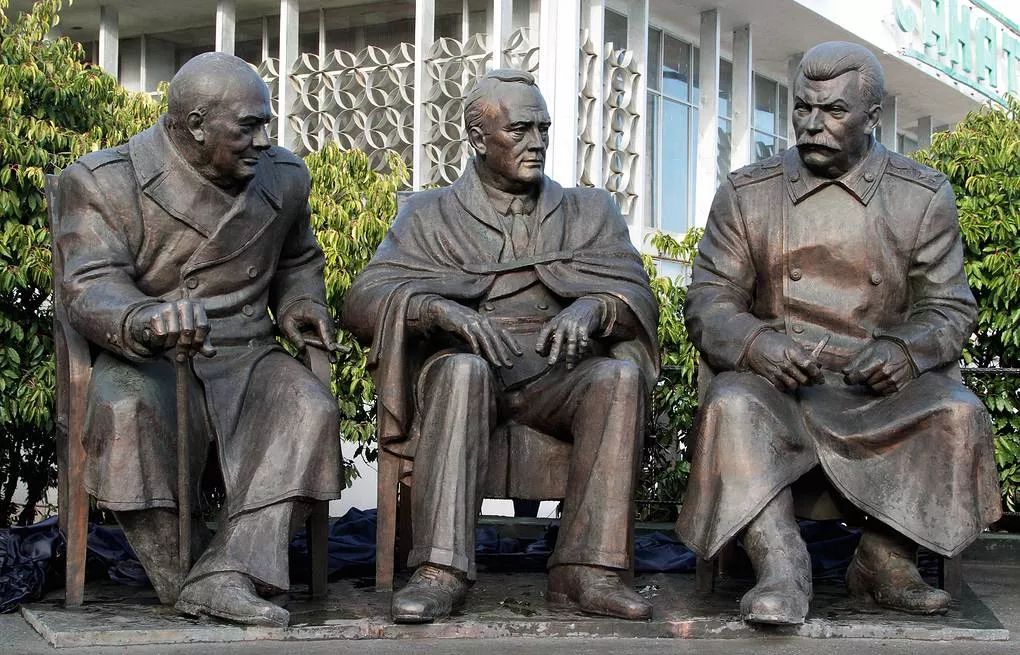
This was a terrible message to the West.
However, by all accounts, the West either turned a blind eye to this message, or simply did not read its true meaning. And today, no one has an answer to the question of why the then US President Obama did not react in 2014 when the Russians occupied Crimea, and why the EU also reacted very lukewarmly, almost approving this move by Putin.
Putin's unveiling of this mega-memorial project to the victorious leaders of World War II, with all the messages this monument carried, also passed with the same silence.
There is countless evidence that the vision of "original Yalta" is still alive in Russia's political action and plans.
One by one, the countries of Eastern Europe, as the Brussels-based EU weakens, are becoming clients of Russia. We are primarily thinking of Orban's Hungary, Fico's Slovakia, and even Romania and parts of Poland.
The New York Times recently published an article stating that certain countries and leaders are on Russia's payroll. Croatia was also explicitly mentioned in that article.
The newspaper also recalled the former communist movements in Germany and Italy and confirmed that today they are, in fact, the strongest strongholds of far-right political ideas and parties. As an illustration, The New York Times published a map of present-day Germany, which clearly shows how the far-right AfD overwhelmingly won the elections on February 23, 2025, in the territory of former East Germany (GDR).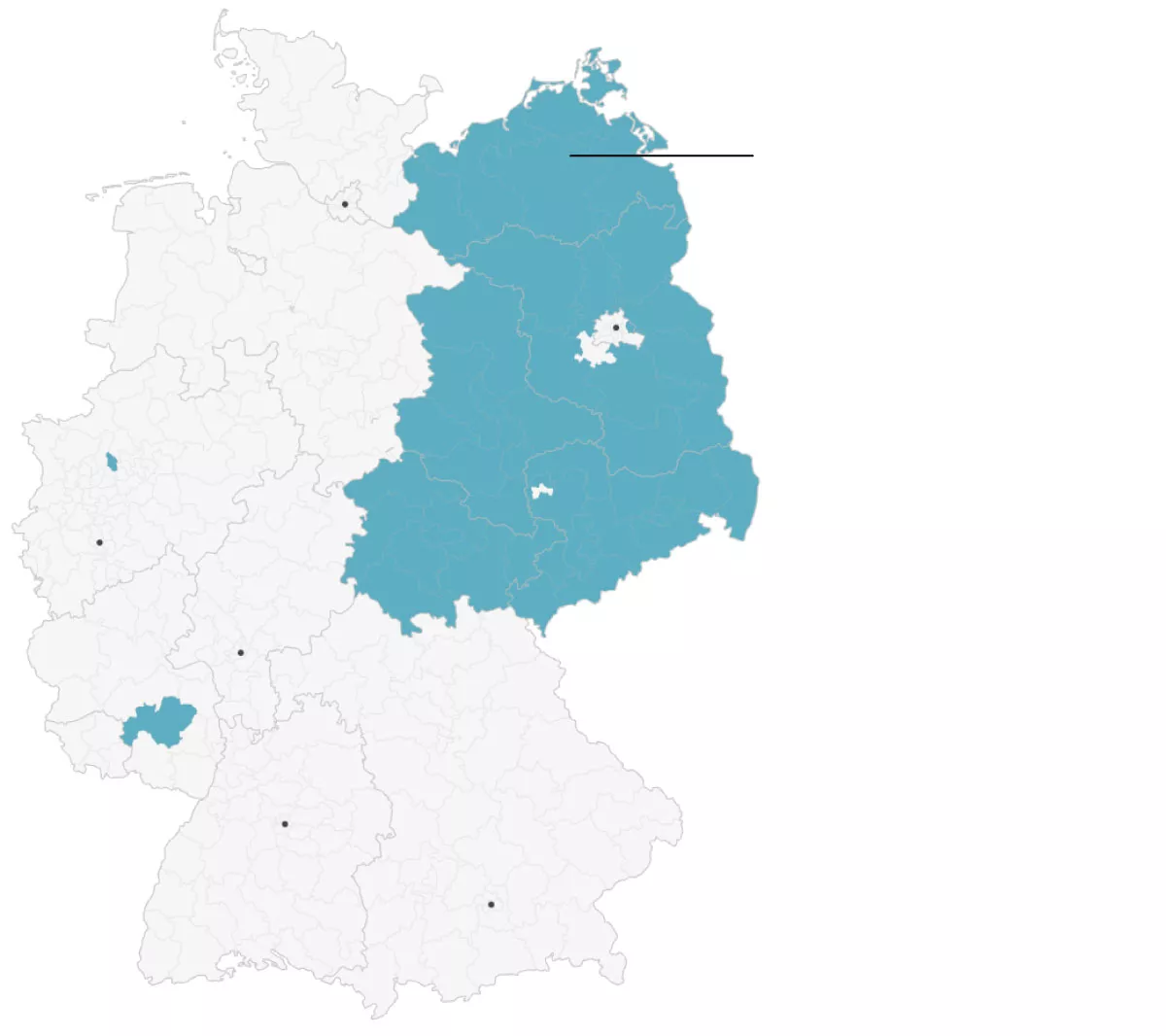
The policy of returning to "original Yalta" and "original Dayton" has its ideological protagonists and helpers. Putin is ideologically supplied by his philosopher Dugin, and Dodik by theorists such as Kecmanović and Tanasković, who, in their recently published book Alija, ulema or balija, pointed to the "deception of Muslims" who used foreigners for their goals regarding the preservation of BiH.
This philosophical revisionist school of returning to "original" agreements seeks similar or identical interlocutors in Europe, and thus expressed their enthusiasm for the electoral results of the AfD in Germany, the Italian right-wing Meloni, or, like Dodik, who compared himself to the far-right Romanian presidential candidate Georgescu.
All these proponents of the policy of returning to "sources" are counting on the return of territories and former lost possessions.
***
What could happen next with the return to "original Dayton" and "original Yalta"? Trump announced this the other day in the Oval Office when he threatened Zelensky: "You are provoking World War III!"
What is Dodik's role in this? Dodik has the task of initiating the return to "original Dayton".
This return could perhaps be a litmus test for Russia's return to "original Yalta". Both returns to the "source" would mean a catastrophe.
In Dodik's case – a catastrophe of regional proportions, which would set the region ablaze, and in Putin's case – a catastrophe that could set Europe ablaze.
It is impossible to predict the exact contours of the catastrophe. And it would not resemble the conflicts of the bipolar world era in any way.
Because the key question remains – where would America find itself in all of this?
It depends on whether the new war, which is on the horizon, will be a war for the image of the world from the 20th or 22nd century.
Komentari (0)
Prijavite se za komentiranje
PrijavaJos nema komentara. Budite prvi!
Minuta
Sve →Iz drugih kategorija

High Representative Not Elected: Germans, French and British Sabotaged Americans, New Attempt at End of June

ČOVIĆ WITHOUT MERCY: How Those Who Brought Ademović to Office Created a Political Hell for Him



Sunny Saturday, quite warm



Tragedy in Albanian resort: Two minors drown












