
By Armin Sijamić
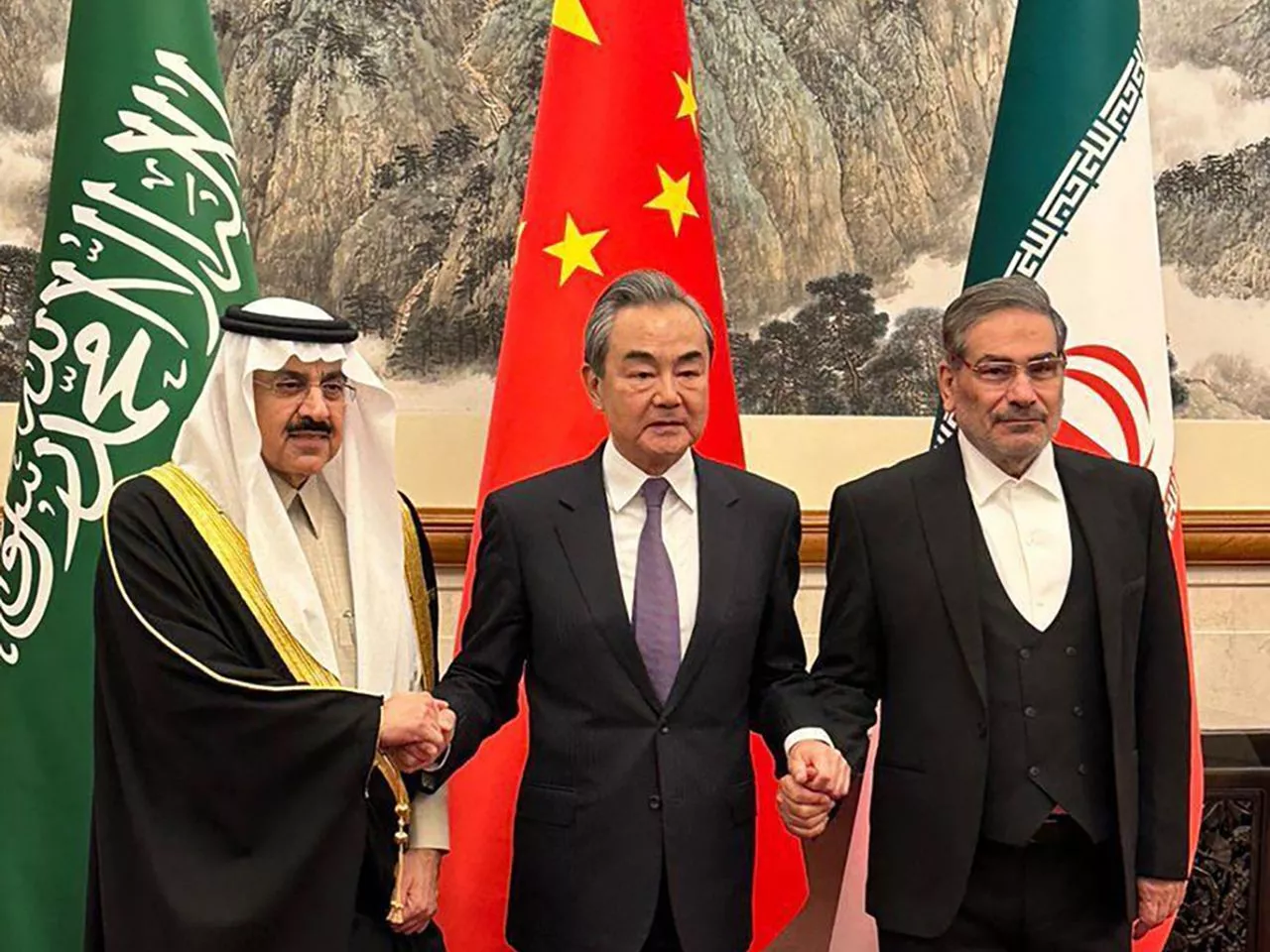
The restoration of diplomatic ties between Riyadh and Tehran, mediated by Beijing, is news that has shaken the Middle East like few others in recent years. The two regional powers have decided to restore diplomatic relations after breaking them off in 2016. In a joint statement by China, Saudi Arabia, and Iran, it is stated that Beijing was the venue for the meeting from March 6 to 10, and that the two countries decided to restore broken diplomatic ties with full respect for each other. From what has been stated, as well as from the reactions of Iran and Saudi Arabia, not many concrete and important data can be extracted, because it is clear that this agreement is more important for what it could be than for what it currently is. Refraining from major statements is a measure of caution towards those within these countries who oppose the agreement, but also a risk for the government if the achieved agreement does not yield the expected results.
China separately offered more information in a statement from its Ministry of Foreign Affairs. China "does not seek any selfish interests" and opposes geopolitical competition in the region. Beijing will continue to support Middle Eastern countries in "resolving differences through dialogue and consultation to jointly promote lasting peace and stability." "We respect the status of Middle Eastern countries as masters of this region and oppose geopolitical competition in the Middle East," the statement said. "China has no intention and will not seek to fill the so-called vacuum, nor to form exclusive blocs," clearly alluding to the United States.
What Beijing stated in a conciliatory tone is more than clear, and it is not difficult to conclude that the success of this agreement would be a great Chinese victory, starting from the fact that China is mediating, reconciling, bringing together... in the Middle East for the first time, something that has been reserved for the US and Russia for decades. This great diplomatic triumph of China is accompanied by standard calls for cooperation and mutual respect among all states regardless of differences. The previously mentioned formulations from the statement, which we will refer to later, speak volumes.
Returning the region to its owners is nothing more than a message that these countries decide for themselves and that others should treat everyone in the region on equal footing, and that respecting the "status of Middle Eastern countries" is a formulation for ceasing pressure on the undesirable. The formulation that China will not form "exclusive blocs" targets sanctions and regional alliances against other countries. For decades, we have witnessed the West's intention to isolate Iran, first from its neighbors, and then from the world, due to Tehran's policy towards Israel. The actions that the West has attributed to Iran for decades have also been committed by others, but they have not faced sanctions for them. China, as an important Iranian ally, clearly wants to end this practice. Essentially, this could also be a long-term result of the agreement, and Riyadh would also benefit. However, we are far from that scenario at the moment.
Regional Support
The agreement between regional powers that unite Sunnis and Shiites has brought an unprecedented wave of optimism to the entire region. Pakistan assessed the agreement as "historic," Hezbollah leader Hassan Nasrallah as a "good development" in relations, and support was also expressed by the Organization of Islamic Cooperation, the Gulf Cooperation Council, the Muslim World League, Egypt, Turkey, Iraq, Kuwait, the United Arab Emirates, Jordan, Bahrain, Palestine, Syria... UN Secretary-General Antonio Guterres also expressed support.
Experts and journalists from the Middle East are competing in positive assessments of the agreement and pointing out the opportunities it offers if Riyadh and Tehran work together on regional stability. On the list of those who could benefit from this agreement, almost everyone mentions Iraq, Syria, Lebanon, and Yemen, from which the Houthis stated that the agreement does not affect them, as Iran does not control them. Many believe that Palestinians could also see an improvement in their status.
A test of the renewed cooperation between the two regional powers could be Lebanon, where Shiite and Sunni parties clash, and whose patrons are Iran and Saudi Arabia. Therefore, Lebanon, many believe, could be a good test for the relations that Riyadh and Tehran plan to build. Lebanon has lacked political stability for years, and the economic crisis has reached unprecedented proportions. Europe, through France, has also become involved in mediation, but there have been no major breakthroughs because Tehran and Riyadh have been unable to align their interests.
Israel's Failure
If the agreement between Iran and Saudi Arabia were to bear fruit, then Israel would suffer a defeat. For now, it is a failure, as formulated by former Israeli Prime Minister and current opposition leader Yair Lapid, while the current Israeli government has not commented excessively on the agreement from Beijing.
Lapid wrote on Twitter that the agreement from Beijing is a "complete and dangerous failure of the Israeli government's foreign policy" and that it is the result of Prime Minister Benjamin Netanyahu's flawed policy. Lapid emphasizes that "this happens when you spend all day dealing with legal madness instead of dealing with Iran and strengthening relations with the US," alluding to the Israeli right-wing government that is trying to bring the judiciary under political control through reforms, which has alienated the Jewish state from its allies in the West. Lapid concludes that the agreement is "the dismantling of the regional defense wall that we began to build against Iran," pointing out that Iran and Saudi Arabia renewed ties at a time when Tel Aviv wanted to establish ties with Riyadh, within the framework of the Abraham Accords to which Morocco, Bahrain, and the UAE agreed.
The Abraham Accords were a great success for Netanyahu, as well as for Donald Trump, who unconditionally supported Israel and sought to break Iran by imposing sanctions and withdrawing the US from the Iranian nuclear program agreement, as Israel demanded. The goal was the complete isolation of Iran and the connection of Israel with surrounding Arab states. Saudi Arabia's refusal to join the "normalization" of relations with Israel slowed down the entire process, as many countries watched how Riyadh would act, also concerned about Iran's nuclear program.
Whether Riyadh will decide to "normalize" relations with Israel remains an open question. The actions of the current right-wing government in Israel do not inspire hope for new agreements with neighbors.
Meanwhile, Riyadh has come into conflict with the administration of Joseph Biden, and Mohammed bin Salman is showing an increasing tendency to make decisions solely in favor of Saudi Arabia, often disregarding Western interests. The refusal of US demands to increase oil production and thus lower energy prices is the best evidence of Riyadh's new policy, and the decision to further reduce oil production is evidence of Saudi Arabia's more independent action on the international stage. A series of agreements with China at the end of last year further confirms this.
Testing the Agreement
Nevertheless, for the benefits of the agreement to be felt, concrete things must happen. The restoration of diplomatic relations is the first step, and lowering mutual tensions should be the next. After that, a series of issues on which the two regional powers disagree would come into play.
Syria, Iraq, Lebanon, and Yemen desperately need an agreement between Tehran and Riyadh. Essentially, their joint work on the ground can bring more change than the involvement of any other power. The immense optimism expressed by regional officials proves this, as it is clear that the keys to stability in the Middle East are in the hands of these two regional powers.
Iranian Foreign Minister Hossein Amir-Abdollahian wrote on Twitter that "the return to normal relations between Iran and Saudi Arabia provides great capacities for the two countries, the region, and the Islamic world," essentially describing what the agreement from Beijing could be. Whether it will be so will be seen very soon on some problem, in a region where one crisis replaces another.
Komentari (0)
Prijavite se za komentiranje
PrijavaJos nema komentara. Budite prvi!
Minuta
Sve →Iz drugih kategorija

High Representative Not Elected: Germans, French and British Against Americans, New Attempt at End of June

ČOVIĆ WITHOUT MERCY: How Those Who Brought Ademović to Office Created a Political Hell for Him



Sunny Saturday, quite warm



Tragedy in Albanian resort: Two minors drown












